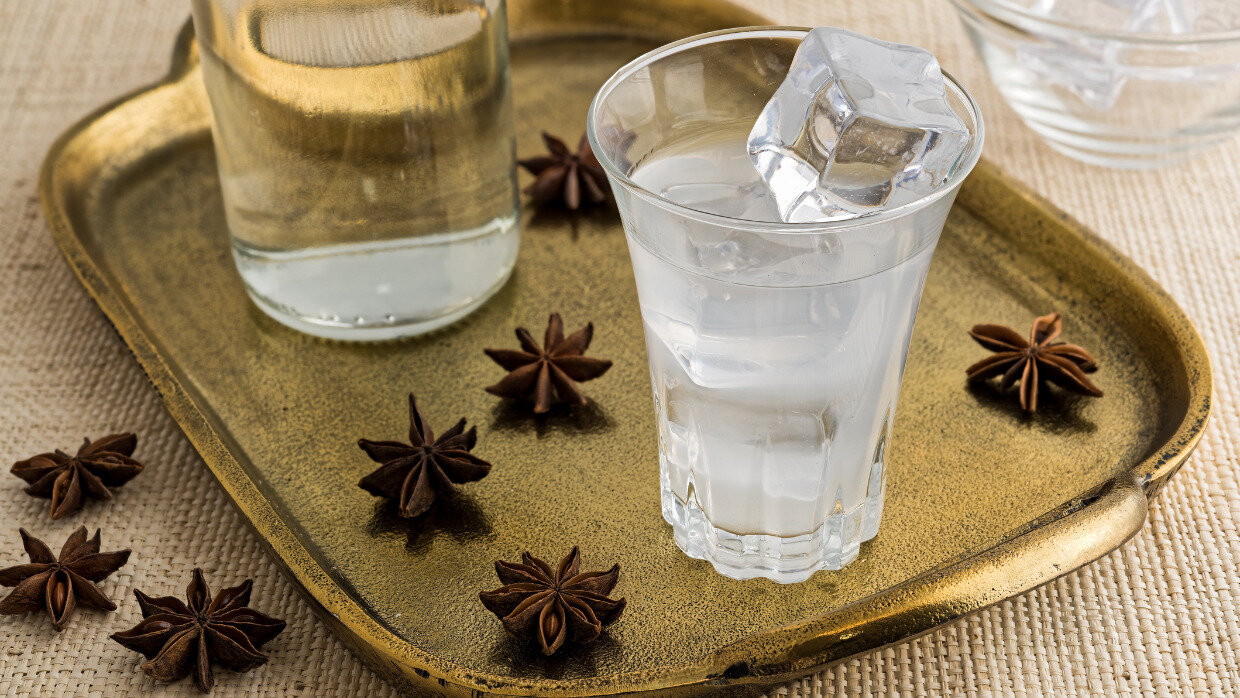
Before Ouzo, Sambuca and Raki, there was Arak.
Arak is one of the oldest distilled alcohols of the Middle East. Transparent at room temperature, this drink turns white when chilled, earning it the nickname Lion's milk. Some people dilute Arak with water because of its high alcohol content, which is about 40-50%. Although when I asked my Israeli husband about this, he stared at me in disbelief and clarified that it should be consumed undiluted, on the rocks. It is important to put the ice in the shot glass before the spirit, so the anise, that gives it its distinct licorice flavor, doesn’t form an undesirable film on the surface. Unlike water, Arak won't turn to ice in the freezer, so it can be stored there until ready to serve.
White grapes are usually the primary ingredient of this liquor. Much like with wine, different grape varieties produce different flavor profiles. Speaking of wine, the first step in the production of Arak is crushing the grapes and letting them ferment. The resulting alcohol is filtered out and distilled to increase the percentage of alcohol by volume. But what gives Arak its distinctive flavor are the crushed anise seeds that are added in the second distillation process. In the third and final distillation, these seeds are filtered out. The subsequent aging can take up to a year for a spirit that's tasty year-round.
When Arak is made from grapes, the same Jewish laws that apply to grape juice and wine need to be considered.
Anise is related to fennel, so many find that Arak tastes and smells like licorice. Personally, I think its scent can almost be compared to perfume. Just like any other wine or liquor, some Arak is better than others.
Traditional Arak has a delicate and pure anise flavor, without sweetness, but in recent years companies like Miami Arak have added smooth flavors such as lychee, lemon-lime, coffee, or even bubble gum. All of these varieties come with a lower alcohol content. My husband's favorite Arak is the Zachlawi fig liqueur which has a less intense anise taste and is also sweet. On Zachlawi's Facebook page, there are several cocktail recipes featuring Arak, which I intend to try making for Purim.
But Arak isn't just for drinking, it can also be used in cooking and baking. Add a teaspoon of Arak to your favorite Moroccan fish recipe, chicken, or lamb dishes, and enjoy the fragrance wafting through your kitchen as you cook. The Arak will balance out the dish, softening the meat and reducing the greasiness. In baked goods, Arak can be used as a substitute for rum, or to enhance your Kaak (Syrian cookies), Sephardic fricassee, and Sfenj.
But the best way to enjoy Arak is to drink it with friends. L’Chaim!