







 Seven Reasons for Hope on October 8

13 min read
5 min read
10 min read
13 min read





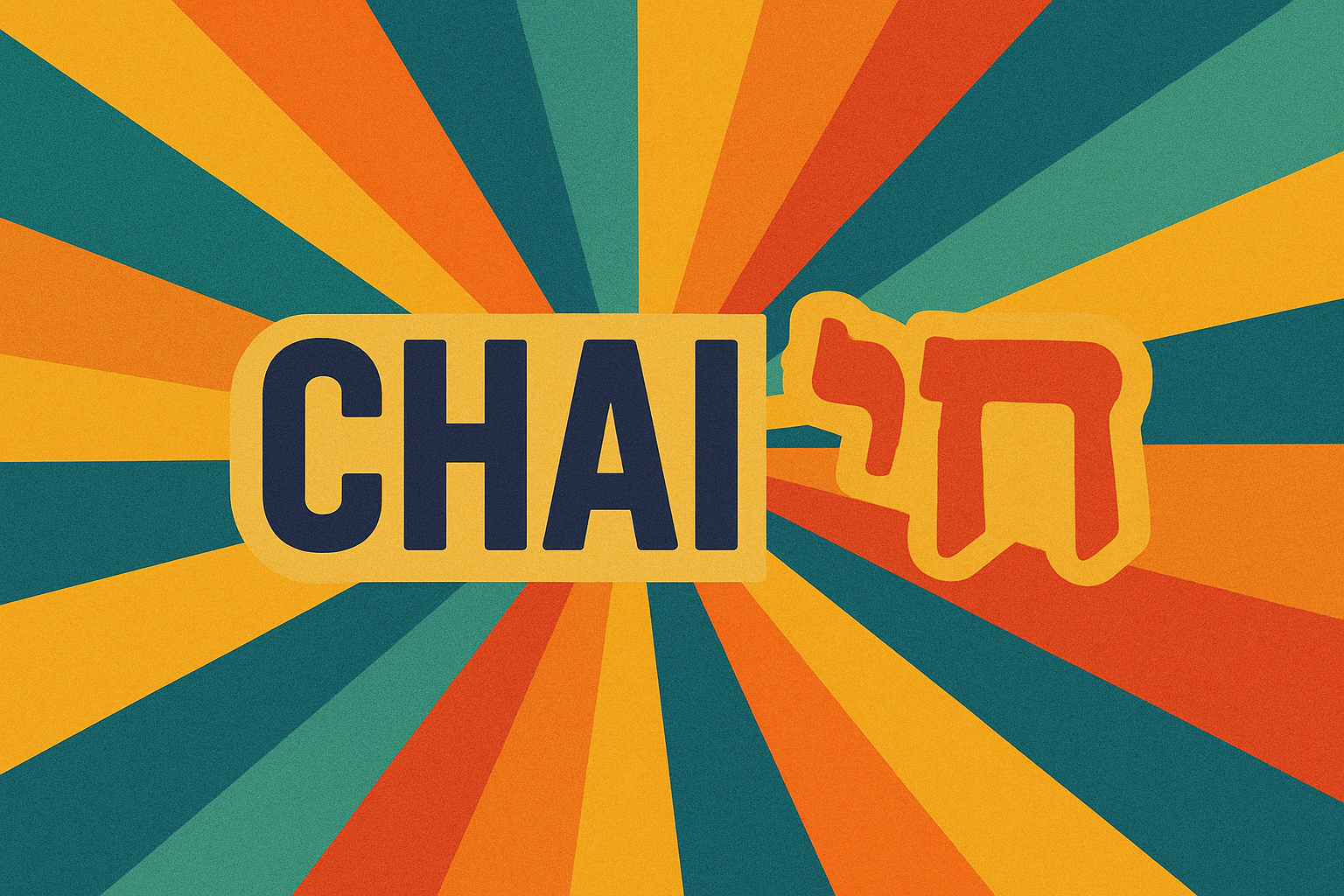
Chai is the Hebrew word for life. What is its deeper meaning and significance?
“Chai (חי)” is the Hebrew word for life, and you’ll see people wearing it as a necklace (or tattooed on their bodies). But why “life,” and what does that say about the deeper meaning of life in Jewish tradition?
In this article:
Chai (חי)—which is pronounced with a Kh sound, with the back of your throat,1 and rhymes with “hi”—is the Hebrew word for “life.” Like it says in Genesis 3:20, “The man named his wife Eve (חוה), because she was the mother of all life (חי).”2
The Hebrew alphabet doubles as a numeric system—called gematria—which means that every Hebrew letter also has a numerical value. It is similar to Roman numerals, where v is 5, x is 10, and so on.
In Hebrew, chai is spelled with just two letters, chet (ח) and yud (י), which add up to 18 (chet is eight, and yud is 10). In other words, “life” equals “18.” That is why many Jews give donations and gifts in multiples of 18, as it’s seen as a way of blessing someone with life and prosperity.)
But 18 has a deeper significance, too. The centerpiece of the daily Jewish prayer service is called the “Eighteen Blessings (שמונה עשרה),” also known as the “Standing Prayer” or “Amidah (עמידה).” According to the Talmud,3 the source for composing an 18-blessing prayer is the 18 times God’s name is mentioned in Psalm 29; as well as the 18 times God’s name is mentioned in the Shema (the daily meditation that focuses on God’s unity and omnipotence); and also the 18 vertebrae that make up the human spine.4
The most common Jewish toast is "L'Chaim," which means, “to life.” According to the great medieval biblical commentator, Rashi (Rabbi Shlomo Yitzchaki 1040-1105):
A person brings a thanksgiving offering when he is saved from potential danger. The four types of danger are: sea travel, desert travel, a person released from prison, and a sick patient who has recovered. As the verse says in Psalms (107:22), "Give thanks to God for His kindness, and for His wonders to mankind."
In Hebrew, the abbreviation of those four travails is also an acronym for “life” (חיים):
In modern times, instead of bringing an offering, you recite a blessing of thanksgiving.5 In the daily liturgy, you thank God for life each morning upon arising—in order to drive home the message that life is great—and, if that isn’t enough, you toast “to life” when you’re drinking with others in social settings.6
In Hebrew, the plural form of the word life, chaim (חיים), is often used even when referring to a single life, like in Genesis 2:7: “God formed man out of dust of the ground, and breathed into his nostrils a breath of life (חיים). Man [thus] became a living creature.”
Life, or “lives,” indicates that in Jewish thought, “life” doesn’t only refer to your life in the temporal, physical world, but to a spiritual, eternal dimension as well. Physical life is an opportunity to choose and become—to acquire spiritual awareness—and in the process, to actualize your potential. Death isn’t the end, however, it is just a different, or spiritual, state of existence.
According to the Jewish philosopher and thinker, Maimonidies (1135-1204), death is a passive experience of the person you chose to be,7 except there’s a catch: your post-death experience is tempered with clarity. You’re no longer blinded by ego, justifications, or rationalizations; and your perspective is broader than the constraints of a three-dimensional, time-bound, physical world.
You get a glimpse of the real you. Hopefully, you like what you see.
According to the Talmud, your physical life is an opportunity—the opportunity to create the real, eternal you—and you’d be a fool to waste it:
One moment of growth and doing the right thing in this world is better than the entire next world. But one moment of spiritual bliss in the next world is better than all the pleasures of this one.8
In recent years, many Jewish people have started wearing the Hebrew letters that spell chai (חי) as a necklace, although the symbol may date back to medieval times. Some notable personalities seen wearing a chai include the rapper, Drake, actor Robert Downey jr., and even Elvis Presley, who although he wasn’t Jewish, is quoted to have said, “I don’t want to get left out of heaven on a technicality.”9
View this post on Instagram
Click here to learn about the phrase ‘Am Yisrael Chai'.










If you are Jewish or not you like to wear the "Chai" the symbol of " life', also when Jews toast with wine they say 'Lachaim" ," to life"
This is great!