







 Those Shameful Thoughts and What They Really Say about You


6 min read
5 min read
4 min read




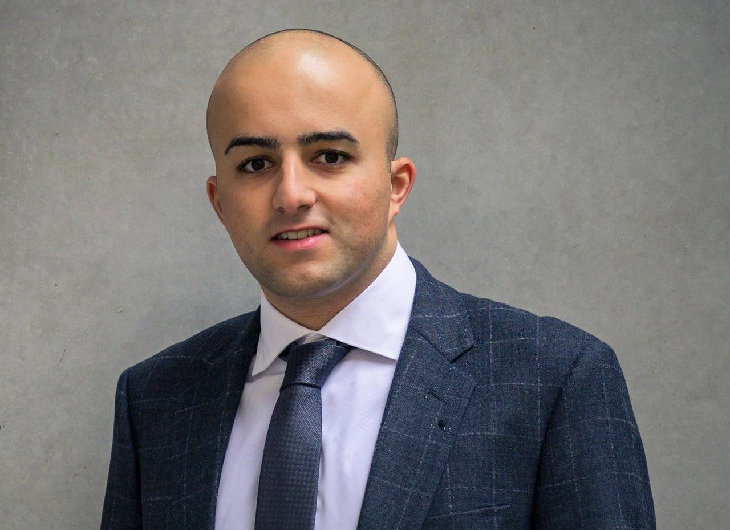
Jonathan Harounoff, Israel’s International Spokesperson to the UN, gives insights into Iran and Jewish life there.
In September 2022, Mahsa Amini, 22-year-old Kurdish-Iranian woman, was detained in Tehran for improperly wearing her hijab. The morality police detained her, and she was taken to a “re-education” center. There, she was beaten so badly that she fell into a coma. Three days later, she died from her injuries.
 Mahsa Amini
Protests broke out in Iran. In Tehran, hundreds of people joined together at the University of Tehran and cried, “Woman, Life, Freedom.” Mahsa’s tragic death and the subsequent protests made international news, sparking more “Woman, Life, Freedom” solidarity gatherings around the globe.
But what followed was more tragedy: the regime executed protestors who dared to defy them.
With world attention on Iran – they funded Hamas and October 7, they have their tentacles in other countries around the Middle East, and they suffered when Israel and the U.S. bombed their nuclear facilities this past summer – people are seeking to understand the country, its history and its people. That’s where author Jonathan Harounoff, a Persian Jew and Israel’s International Spokesperson to the UN, comes in. His new book, “Unveiled: Inside Iran's #WomanLifeFreedom Revolt,” provides a guide for understanding the rapid change unfolding in Iran and how it affects the world at large.
#There is an enormous gulf between Islamic Republic and the vast majority of Iranians who are peaceful, courageous, brave and desperately want a brighter, more prosperous future.
“There is an enormous information gap in the West when it comes to what’s happening on the ground inside Iran,” he told Aish. “When you Google ‘Iran’ or ‘Islamic Republic,’ you’re likely going to read news items about the regime’s destructive nuclear weapons program, its dangerous and expensive foreign policy, and its sprawling network of terror proxies. You’re less likely to read about the 90-plus million people of Iran, who they are, what their aspirations are, how they feel about the Islamic Republic, and whether or not they agree with the direction the regime has taken vis-a-vis the United States, Israel and other allies.
“The reality is that there is an enormous gulf that exists between Islamic Republic and the vast majority of Iranians who are peaceful, courageous, brave and desperately want a brighter, more prosperous future.”
Jonathan’s grandparents and great grandparents left Mashhad in the early 1950s. Other family members, distant relatives, as well as family friends left in the subsequent decades as Jewish life became more difficult after the Iranian Revolution, in which the Islamists took over.
In “Unveiled,” Jonathan writes, “Jewish history in Iran had traumatic, painful elements to it. Yet there’s also a huge sense of pride and attachment to Iran that Jewish Iranians still feel, oftentimes exhibiting a complete dissociation between the country of Iran, with thousands of years of rich history and civilization, and the 46-year-old Islamic Republic of Iran. Like many in the diaspora, my family saw the authoritarian regime as not so much leading, but occupying, Iran for nearly five decades. In the aftermath of the Islamic Revolution of 1979, tens of thousands of Persian Jews left Iran, with the population dwindling from 80,000 then to around 10,000 today, making it still, remarkably, the second-largest Jewish population in the Middle East after Israel.”
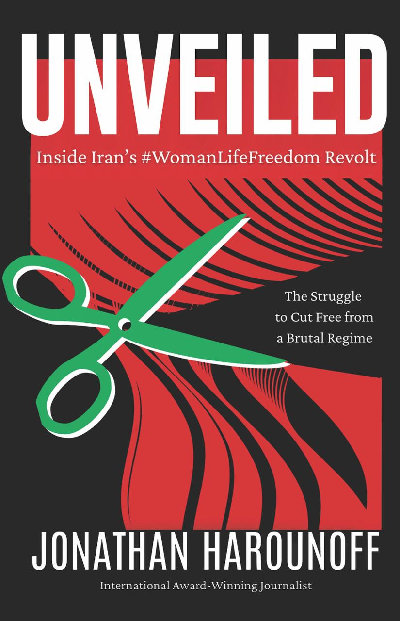
The author, who was trained as a journalist and has written for the New York Post and the Jewish Chronicle, includes information he learned from interviews with Iranians inside and outside of the country.
He also dives into the Israel-Iran relationship in the book. For instance, Iran blamed Israel and the U.S. for the protests, believing these countries fueled them to destabilize the Islamic Republic. Regarding the Iran-funded Hamas attacks on Israel, Jonathan quotes Angel Losada, the Spanish Ambassador to Iran as saying, “October 7th was Iran’s saving grace… It was what pulled them back into the fold and out of the spotlight for domestic problems.”
Now, the Jewish community in Iran is paying the price in horrendous ways, especially since the 12-day war with Israel in June.
“We saw a highly disconcerting shift in the language and tone of the Islamic Republic concerning its Jewish population,” said Jonathan. “Whereas before, the regime would highlight how its enemy was the ‘Zionist State of Israel,’ it shifted in language to suggest that its war was now with Jews. We read reports of mass arrests taking place inside Iran in the wake of Operation Rising Lion, including several dozen members of the Jewish community in Tehran and Shiraz who were accused of espionage and forced to cut contact with their relatives abroad.”
Still, even in the face of such evil, there is a glimmer of hope: the Jewish community in Iran is strong.
“I spoke to many incredibly Jewish Iranian voices inside Iran and in the diaspora,” Jonathan said. “They were not named to protect their identity but a recurring theme that emerged throughout was that this is an extraordinary community, one that is brave, fiercely proud of their Judaism and resilient in the face of tremendous hardship.”
Looking back at the Iran-Israel relationship throughout history, there is a reason to be optimistic. After all, things weren’t always this way.
“Israel and Iran enjoyed many decades of quite extraordinary collaboration and alignment in the mid-twentieth century before the 1979 Islamic Revolution,” said Jonathan. “This was a relationship Ben-Gurion had once described as ‘friendly, informal, but not hidden, and based on mutual benefit’ and formed an integral part of the periphery doctrine Israel was developing in the early years of the modern State of Israel when the country was forging strategic partnerships with non-Arab countries, namely Turkey and Iran, to counteract the growing hostility exhibited by Arab states led by Egypt at the time. This is in part why Iran became the second Muslim-majority country (after Turkey) to formally recognize the State of Israel in 1950.”
While Israel, the U.S., and the entire world held its breath during the 12-day war – with many hoping for an internal uprising from the people of Iran – that didn’t happen… yet.
Even though things may seem bleak now, Jonathan still holds out hope for a positive change.
“It is up to the people inside Iran to dictate what kind of future they would like,” he said. “The international community should do whatever it can to support the Iranian people in their quest for freedom.”








For 45 years now, we have heard about the "good people of Iran" and how they would soon throw off the brutal theocracy that was oppressing them. It still hasn't happened. "Experts" keep telling us how unhappy the Iranian people are, and how they will soon rise up and establish a new, liberal democracy. I'll believe it when I see it. The "vast majority of Iranians who are peaceful, courageous and brave" are just like the "good" Germans in Nazi Germany - they are irrelevant. They are tolerating the regime that oppresses them. If they were that courageous and brave, they would have risen up and overthrown their government by now. People get the government they deserve.
I agree. If the Iranians do not like their leaders then they can change the leaders but they do not. Yes there are people in Iran who are against the regime. Like in Russia opponents of the regime are brutally punished and many of them just disappear. However, there is still a majority of people who agree with the persecution of women, children and people who do not follow the religion of Islam or do follow Islam but do not believe in the ourtrageous interpretation of it, expressed by the leaders of Iran.
It’s easy to sit in your home and opine on how people should behave while living under a totalitarian regime.
Yes, it is. People sit in their homes and opine on how other people should behave and what they should do all the time. You don't have to be in a particular situation to voice your opinion about it.
Actually, you do - you need to be in a situation where you can voice your opinion without paying for it with your life and/or livelihood.