







 Peace Prize Winner Navi Pillay’s Long Record of Anti-Israel Hatred

17 min read
5 min read
15 min read





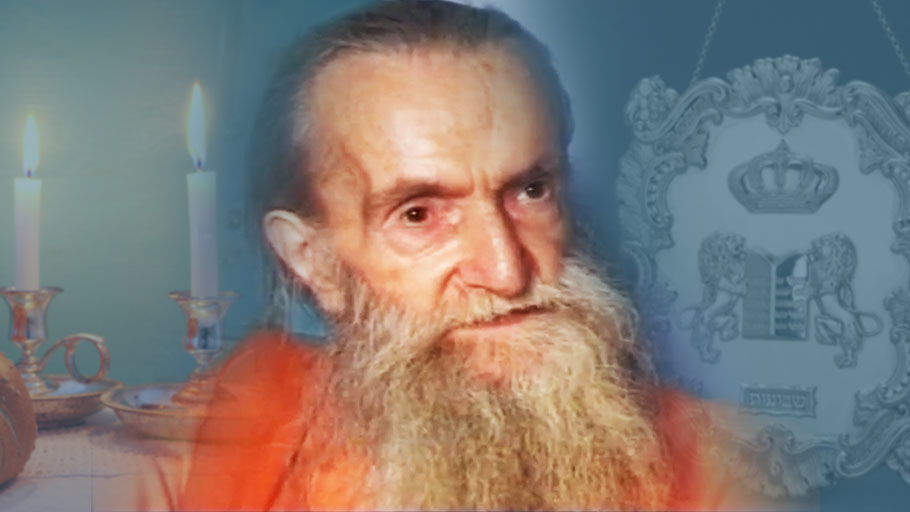
The stranger-than-fiction true story of Swami Vijayananda.
One sweltering day in the summer of 2008, near Hardwar, India, the pilgrimage city at the headwaters of the Ganges, an incongruous scene unfolded. Amidst the dhoti-clad men and sari-clad women, two Hasidic men from Israel, with long peyot and black kippahs, strode quickly through the crowded streets. When they reached their destination — the ashram of Anandamayi-ma, India’s most adulated woman saint of the 20th century — they hesitated at the entrance to the courtyard. Idolatrous statues dotted the courtyard. As religious Jews, they wondered whether they were permitted to enter.
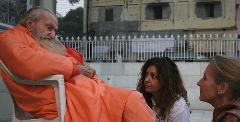 Swami Vijayananda with devotees
Standing there, they saw the guru, Swami Vijayananda, garbed in the ochre robes of a monk, exit from one of the buildings. He took his seat on a stone bench in order to receive the long line of waiting devotees. One by one, they approached the 93-year-old guru, bowed on their knees, and took the dust of his feet — a Hindu gesture of honor, whereby one touches the guru’s feet with one’s hand, and then one’s own forehead. Each devotee had barely a minute of the guru’s attention to ask or utter a few words. Then, still kneeling, the devotee found a place on the ground some distance away to continue to bask in the presence of the guru.
The two Hasidic men were Eliezer Botzer and his friend Natti, heads of the Bayit Yehudi, Jewish Home, a chain of Jewish centers situated throughout India in locations such as Hardwar and Goa, where thousands of post-army Israelis congregate. Although Eliezer and Natti spent a lot of time in India, standing there at the entrance to Anandamayi-ma’s ashram they were as out of place as a klezmer clarinet at a sitar concert.
After a few minutes, the guru noticed the two religious Jews. The next devotee at the head of the line was about to approach the guru, but he stopped him. He gestured to the two attendants who flanked him to block the line. Then the guru beckoned to the two religious Jews to come to him. While the long line of devotees, many of them Europeans, looked on in surprise, Eliezer and Natti directly approached the guru. No bowing, no taking the dust of his feet, no kneeling on the ground. The guru motioned for them to sit beside him on the bench.
Looking directly at the guru, Eliezer asked, “I heard that you’re a Jew. Is it true?”
Eliezer’s question was different than that of the devotees who asked Swami Vijayananda about the purpose of life or the way to higher consciousness. Looking directly at the guru, Eliezer asked, “I heard that you’re a Jew. Is it true?”
The guru smiled. Yes, he had been born into a Hasidic family in France. Although his grandparents were Lubliner Hasidim, his parents were more modern, but still fully observant. He had gone to Heder (Talmud Torah) and had been raised with all the devout trappings of Judaism. In his twenties, he told Eliezer and Natti, he abandoned Jewish observance. He became a doctor. Then the Holocaust descended. He told them about his Holocaust experiences, and about how he gave his tefillin away to a religious fellow because he wasn’t using them anyway.
“Why did you come to India?” Eliezer asked him.
The guru related that, after the war, he was on a ship bound for the nascent State of Israel. A woman on the ship asked him why he was going from one war to another. “Where should I go?” he asked her. She suggested India, a place of peace, with no anti-Semitism.
In India, in 1951, at the age of 36, he met Anandamayi-ma. Already at that time, hundreds of thousands of Indians venerated her not only as an enlightened soul, but as an Incarnation of the Divine Mother. He became her faithful disciple, taking on the monastic name of Swami Vijayananda. After her passing in 1982, many Indians and Westerners gravitated to him as their new guru.
Looking at Eliezer and Natti, he said, “There are two levels of spirituality: a lower level and a higher level. The lower level is religion; the higher level is the recognition that everything is one.”
Eliezer looked back at him and rejoined: “There are two levels of love: a higher level and a lower level. There is love for every person in the world, and there is love for your own wife and family. If you’re not able to love your own family, your love of the whole world is fake.”
“I agree,” nodded the guru.
“So,” continued Eliezer, “You’re Jewish. Before you go out and love the whole world, you should practice loving those who are closest to you, the Jewish People.”
The guru laughed. That started their discussion. As the attendants looked on nervously and the many devotees in the line fidgeted restlessly, the guru and the Hasids sparred back and forth for a long time. “He was trying to show us that we were wrong,” remembers Eliezer, “that religion is not the Truth.”
With neither side conceding to the other, Eliezer suddenly switched gears. He asked, “What did your mother call you when you were a child?”
Tears came to the guru’s eyes, and he murmured, “Avrimka. My name was Avraham Yitzhak. My mother called me Avrimka.”
Eliezer continued to probe: “Do you remember a Shabbos table when you were a child?”
From out of hazy depths 70 years dormant, the guru started to sing A Woman of Valor, from beginning to end with tears streaming from his closed eyes.
The guru closed his eyes. Then, from out of hazy depths 70 years dormant, he started to sing “Eishes Hayil, A Woman of Valor,” the song sung before Kiddush at every Shabbos dinner. With tears streaming from his closed eyes, he sang the entire song, from beginning to end. Electricity filled the air of the ashram courtyard, igniting a charged atmosphere that reached both backward in time and heavenward in intensity.
The two attendants, who had never before seen their guru cry, became afraid. They moved to eject the foreign men, telling them that their time was up. The guru opened his eyes, suddenly back in the present, and waved the attendants away.
Eliezer pulled out of his backpack a Hebrew Bible and presented it to the guru.
With a wistful smile, the guru told him, “I already have one, and I’ll tell you from where.” Relating the story like a Hasidic tale, he told how, in the 1980s, an Israeli with a dilemma came to him here at the ashram. The Israeli had been a soldier in the first Lebanon War. Traumatized by the war and the ceaseless specter of more wars in Israel, the non-observant ex-soldier had decided that he wanted to sever all connection with Israel and with Judaism. He became a Christian, but he was unsatisfied and unsettled. So he came to India and started to practice Hinduism. But here, too, he felt unsatisfied. Coming to Swami Vijayananda, he complained, “Maybe the reason I’m not finding myself in India, and I can’t get rid of this Jewish feeling, is that I still have the Bible they gave me when I was inducted into the Israeli army. Is it proper to throw it away?”
“No,” the guru replied, “don’t throw it away. Give it to me.” He proceeded to tell the ex-soldier the story of Rabbi Akiva, who, as the Romans were flaying him alive, recited the Shema. When his agonized students asked him how he could perform the mitzvah of Shema while being tortured, Rabbi Akiva replied that all his life he had yearned to get to the place of serving God with his very life. “I told him,” related the guru, “Do you know the difference between Rabbi Akiva and us? After all we went through [in the Holocaust and the Lebanon War], we asked, ‘My God, my God, why have you abandoned me?’” The guru had been relating the story in English, but at this point he quoted the line from Psalm 22 in its original Hebrew. Then he continued in English: “’But Rabbi Akiva,’ I told the Israeli soldier, ‘understood that his suffering was not a punishment, but rather a path to the highest spiritual state of attaining complete unity with God.’“ The guru peered at Eliezer and Natti. “I don’t know where he is now, but I think he must have come back to Judaism after what I told him.”
This was Eliezer’s opening. “Maybe it’s time for you, too, to come back. You’re not young. Do you want to be cremated and your ashes thrown into the Ganges? It’s time for you to come back to Judaism.”
“You’re trying to take our guru away from us,” they accused the Jewish visitors.
At that the attendants got agitated and angry. “You’re trying to take our guru away from us,” they accused the Jewish visitors.
Eliezer made one last try. “God loves every Jew, and wants every Jew to return to Judaism.”
The attendants had heard enough. Furiously, they evicted the two Hasids.
In April, 2010, Swami Vijayananda died at the ashram in Hardwar. Departing from Hindu practice, he insisted on being buried instead of cremated. His body was flown to France, and he had a Jewish burial with his Jewish relatives.
On December 20, 2024, the Hasid in this story, Eliezer Botzer, 43, was killed in a tragic accident while serving in the Israeli army reserves. In 2002, after completing his active service in the IDF, Eliezer went to India to help head “Bayit Yehudi,” a chain of Jewish centers in places in India where post-army Israelis liked to congregate. After several years, Eliezer and his wife returned to Israel. A musician and composer, Eliezer released his first album "Disruptions. Attention. Concentration" in 2013, followed by other soulful albums.

His song, “Tzion” was played at his military funeral, where Eliezer was eulogized as “a man of great soul, who inspired faith in many." Eliezer Botzer leaves behind his wife Noa and eight children.











Thank you for reposting this story. Eliezer Botzer was a true hero in every sense of the word. He expressed himself in his art, his music and in his love of the Jewish people, wherever they were. His funeral was attended by people from every Jewish population, from the Ultra-Orthodox to the Ultra-Secular. As his wife stated at his funeral, he's now in shamayim, fighting for us.
As it happened, Swami Abraham Z''TL , passed away, and requested a departure from the customary Hindu practice of cremation and insisted to be buried instead, to keep to the Jewish burial process. He was flown to France, and had a levayah in front of his Jewish family. He has since returned to Hashem as his biological tradition directed him.
We return to our God! The Guru is wise- he had such a beautiful sentiments and life lessons. Many of us do not have the value of the Guru’s life experiences. It certainly provides the canvass for such extraordinary insight. To me it is a confirmation God wants us to be one united in Love and peace. May Eliezer rest in OUR FATHER’s Eternal peace. May his family find comfort in the memories of Eliezer’s wonderful life. Marie