








 Those Shameful Thoughts and What They Really Say about You

17 min read




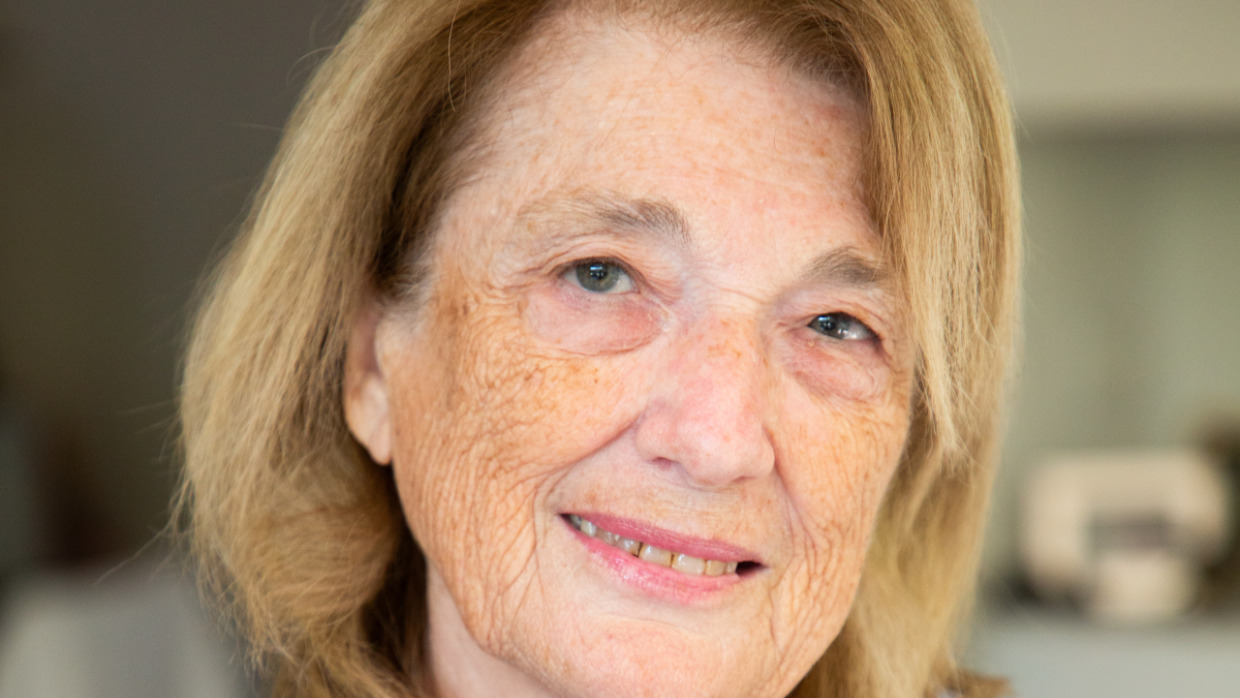
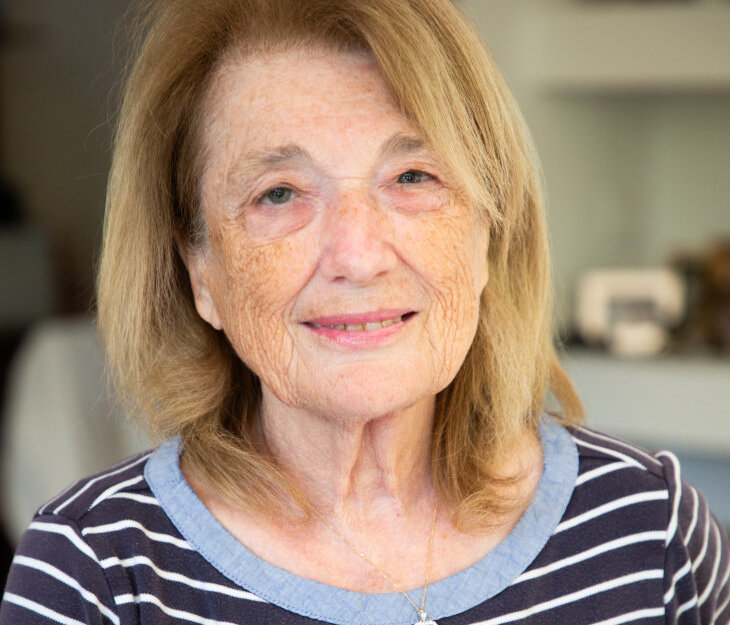
Erika Nissanoff was born on October 17, 1944 in a Nazi hospital in Austria. Her miraculous birth and survival is a harrowing story that everyone should hear.
Erika Nissanoff wasn’t yet born when World War II broke out. Her father’s parents, Ferenc and Aranka, were well-to-do Hungarians. They owned a mill where the entire community brought their grains to be processed. They also owned the local tavern at the corner. The townspeople would come to process their grain by day and enjoy drinks at night.
When World War II broke out, Erika's father, Imre, was deported to Ukraine. At the time of his departure, her mother, Gizella, was pregnant but didn’t know it. Things became bleak as she already had a five-year old child to look after, and now one on the way with no hope of her husband ever returning. She leaned heavily on her in-laws for support. Together, they lived in a large town called Debrecen in Hungary.
Shortly after Imre was deported, the Nazis transported all Jews out of Debrecen and put them on trains to Auschwitz. Erika’s mother and sister were placed on one such train. In a twist of fate, the train Erika’s mother and sister were on was confused with a train that had been bribed to be redirected to Austria, where the two of them were sent to a hospital.
“My mother, who was pregnant with me, was taken into this hospital to work. It was then taken over by Germans, but it was originally a Jewish hospital in a Jewish neighborhood. Interestingly enough, today the building is a yeshiva. The hospital was turned into a working camp.”
Although pregnant, Erika’s mother worked diligently in the hospital. Her husband was still detained in Ukraine, and her older daughter was placed in a kindergarten. Once in a while she would sneak out in the middle of the night to check that her daughter was still alive, risking her own life in the process.
Gizella gave birth to Erika on October 17, 1944. The doctor who delivered Erika was a Nazi.
“That’s why I am called a miracle baby. I don’t know why he let me live. The only thing I do know is that I was saved. My cousin lost both her father and mother. Her mother had been with us on the same train.”
Erika’s mother took care of her in the hospital. “She carried me around while she worked in the hospital. She breastfed me and did everything she could to keep me alive for as long as possible.”
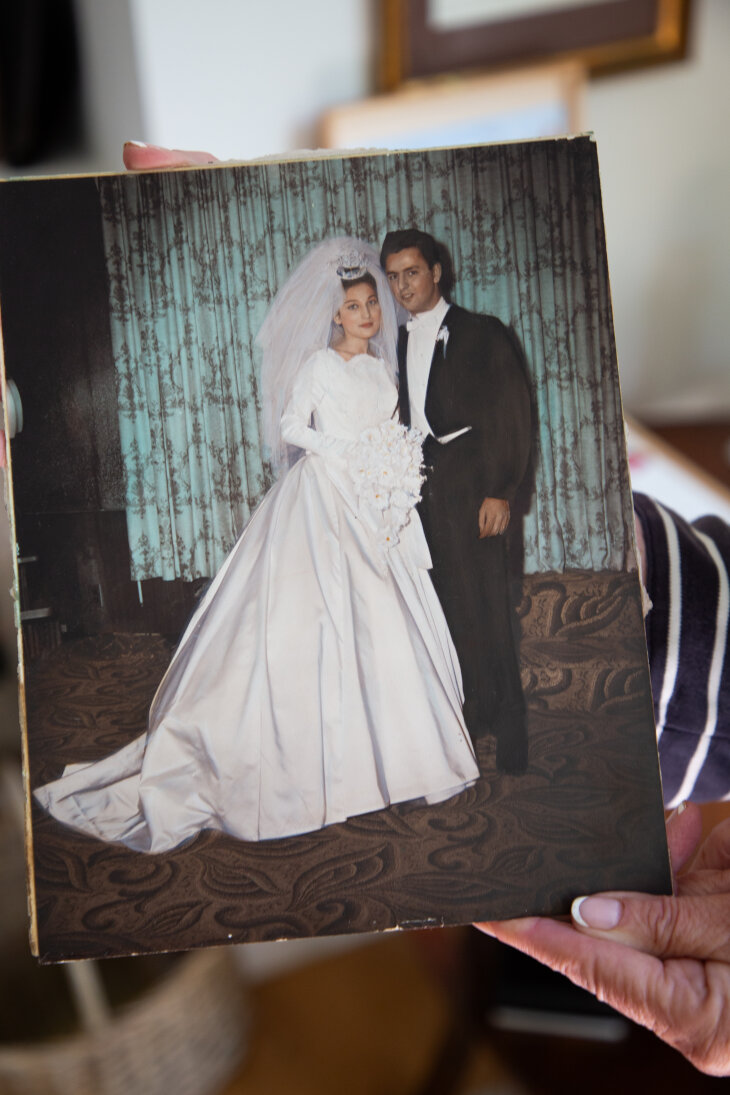 Erika holding her wedding portrait, 1964
As the Nazis were being defeated, Erika’s mother saw a truck with American soldiers inside. She asked if they were heading to Hungary. They answered, “We will be passing by.” With her two daughters in her arms, she begged them to give her a ride in that direction. These American soldiers went out of their way to bring her all the way back home to Debrecen.
It was there that she was reunited with her husband and his parents. They had made a pact before separating that they would meet back at her in-laws’ home in Hungary if they survived. Erika’s mother, father, sister, and grandparents all survived the war.
By war’s end, Erika’s parents and grandparents had lost their wealth and their status. Communist Hungary took everything that was left and they had to rebuild from scratch. For the next 12 years of her life, Erika grew up under harsh Communist rule.
Her mother and father eventually had a third child, a baby boy. He became ill and was taken to the local hospital. At the time, there wasn’t enough supervision of infants in the hospital. The crib panels where he was kept were very wide, and the baby suffered a tragic accident. His head got caught between the crib bars and he suffocated.
After this, Erika recalls that her mother suddenly became very religious. She began covering her hair, keeping kosher, and dressing modestly. She had previously lost all her ties to religion because of Communism and persecution, but decided to make changes after her baby’s death.
Once, three men came to her building in uniform and forced a religious man with a beard and sidelocks to start digging. “The soldiers assumed he was hiding gold or jewelry. He had to dig for about an hour and was sweating under his shtreimel. There was nothing he was hiding, but that image has never left my mind.”
Erika explained that a lot of young Jewish people joined the Communist party to survive. “If you wanted to do well, it was important to join the Communist party. Otherwise, you couldn’t get anywhere in life. We didn’t know any differently because we were so young.”
It was during the 1956 Hungarian Revolution that her family escaped.
Erika’s father had a mother who was elderly. “She must have been in her late eighties, and my father was the only child that had not been killed. He couldn’t leave her alone.”
Erika’s mother wanted to get out of Hungary immediately. All of her siblings had moved to America after the war. “My mother decided that she, my sister, and I should escape. We left my father behind to watch over his mother. We had no idea where we were going. Going to America was like trying to go to the moon. She took the two of us, and we got onto a train that she heard would be going close to the border. It was a nonsensical idea because we didn’t know the neighborhood.”
The family entered their local train station and asked the first person they saw, “Which train will bring us closest to Austria?”
The stranger pointed her towards a specific train, and Erika’s family hopped on.
A random person on the train asked, “Are you going to Vienna?”
Erika explained, “It could have been a Communist or anyone, but my mother said, ‘Yeah I’m going to such-and-such a place.’
“Another man approached my mother on the train and asked, ‘Are you trying to run away?’
“Naïvely, she answered, ‘Yes.’
“He said, ‘Me, too. You can get off the train and follow me.’
“He could have been a Communist. We went as far as we could on the train, and eventually got off with a bunch of other people.”
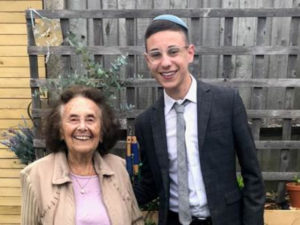
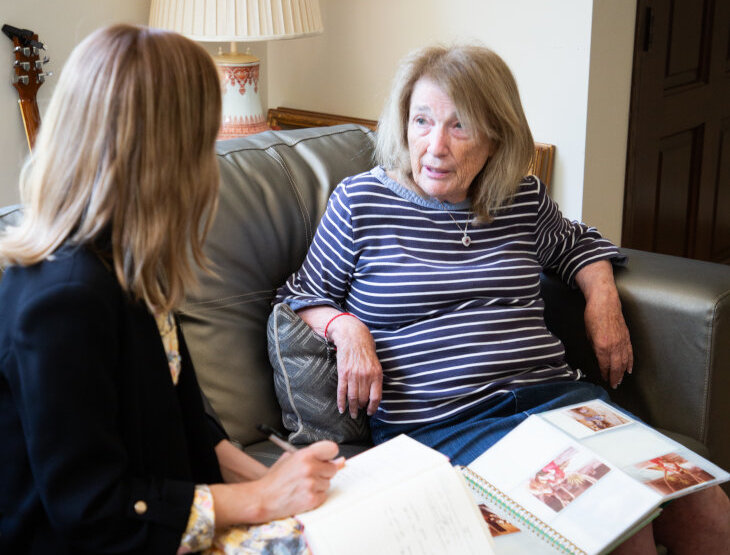 Erika with the author
When Erika and her family exited the train, they had no idea where they were. It was three in the morning, and pitch-black outside. Someone shined their flashlight to illuminate the path, knowing that they could be caught at any moment. They had no choice but to blindly continue.
Suddenly, someone standing in the middle of the road shouted, “Achtung!” which means stop in German.
“We got lucky. It was there that HIAS (The Hebrew Immigrant Aid Society) picked us up.”
The group had arrived in Germany, and we were finally safe. HIAS took them to a synagogue to sleep. They provided mattresses for them to stay overnight. Afterwards, a different train took them to Vienna, where documents were arranged for the group. It was here that they were reunited with Erika’s father.
While Erika’s father had initially stayed behind with his mother, he also procured information on how to cross the border. He soon said goodbye to his mother, whom he left in the hands of a caretaker, and attempted to escape. The first time he was caught and sent back to Hungary.
His second attempt began during one of the biggest snowstorms of the century. At one terrible moment, he felt he could not continue on, at which point his guide said, “If you stop, you’re a dead man.” He continued on, step by step, despite being unable to see even two feet in front of him.
Finally, the guide announced, “You are here. I am not going further. You are now on your own.” Her father kept walking until he met people that spoke German and he realized he was in Germany.
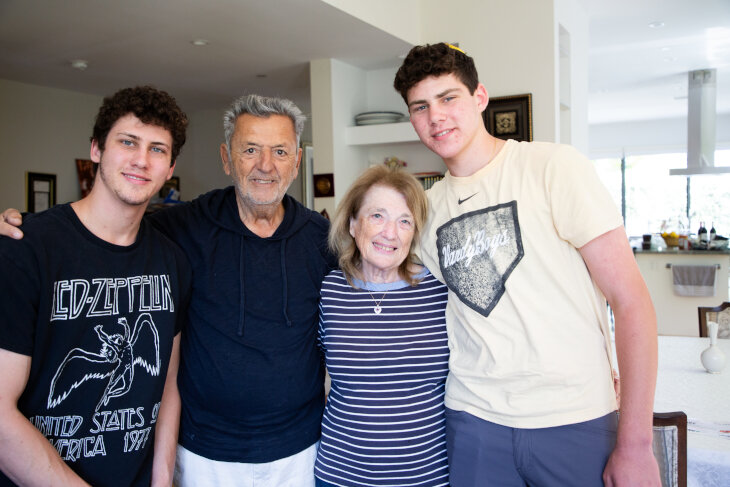 Erika and her husband with two grandsons
Eventually, he was reunited with his family in Austria at the synagogue. Together, they stayed in Austria for several months while waiting for their American visas. When their visas came through they were put on a military cargo plane which flew them to Camp Kilmer in New Jersey, where they stayed for one month before being reunited with family in Brooklyn New York. “The U.S. took care of us. This is where I lived from the time I was 12 years old.”
Erika claims that even though she grew up in Communist Hungary, the most painful part of her childhood was actually moving to the U.S. as a child, and not being able to speak the language. It was exceedingly difficult for her to fit in and the bullying that she endured was excruciating.
In 1964, Erika married at the young age of 19, right after high school, and moved to Los Angeles. “At the time, everyone got married as young as possible. I met my husband at a Shabbaton in the Borough Park Young Israel Synagogue.”
Erika believes that today’s antisemitism has reached a new level. “We have to learn from the past and recognize that things can change at any moment. The world keeps changing, but not for the better, unfortunately. Hopefully we are not headed in the same direction, but things don’t look good.”
Erika remarks that just like people today can’t understand the reaction of the world in the face of Jewish persecution, the Jews in Europe didn’t understand their situation, either.
“Nobody has an answer, we just hope for the best.”
Photos by Lynn Abesera Photography








I found an other error in this story. She said that when they crossed the border, they arrived in Germany. Hungary does not have a border with Germany. She must have meant Austria. That's where all of the people escaping ended up. I was one of them. I was born in 1943 in Budapest so I was 13 when the revolution broke out.
Beautiful story, however I noticed two mistakes. (1) she is not the youngest survivor. while it was VERY rare for babies born during the war to survive, there are some born in 1945 - later than Erika - who did. The title doesn't make the article look professional. (2) you say Erika's dad was deported when WWII broke out and that Erika's mom was pregnant with her. The war broke out in 1939. Erika was born in 44. You must mean that she was pregnant when the Nazis entered Hungary in 44...BIG difference!
Fascinating.
Amazing story!!
Wow. Interesting story.
An incredible example of Divine Providence! Thank you so much for sharing!
And human choice: To be fearless in the face of adversity; to over ride every human instinct of fear; to be fearless and righteous.
HaShem's kingdom is built up again with the installment of good where evil once stood.
I am so grateful to HaShem, Erika, that you are alive. You are a blessing and an inspiration to us all.
"Erika’s mother took care of her in the hospital. “She carried me around while she worked in the hospital. She breastfed me and did everything she could to keep me alive for as long as possible.”
Such bravery and courage. Such faith in HaShem.
Bless HaShem the Blessed One for all eternity.
The actions of the Nazis to separate families, and break family ties are the actions of the Adversary against of all humanity.
In short, the Nazis were open to demonic possession to achieve their goals.
Very similar to the hamas tactics backed by Qatar Turkey Iran China Russia
Yes. What they did on October 7th was root evil and heinous to the highest level; and, against their own book, which condemns murder, mischief making, and mayhem in the land.
Thank you for sharing this incredible story about my mom!
I was born April 2, 1945, in occupied Poland; am younger survivor. My mother was pregnant with me when she escaped from a concentration camp with my father and approximately 20 men She was the only woman to escape.
My memoir, My Father's Book, is archived and digitized at the USHMM in D.C., and is available at a local library and also at the Oregon Jewish Museum in Portland, Or..
Rosalyn, did you formally self-publish it? I have my mother’s memoirs of the war years, which she dictated for me. She left Vienna at the end of 1938 with her parents and they ran from there to Belgium, France, and eventually got to Switzerland. I would love to share it with a wider audience. You can contact me at mgbellamy@gmail.com
Thank you! Will be sure to look for it when in the valley! An awaiting treasure im sure!
Great piece!