




 “I Don’t Want to Work for a Jew”

6 min read
5 min read
14 min read
3 min read



8 min read


Can a person really change?
The gripping documentary “The Commandant’s Shadow” delves into the minds (among others) of Hans-Juergen Höss, the son of Rudolf Höss, who was the Commandant of Auschwitz, and Anita Lasker-Wallfisch, an Auschwitz survivor. (See Aish.com’s review here.)
The least likable character is Hans-Juergen, the son who enjoyed what he called, “a lovely and idyllic childhood” in a villa outside the wall of the deathcamp (portrayed in the award-winning film “The Zone of Interest”). He lived in that villa, enjoying its garden, pool, and fancy toys built by Auschwitz inmates from the age of two until seven. In the beginning of the film, at the age of 84, Hans-Juergen claims that he had no idea of what was happening on the other side of the wall. He thought it was a prison and his father was in charge.
Didn’t he smell burning flesh? No. Didn’t he see the soot in the air from the chimney of the crematoria? No. His Daddy, he maintains, was a good and kind father. Juergen’s denial is complete. In the 76 years since the end of the Holocaust, he had no curiosity to know more.
As the movie shows, Hans-Juergen underwent a total transformation. For the first 84 years of his life he refused to look at and accept his father’s heinous crimes, believing him to be only the mastermind and boss of the camp, as disconnected to the actual killing as a CEO is to what transpires in the company mailroom. At an advanced age, he was willing to read his father’s own detailed memoir, go to Auschwitz with the daughter of survivor Anita Lasker-Wallfisch, and then visit Anita in her home in London, where he told her, “We live with the guilt.”
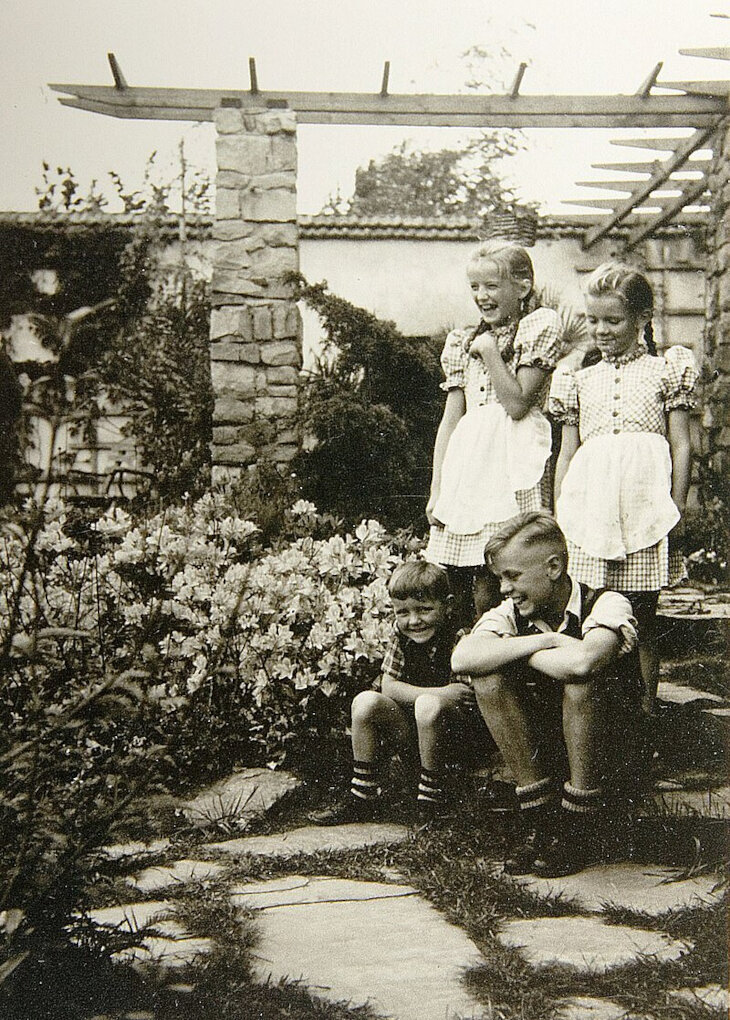 Children of Rudolph Hoss in their villa next to Auschwitz
What accounts for this transformation? Can a person in his mid-eighties really change? Can any of us?
Wendy Robbins, executive producer of the film, admits that when she first met Hans-Juergen, she was turned off by “his total lack of curiosity to meet Jews, of whom his father had killed over a million.” Today, in an Aish.com interview, she says, “I now think of him as a courageous person, who has exposed himself, made himself vulnerable at a very advanced age – going to Auschwitz, standing by the ovens, looking at the hair and the teeth in actuality, going to the gallows where his father was hanged, then going to London to the home of a Holocaust survivor, knowing that his father and Nazism were responsible for her family’s murder. I think that’s an extraordinary thing to do.”
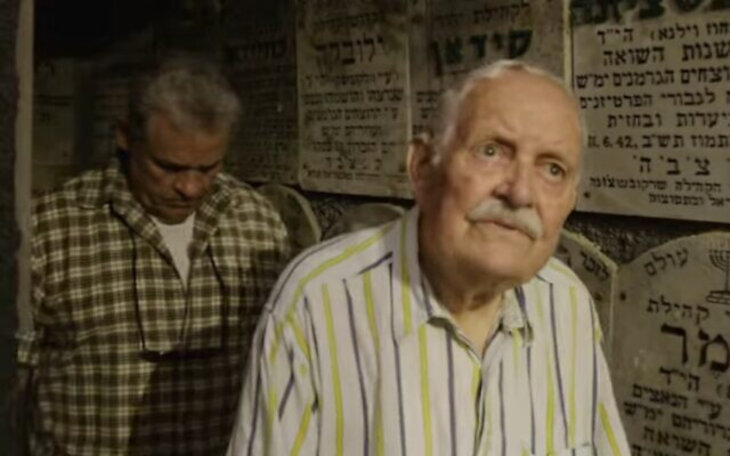 Hans Jürgen Höss, son of Auschwitz commandant Rudolf Höss, examines Jewish gravestones
Daniela Volker, the director, attributes Hans-Juergen’s transformation to timing. When he agreed to the first interview, he had just come home from months in the hospital. He was 84 years old and sick. “I think he was possibly becoming aware of feeling his mortality,” she explains.
Yet the film itself refutes this reason. An interview with Hans-Juergen’s older sister Inge-Brigitt, who was suffering from terminal cancer and died soon afterwards, is spine-chilling in its total denial, her unwillingness to look at her father as anything other than loving and kind. Neither her age nor her impending mortality got her to confront the horrors of the Holocaust.
Why did Hans-Juergen?
The answer is that Daniela Volker herself led Rudolf Höss’s son along a gradual process of confronting the truth. She spoke to him on the phone for three months before that first interview, building up his trust. Daniela, a Catholic born in Argentina, whose father was a German of the same generation, speaks fluent German. She understood and empathized with Hans-Juergen. Instead of condemning his cowardice, she coaxed out his courage.
On the fifth day of interviewing him, she showed Hans-Juergen a copy of his father’s autobiography, Commandant of Auschwitz, which he wrote in prison while awaiting his execution. She had earmarked certain passages, and asked him to read out them aloud. In one passage Rudolf Höss described how a mother tried to push her two children out of the gas chamber before the doors closed. Höss, standing there and witnessing the scene, wrote that he thought of his own children at that moment.
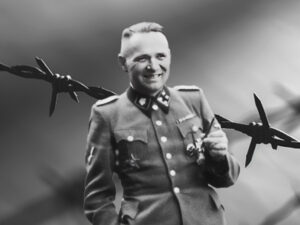
 Moments before Rudolph Hoss was put to death for his crimes at Auschwitz.
Hans-Juergen had always thought that other people had conducted the industrial scale murder at the camp, that his father was not personally involved. Only upon reading those words did the truth dawn on him. Daniela deliberately gave him several months to reflect on what he read. She understood that people need time to digest truths that challenge their viewpoint.
In a second interview months later, Hans-Juergen is filmed saying, “I wish I hadn’t read it. At first, I didn’t believe it was true.” Then he looked at the camera and said, “But they were my father’s words, and they must be true.”
Daniela reveals, “The more I talked to him, the more he opened up.” Three years into the making of the movie, Hans-Juergen disclosed to her, “I spent my life suppressing it, and sometimes it bubbled up, and I suppressed it again.” Sometimes it takes a patient and gentle midwife to help a person birth the moral courage to admit a truth that contradicts their tightly held convictions.
At other times, truth hits human beings with hurricane force and rips their tightly held convictions from their embrace. This is what happened to most Israelis on October 7. Left-wing author and journalist Shlomi Eldar, who had friends in Hamas, said in a televised interview two weeks after the massacre, “The Shlomi Eldar of October 6 is not the Shlomi Eldar of today.” Right-wing journalist and television broadcaster Shai Goldin, who passionately supported the judicial reforms that threatened to bring Israel to civil war, said on the news, "I've erased everything I said, everything I thought."
Ariel Schnabel, a leading Israeli right-wing political commentator, recently called out those from both sides of the political spectrum who are refusing to change:
“Anyone for whom nothing changed between Simchat Torah and the day that the extent of the slaughter became clear, someone who did not check his values and beliefs, especially in the political sphere, whoever has not asked himself whether it is really still possible to hold all those same beliefs as if nothing has happened—that person is shallow, unidimensional, lazy and a coward.”1
All of us should be inspired by the courage of those who are willing to re-examine and, if need be, relinquish life-long beliefs that do not correspond with the truth before our eyes. Hans-Juergen Höss, the son of the Commandant of Auschwitz, is an unlikely hero of that tortuous process.
Holocaust survivor Anita Lasker-Wallfisch has spent much of her life in Holocaust education. Watching the surge of antisemitism in the aftermath of October 7, she feels that Holocaust education has largely failed. She told producer Wendy Robbins, “If I can have the man whose father killed over a million Jews into my home and have coffee with him, then come on, world, you can talk to each other.” This is the final message of the film: that we must meet and talk with the other side.
It took 80 years to bring the Holocaust survivor and the son of the Nazi together. I’m afraid it will take another 80 years till our children can sit down with the children of Hamas.
However, there is a prerequisite. Both sides have to acknowledge what actually happened. As long as the son of Rudolf Höss refused to face his father’s culpability, there was no one to talk to. As long as women’s groups deny the Hamas rapes of October 7, as long as the Muslim world denies that the Jews are the indigenous people of the land of Israel and left only when they were forcibly exiled, is there anyone to talk to?
 Hans Jürgen Höss in the Judean desert
A couple weeks ago, producer Wendy Robbins attended the Nova exhibit in New York. Two young women who were survivors of the Nova festival were there. Wendy showed one young woman the trailer for “The Commandant’s Shadow.” The woman burst into tears. Wendy asked her why she was crying.
She replied, “It took 80 years to bring the Holocaust survivor and the son of the Nazi together. I’m afraid it will take another 80 years till our children can sit down with the children of Hamas.”









Great piece!
It’s my understanding that those opposing the changes to the Israeli judicial system want to continue the separation of powers typical in most legal systems derived from British law. This seems like a reasonable policy discussion that should in no way be equated with the acts of terrorists.
As for Hoss’ son: he lost his father at the age 8. It’s understandable that he and his sister wanted to keep their memories of a father they loved, even though the rest of the world knows him to have been a monster.
"It’s my understanding that those opposing the changes to the Israeli judicial system want to continue the separation of powers typical in most legal systems..."
I'm sorry, but that is not accurate. The separation of powers system might have existed in Israel until about 40 years ago when Aaron Barak executed what amounted to a 'judicial coup.' This act disrupted the balance, creating a judicial dictatorship that can strike down any democratically passed legislation or even military security decisions without needing any legal justification beyond 'they don't agree with it.' The judicial reform aims to restore the balance of powers that countries like the US and Britain take for granted.
Obviously it will depend on what the children of Hamas do - what kind of people they will be.
Without being too technical here, chairman Moa, Stalin, Hitler, and Pol Pot murdered more people than Hoss did by a wide margin. That being said, the central theme is something called Mass Indoctrination. The pre–WW2 German propaganda machine (same thing in Russia, China, and N. Korea past and present) put forth by Goebbels and Goering destroyed the mental health of an entire nation and region.
Author responds: What Kai meant was that his father actually planned and operated the death camp, in a hands-on way. The others you mention were the force behind the murders, but they did not oversee the actual murders while standing there.
I feel like the truth is more that Kai thinks of his father as the "best," if not the best man, then the best murderer. He oversaw one camp. Stalin alone had 25 million Russians killed. It's not a competition that can truly be "won," but I think it's really just hubris that made him say that particular phrase vs "my father killed so many people" or "my father is one of the worst mass murderers" or whatever. Also, I'm a bit surprised you mentioned The Zone of Interest considering the director's extremely antisemitic remarks during the Oscars. (I personally have a very hard time separating art from artist).
It takes courage to look at oneself and say, "I was wrong" or "I did wrong." Hans-Juergen's denial was his coping mechanism to not face the awful truth about his father's evil actions. Substance abuse, overeaters, and alcoholics often are also hurting themselves as a way to cope with pain. Hiding from the truth may seem to keep the pain away, but as Hans-Juergen said, "I spent my life suppressing it, and sometimes it bubbled up, and I suppressed it again." The vicious cycle does not stop until one is honest with himself and takes the courageous step (often with outside help) to look at the 'monster' [i.e. the Truth], admit, regret, and commit to move on.
I am glad that he was able to recognize his father's crimes. We should all recognize the crimes our ancestral nations have committed. However, we are in no way responsible for those crimes. Nonetheless, we should help the victims.
The only reason some Germans were in the position to do tshuva is that Germany was decisively defeated.
At this time Hamas and the Islamic world are in the process of trying to
destroy all Jews. The rest of the "civilized" world seems to be supporting them.
Powerful and chlling and inspring! Well written. Really gave me a lot t think about.