








 The Macklemore Mess: What Pink Got Right and Everyone Else Got Wrong




7 min read
6 min read





A new documentary introduces the family of the Rudoph Hoss, who was depicted in “The Zone of Interest.”
In the Academy Award-winning film The Zone of Interest, the young family of Auschwitz Commandant Rudolf Hoss lives just outside the gates of Auschwitz, unaware of the horrors taking place within. As that movie was being filmed on location at Auschwitz, a smaller group of filmmakers, including members of Rudolf Hoss’s actual family, was also working on the site. Hoss’ son, Hans-Jurgen Hoss, was revisiting the site of his early childhood for the very first time.
His story is told in The Commandant’s Shadow, a new documentary that brings Hoss together with Anita Lasker-Wallfisch, a Jewish prisoner of Auschwitz who struggled to survive on the other side of the fence. The movie also introduces us to Anita’s daughter and Hans-Jurgen’s son.
“I was sort of amazed that we hadn’t been approached by The Zone of Interest film crew,” explained The Commandant’s Shadow director Daniela Volker, in a recent Aish.com interview. The Commandant’s Shadow culminates in an incredibly moving – and unprecedented – meeting between the participants in the film.
Looming over the movie is Rudolf Hoss, the Commandant of Auschwitz. A fanatical Nazi who was convicted of murder at the age of 23 (and later pardoned), Hoss joined the SS and worked at Dachau and Sachsenhausen concentration camps before being placed in charge of Auschwitz in 1940. The Commandant’s Shadow documents how he came up with the idea of using the poison gas Zyklon B to kill large numbers of Jews and other prisoners. He later explained that using Zyklon B was easier than killing large numbers by shooting as that “would have placed too heavy a burden on the SS men who had to carry it out, especially because of the women and children among the victims.”
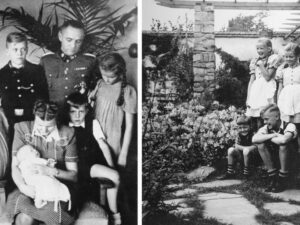
 Rudolph and Hedwig Hoss with their family
Hoss installed his wife Hedwig and his three children inside the “Zone of Interest,” a large residential area outside of Auschwiz’s main camp. They lived a life of luxury. In the documentary, Hoss’ son Hans-Jurgen and daughter Brigitte remember their father as a kind, gentle man. “I think Hans-Jurgen suppresses memories,” notes director Daniela Volker. “He was trying to avoid dealing with this horrendous family heritage.”
As Allied forces closed in on Auschwitz, the Hoss family went into hiding. Hedwig and the three children moved to a picturesque village in the German countryside while Rudolf Hoss worked under an alias. He was arrested in 1946 by British forces and testified in the Nuremberg Trials, was found guilty of crimes against humanity, and sentenced to death.
During the trial, Rudolf Hoss issued an affidavit confirming his crimes: “I declare herewith under oath that in the years 1941 to 1943 during my tenure in office as commandant of Auschwitz Concentration Camp, two million Jews were put to death by gassing and a half million by other means. Rudolf Hoss, May 14, 1946.”
Before his execution in 1947, Hoss wrote a memoir, describing his life and his family’s lives during their time in Auschwiz’s luxurious SS quarters. This memoir “absolutely floored me,” recalls Daniela Volker. “I wasn’t aware of half the things he was talking about.” She used this shocking document - in which Hoss described Auschwitz prisoners acting as servants for his family and the fact that there was no way to keep what was taking place inside Auschwitz a secret - from the public, who surely knew what was taking place inside, as a way to begin stripping away decades of obfuscation and denial.
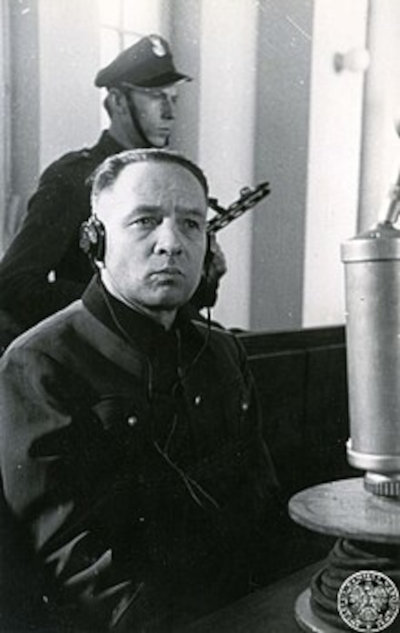 Rudolph Hoss at the Nuremberg Trials
While the Hoss family was enjoying an opulent lifestyle outside of Auschwitz, Anita Lasker-Wallfisch was starving, freezing cold, overworked, and terrified inside. Born into a cultured, musical Jewish family in Breslau, Anita was a gifted cellist, a talent which saved her life. She recalled the eruption of antisemitism that engulfed her as a child: “Children spat at me in the street and called me a dirty Jew. I did not really understand what was going on. One just had to accept that one was different. One did not belong to the master race.”
 Anita Lasker-Wallfisch
In Auschwitz, Anita was assigned to the prisoner orchestra. “As long as the Germans wanted an orchestra, it would have been counterproductive to kill us. Our task consisted of playing every morning and every evening at the gate of the camp so that the outgoing and incoming work commandos would march neatly in step to the marches we played. We also had to be available at all times to play to individual SS staff who would come into our Block and wanted to hear some music after sending thousands of people to their death.” Anita felt that every moment in Auschwitz might be her last, that death could come at any moment.
After being liberated, Anita moved to London and married fellow survivor Peter Wallfisch. She had two children and built a successful music career. Her daughter Maya Lasker-Wallfisch is featured in The Commandant’s Shadow. “One sibling inherits the manifestations of trauma,” Maya recently explained to Aish.com. Maya moved to Germany five years ago, trying to recapture what she says should have been her “real” life if her parents hadn’t been forced to flee. One of the most moving aspects of the documentary is the way it shows Maya and her elderly mother Anita collaborating during the many years they spent working together on the film, sharing memories and forging new ones.
“My mum, although I never believed she didn’t love me, wasn’t present in any way,” Maya Lasker-Wallfisch explains. “She was unavailable.” Anita’s horrific experiences during the Holocaust stunted their relationship. “Intimacy is not something that my mum does. So I always had a profound sense that something was wrong with me.” Maya is a psychotherapist and notes the way trauma is inherited in families.
“In my own inner world, there are days when I’m completely dominated by the past,” she describes. The Commandant’s Shadow shows Maya settling into a new home in Germany, reclaiming something “stolen” not only from her parents but also from her by the Nazis. In one moving scene in the film, Maya visits a cemetery and FaceTimes her mother from the site. They pour over old family documents together.
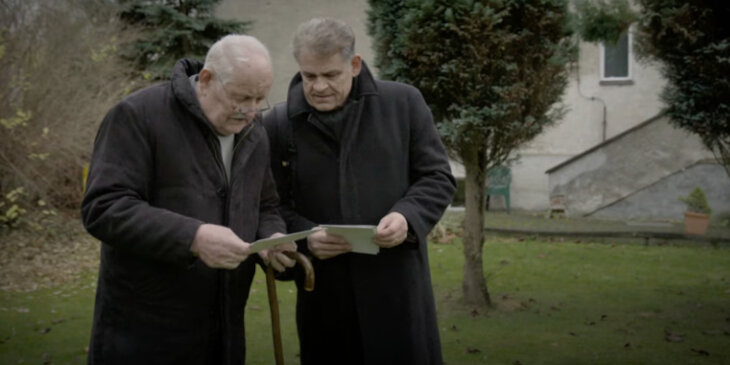 Hans Jürgen Höss and his son Kai
When Maya invites her mother Anita to visit Auschwitz with her, however, Anita refuses. “Your Auschwitz is not my Auschwitz,” Anita says, in one of the film’s most emotional moments.
Working on the documentary helped Maya and her mother Anita become closer. “I guess perhaps we’ve had more honest conversations about my life and what happened. She’s acknowledged what it was like for me growing up and we’ve forgiven each other,” Maya tells Aish.com.
The Commandant’s Shadow records Maya’s meetings with Rudolf Hoss’s son and grandson, and shows them gradually understanding of the magnitude of Rudolf Hoss’ crimes.
Hans-Jurgen Hoss, Rudolf Hoss’ son, remembers growing up next door to Auschwitz. It was “where I had the best part of my life,” he says. Over the course of making the documentary, Hans-Jurgen read his father’s memoir for the first time; the contents shocked him. He describes his memories of his father as being a kind, loving man who, he insists, couldn’t possibly have known about the genocide of millions of Jews and others taking place in Auschwitz. Viewers watch the elderly Hans-Jurgen begin to reassess the way he views his father and his entire childhood.
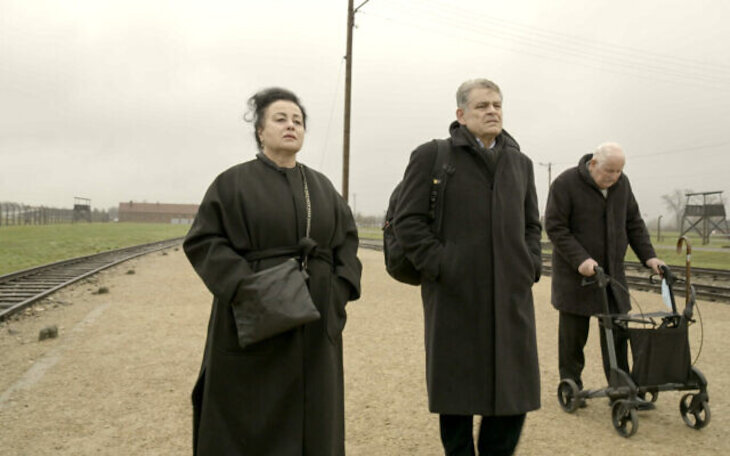 Maya Lasker-Wallfisch, Kai Hoss and Hans Jurgen Hoss visit the Birkenau Nazi death camp
After reading the memoir, Hans-Jurgen - along with his son Kai Hoss, and Maya Lasker-Wallfisch - visits Auschwitz. Their first stop is the Hoss family’s old house. Hans-Jurgen shows us the handsomely apportioned home, describing where he used to play. They visit the prison camp on the other side of the walls where Rudolf Hoss “worked.” It’s a shocking contrast. To his credit, the elderly Hans-Jurgen doesn’t shy away from these difficult encounters, struggling to put into words the intense emotions he feels as he learns more about his father’s crimes.
When the documentary was made, Hans-Jurgen Hoss hadn’t seen his older sister Inge-Brigitt for 55 years. (They also have another living brother, Rainer, who does not appear in the film.) Hans-Jurgen, along with director Daniela Volker, traveled to the suburbs of Washington DC where Inge-Brigitt lived. (She has passed away since The Commandant’s Shadow was completed.)
A former model, Inge-Brigitt is a composed, forceful old lady who adamantly insists that her parents were both loving and gentle people in all situations. In a previous interview, she had insisted that the Auschwitz prisoners who worked in her family’s home and grounds “were always very happy” and that “they called my mother ‘the Angel of Auschwitz’” because her mother “was just a nice person.”
In The Commandant’s Shadow, Inge-Brigitt doubles down on her whitewashing of the past. She isn’t sure the Holocaust really happened, certainly not the way history books record it. Did so many people really die? she wonders. If so, why are there so many survivors? Her callousness is shocking, standing in sharp contrast to her brother who is willing to learn as much about his father’s actions as he can.
“It took me two years to get to the point of talking to Inge-Brigitt,” Daniela Volker recalls. When Inge-Brigitt first expressed her willingness to doubt the horrors of the Holocaust, Daniela was willing to believe that she misspoke and gave her opportunities to change her comments. “I kept trying to ask her again; I didn’t want to be unfair. But it was extraordinary that she wanted to share her Holocaust-denial thoughts.” They remain in the film, perhaps the last words she ever spoke about her father’s horrific legacy.
A moral center of the film is Hans-Jurgen Hoss’ son Kai, Rudolf Hoss’ grandson. Although Kai never knew his Nazi grandfather, he has spent much of his life thinking about what it means to be closely related to a man who killed millions of Jews. Kai works as a pastor in Stuttgart. His church serves many American servicemembers from a nearby army base, and he speaks English with the twang of the American south.
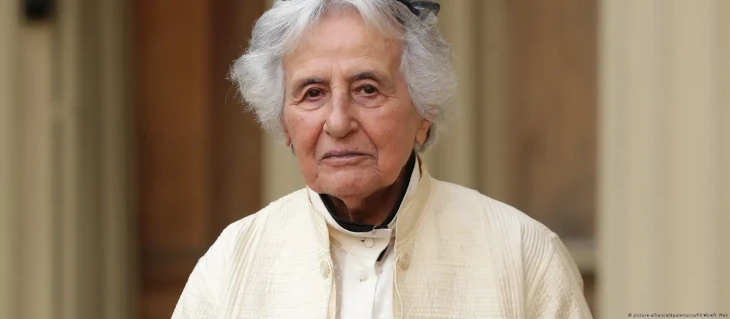 Anita Lasker-Wallfisch
In the film, he’s shown speaking to his congregation and telling them that he acknowledges his family’s horrible sins. He quotes from Deuteronomy, “I am…God, Who visits the sin of fathers upon children to the third and fourth generations” (Deuteronomy 5:9). For Kai, these words feel very personal. He doesn’t have any easy answers about what it means to be the grandson of a mass murderer, but he is consumed by the question.
The climax of The Commandant’s Shadow occurs when Maya Lasker-Wallfisch phones her mother Anita in London and asks if she’d like to meet the Hoss family too.
“We hadn’t seen that before,” director Daniella Volker notes. She believes this is the only time the son of a high-ranking Nazi has visited the home of an Auschwitz survivor. “Anita invited Hans-Jurgen into her home, and met with him, surrounded by pictures of her dead parents and other dead relatives on her walls” who’d been murdered by Hans-Jurgen’s father. “I have nothing against meeting the son of Hoss,” Anita says, before inviting him to visit.
“It was terrifying. The night before, I was thinking, ‘What have I done?’” Maya remembers. “This could not be predicted or planned. I had to just show up and see what happened.”
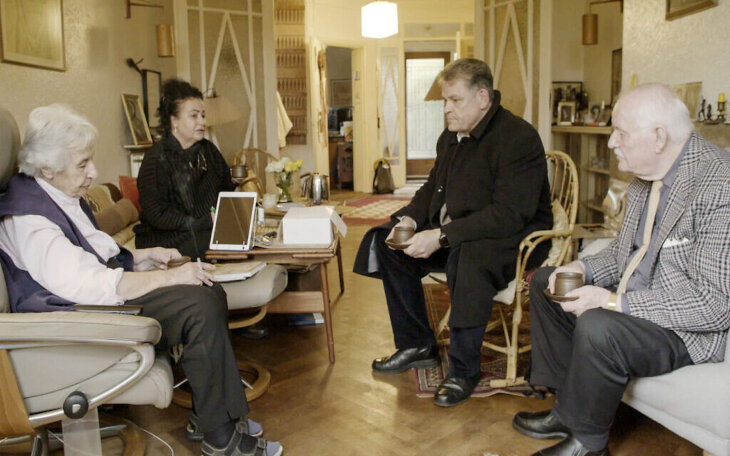 Anita Lasker-Wallfisch, Maya Lasker-Wallfisch, Kai Hoss and Hans Jurgen Hoss meet at Anita's apartment in 'The Commandant's Shadow.'
As Anita Lakser-Wallfish and her daughter Maya greet Hans-Jurgen Hoss and Kai, Anita notes the incredible irony of this moment. The son of the very Commandant who murdered her friends and relatives and who had power over her life every second of every day is sitting in her home, but he is a very different figure from the one we met in the beginning of the film. After learning so much about his brutal father, Hans-Jurgen is a changed man. He thanks Anita for her selflessness in inviting him in.
It’s a moving moment, and director Daniela Volker wisely allows us to observe the pleasantries these two very elderly people share as they chat and look at old pictures together. Maya described her mother’s invitation as “magnificent generosity” and hopes viewers will be inspired by her example.
The film was in its final production stages when Hamas staged its October 7, 2023 attack. Maya, still living in Germany, has found that anti-Jewish sentiment has skyrocketed there and feels the lessons of The Commandant’s Shadow are needed now more than ever.
“Life has profoundly changed,” Maya notes. “I’d always been aware of an unconscious bias in Germany before October 7; it’s one of the things I’ve struggled with in my transition to living here, the unconscious antisemitism. Now it’s not so unconscious. I’d never felt fear before. Now I’ve felt fear.”
She’s stopped wearing the Magen David necklace she inherited from her Aunt Renata, who perished in the Holocaust, noting that this feels like another theft from those who hate her and seek to do her harm.
Daniela Volker was also surprised to see anti-Jewish hatred rising in her native Germany. It reminds her of the stories about Nazi Germany that Anita told her. “What shocked me was that so many things Anita said before October 7 took on a new meaning. They were almost prescient. She was saying that Jews aren’t out of danger. I didn’t really understand it until we all saw it being live streamed.”
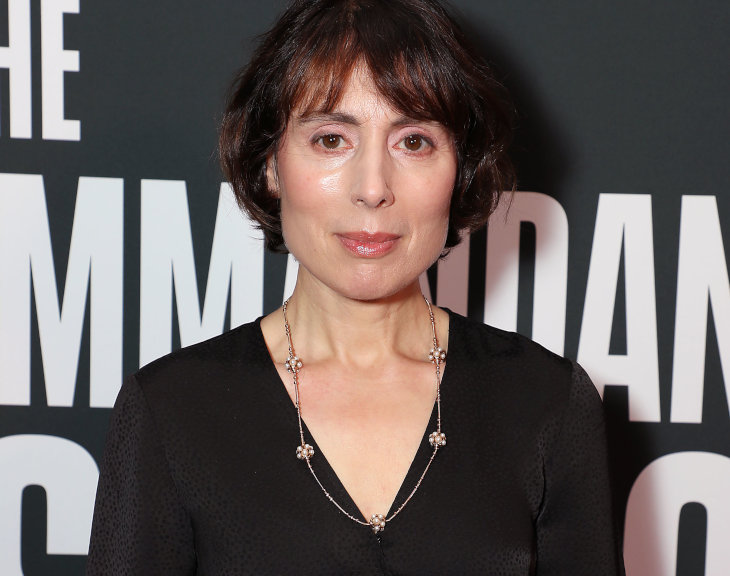 Daniele Volker at the film’s premiere in New York City
“It’s Anita’s view that the Holocaust is something that can’t be put together with other genocides,” Daniela explains. Each experience has its own specific roots, and it’s crucial to learn from the Holocaust that all forms of Jew-hatred are wrong. “I wanted to let her have the last word: survivors won’t be around forever. She’s someone who has so much to say and has a razor-sharp intellect. I wanted to end it with her thoughts.”
The Holocaust began with hatred against Jews and isolating them as the “other. That seems to be happening again today. The Commandant’s Shadow is a dire warning of where anti-Jewish hatred leads.












I componed the original music-
Stories of the Holocaust are all different, but at the same time, they are all the same. Human behaviour. And Hamas is trying to start it all over.
Maybe I missed it but where can we view this documentary, The Commadant's Shadow?
How do you explain WHY in heaven's name do Jews live in Germany today, after what happened there to our people? And it seems that we are still hated there today.
Please tell me how I can access this movie
Where can we see this documentary?
I am Catholic (non practicing),grew up in NYC surrounded by Jewish people. And I have read dozens of books on the Holocaust and viewed many horrible photos of mass graves. I have visited Holocaust museums in Illinois and Wash DC. I also have visited Dachau and stood in one of the gas chambers. Israel can kill as many Hamas people as they can. Israel should destroy Iran's nuclear capability before it is too late. I am glad Israel is hitting back! The world is full of weak kneed "leaders" that lack to courage to stand up to bullies. That also includes the ignorant/brain-washed media types.
I agree with your statement about Israel should destroy Iran's nuclear capabilities, and kill their proxy terrorists Hamas, and the other two starting with a H, Iran used to be called Persia and Jews have a holiday called Purim, because the Jews defeated the Persians and the others that tried to kill us, also Iran will start with Israel but it doesn't end there then they will start with the rest of the world, during the Holocaust someone wrote they started with the Jews and ended up going after a lot of others too
Few people have a problem with killing Hamas people, the issue is the killing of others, are children, women, others are fault. If 40 hostages are held, is it okay to kill 2,000 Palestinians because of that.
dearest Stan! my mother, grandparents and several aunts, were lovingly saved by dear loving Catholic nuns during world war 2 in France. The natzis kept poundiing on their door shouting 'let us in, we know you are hidding jews in there! If you don't let us in we'll kill all of you too. The dear nuns refused to let them in and lovkngly saved my family at there own risk. So thanks to the dear loving nuns my children and I are still alive! Very very greatfull ! verry verry greatfull me . And my family! Thank you!!! for saving them and me!!!!!
The world needs brave people like you- wishing you many blessings
muy fuerte e ilustrativo
It is clear that words and film are totally inadequate to explain why the German People would allow their political leader to initiate and carry out the industrial murder of 6 million totally innocent Jewish men,women and children because they were Jews and the German Chancellor today approves of the ICJ condemning the Premier of tiny democratic Israel who is desperately trying to keep Israel alive as it wages war for survival against Arab and Iranian nations who surround it and who publicly state that their goal is to kill all Jews because they are non-believers in Islam and have been at war non-stop since1948 to destroy Israel.It is also beyond human understanding that Western and Muslim nations fund in the billions the faked “ Palestinian State” whose Charter’s goal is to kill Jews.
I had a German acquaintance who told me that they didn't know. He was a teenager during the war. After discussion, he admitted that they did know to a large degree. The Hoss children were young, but I have a hard time believing that their mother didn't know.
The film makes clear that their mother did know.
This powerful article, amid today's resurgence of antisemitism, made me ponder how Jews should view descendants of Holocaust-era perpetrators:
AN OPEN LETTER TO THE GERMAN PEOPLE
Over eighty years have passed since World War II and the Holocaust.
As a Jew, I do not judge you. I cannot.
However, you can judge yourselves by asking:
1) In your heart of hearts, do you believe the world would be a better place if we Jews were no longer part of it?
2) If you could - silently, cleanly, with nobody knowing - push a button that would make us disappear, would you?
If you honestly answer ‘no,’ you may consider yourself guiltless for your forbears' crimes. If ‘yes,’ you are essentially no different from the Germans of eighty-five years ago; all you lack is opportunity.
I wonder if Germany(the leopard) changed its spots concerning Jews(to want to kill us or not), some of the Germans I heard convert to Judiasm, so there is two trends going on here, to be a hater on one hand and the other hand becoming Jewish, so I wonder what will they chose
That is terrifying. However, think about asking that question in America, and especially of those college kids that are heading for high positions in bureaucracy and government and it becomes even more terrifying.