





 Three Things Every Jew Needs to Hear at the Seder This Year





11 min read


Eighty years ago 283 Jews were released by Nazi Germany and brought to the Land of Israel. This is their remarkable story.
Throughout the 1930s there was a steady flow of Jewish immigration out of Nazi Germany and Europe to the Land of Israel (Mandatory Palestine under British control), but after the war broke out in 1939, the road to freedom became highly restricted and complicated. Very few Jews managed to escape Europe during the Holocaust and for those interred in concentration camps, it was virtually impossible.
Yet in July 1944, while Europe was ablaze, 283 Jews made the unimaginable train journey from the Bergen-Belsen concentration camp in Germany to the city of Haifa. This is their incredible story.
By 1939, there were 445,000 Jews in the Land of Israel, about 1/3 of the total population. A good portion of them were born there and were already speaking Hebrew for two or three generations. Although Mandatory Palestine was under British control and not a sovereign state, it nevertheless issued passports to its Palestinian Jewish and Arab inhabitants. Palestinian Jews would visit European destinations, usually in the summer, both for tourism purposes and to visit relatives abroad. The summer of 1939 was no different, but those Palestinian Jews visiting Germany and Poland who were unable to make it back home by the end of August got stuck there.
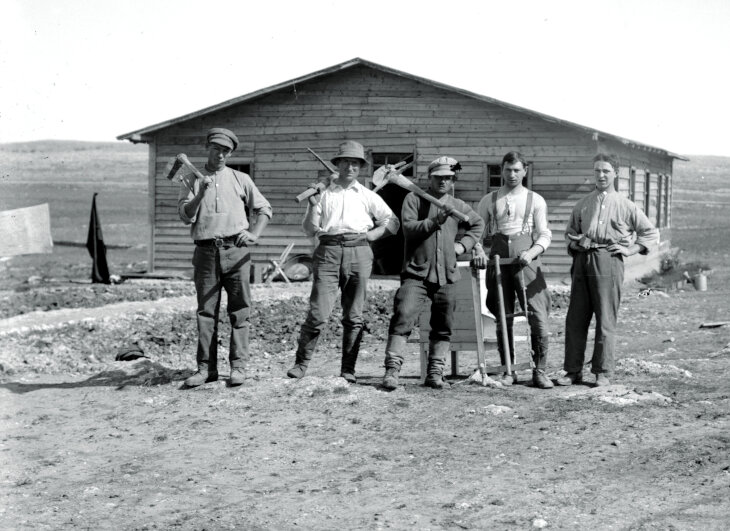 Jewish settlers circa 1920 building their kibbutz. From the Library of Congress’s Prints & Photographs division.
Two days after Nazi Germany invaded Poland, on September 3, 1939, Britain declared war on Germany. That meant every British citizen travelling within German territory (including German-occupied Poland) became designated as enemy aliens. Palestinian Jews, as citizens of a British protectorate, also fell under that category. Within weeks, both Jews and non-Jews with British paperwork were put into interment camps. The Nazi regime calculated that they could use these hostages as bargaining chips to recover German citizens within British territory.
Meanwhile, back in Mandatory Palestine, families of the hostages formed committees and actively petitioned several organizations for help including the Jewish Agency, the Red Cross, the U.S. embassy in Berlin, and the Swiss Delegation. Both the U.S. and Switzerland were neutral countries at the time and were able to have some degree of influence on the formation of a hostage deal.
Remarkably, during the war, exchange deals did take place between the British and German governments that involved the transfer of 550 Palestinian Jews within Germany and the German-occupied territories in exchange for 1000 German citizens who were living in British Mandatory Palestine at the time. These Germans were descendants of a Christian puritan community known as The Templers who came to the Holy Land (then under Ottoman rule) starting in 1868. Throughout the late 19th century, they built several German colonies in Haifa, Jaffa, Tel Aviv, Jerusalem, and other localities as well. Until today, there are residential neighborhoods in Jerusalem and Haifa that are still refereed to as the “German Colony”.
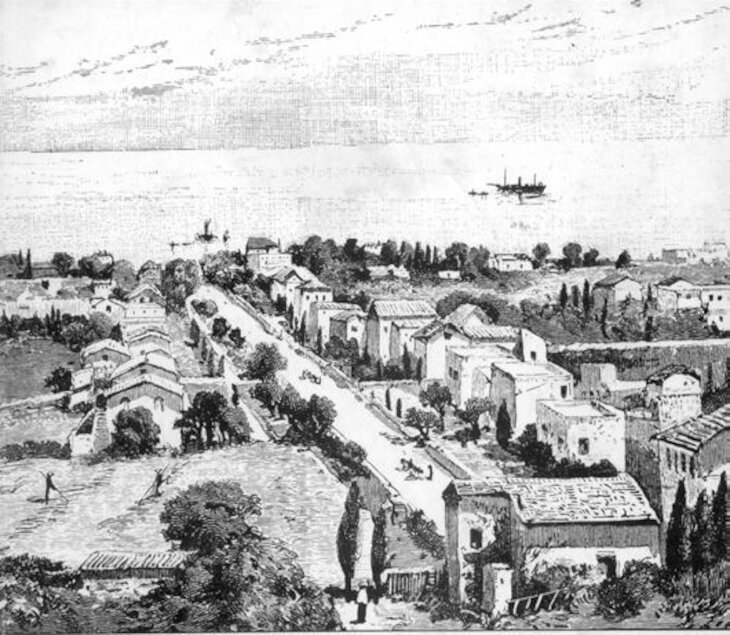 The German Colony in Haifa, 1875
Over the decades, the German government provided financial support to Templer schools in the various German colonies across Mandatory Palestine. When the Nazi party came to power, it required all German educational institutions (including those overseas) to have curriculum and teachers in line with Nazi ideology. Within a few years, 75% of the Templers belonged to the Nazi party or supported Nazi ideals. Some of the Templer youth even left Palestine to join the German army in the late 1930s.
When World War II broke out, the British declared the Templer community consisting of some 2000 individuals as enemy nationals. They were rounded up into two Templer colonies, one in Wilhelma (in the Galilee) and the other in Sarona (today in the heart of Tel Aviv) that were enclosed with barbed wire and placed under armed guard. Feeding and tending to the needs of 2000 German citizens and Nazi sympathizers was a burden to the government of Mandatory Palestine. With the prospect of a German invasion from North Africa into Mandatory Palestine, the British were eager to dispose of their fifth column.
On July 31st, 1941, the British decided to unilaterally deport 661 German citizens (mostly men of fighting age) from Mandatory Palestine to Australia via Egypt. This was considered a loss for Germany, which by this point was fighting a two front war and needed all the manpower they could get. The German foreign office therefore took renewed interest in a potential exchange deal with the British. In the course of the war, three deals did in fact take place. The first two exchanges were less documented and not highly publicized, but we do know that they took place in December 1941 and November 1942 and involved the transfer of some 267 Palestinian Jews who had been imprisoned in Germany and Poland since 1939.
The third deal took place in July 1944 and received a lot more public attention since, by this point, the magnitude of the Holocaust was starting to surface. Unlike the first two deals, the third deal was not applicable to Palestinian Jews who got trapped in Europe at the outset of the war. Rather, it was meant for Jews who were residents of Europe, the Netherlands in particular, but who had relatives in Mandatory Palestine who had sent them valid immigration certificates.
By the summer of 1944, the Netherlands had been under German occupation for four years. Between May 1940 and July 1942, all 140,000 Jews in the Netherlands were required to live exclusively within the municipal boundaries of Amsterdam. Between 1942-44, the majority of the Jewish population was forcibly relocated to the Westerbork transit camp on the Dutch-German border. From Westerbork, some 100,000 Jews were deported to extermination camps and concentration camps in Auschwitz, Sobibor, Theresienstadt, and Bergen-Belsen. Of that number, only 3,500 were selected for Bergen-Belsen.
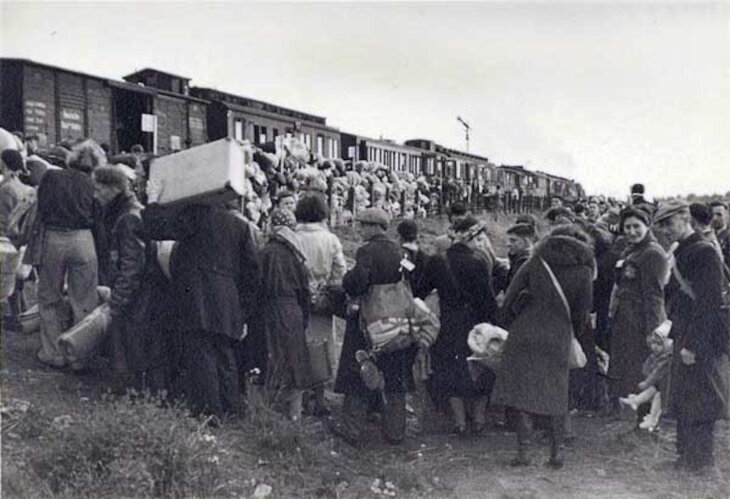 Jews in Westerbork boarding the deportation train to Auschwitz
Part of the camp was designated as a holding camp meant for Jews with dual citizenship and/or immigration certificates to other countries who could be used as bargaining chips in exchange deals for German foreign nationals imprisoned in enemy states. The “Star Camp” was a subsection of the holding camp that applied to Dutch Jews with immigration certificates to Mandatory Palestine that were sent to them by their relatives in the Land of Israel. Although the certificates were sent to them while they were still living in Amsterdam (prior to their deportation to the camps), very few passenger ships left European ports under Nazi occupation due to a naval blockade that was imposed by the Allied Forces. Furthermore, travelling between enemy territories (German-occupied Netherlands and British-controlled Palestine) was illegal and could have resulted in arrest, interception at sea, or getting sunk by German or British submarines. As a result, hundreds of Dutch Jews arrived to Bergen-Belsen with their immigration certificates, which they were unable to use until that point.
In the climax of the negotiations, it was decided that 222 Dutch Jews with immigration paperwork for Mandatory Palestine would be selected from the holding camp in Bergen-Belsen. Those who were chosen were informed months in advance along with their families in Mandatory Palestine. Despite the hope in their hearts, they also had their guard up as the Nazis previously used dubious tactics to relocate Jews to ghettos and concentration camps.
Emotions ran high when on Friday June 30, 1944 at 5:00 AM, the gates of Bergen-Belsen opened and the group of survivors exited the barbed wire encampment on foot. Surrounded by armed SS guards, they were taken on a two-hour walk. They didn’t know if they were on their way to the Land of Israel or at the start of a death march. At the end of the journey was a train station. The train arrived, but to everyone’s amazement, these were not the windowless cattle cars that they were sardined into on their way from the Netherlands to Bergen-Belsen. This was actually a passenger train fit for humans complete with chairs and bathrooms. The Kommandant of Bergen-Belsen himself even showed up to make sure that everyone’s needs were being attended to. Was this some kind of a joke?
Stopping in Vienna for the night, they were set up in a hotel with running water, beds, pillows, and a real meal, the first one in years. They felt almost human until they looked out the window into the hotel courtyard and saw hundreds of their fellow Jewish brothers and sisters sleeping on the ground surrounded by SS guards. These were Hungarian Jews on their way to an uncertain fate in one of the camps. Returning to the train station the next morning, they were joined by a group of 61 Jews from Vittel, France who were also part of the hostage exchange deal.
The group from France was known as the Istanbul List. They were not Dutch Jews, but rather French and German Jews with proof of Turkish citizenship. The reason they had Turkish citizenship is because someone in the family lived in Palestine when the country was under Ottoman rule (prior to World War I) and passed down Turkish citizenship to their children who relocated to Europe at some point before the outbreak of World War II. For the German authorities involved in the exchange deal, this justified their legal right to be deported to Mandatory Palestine.
Ruth Jacobson, one of the survivors of the Istanbul list, described her first encounter with the Jews from Bergen-Belsen whom she met in Vienna: “These people were in a terrible state, skeletons, still in their prison garb with the yellow star, just as you will have seen on film.”
Due to the presence of the Red Cross overseeing this stage of the exchange deal, the Germans made sure to provide luxurious treatment to the survivors. The train that picked them up in Vienna had sleeping cabins, restaurants, served warm meals, and cold beer. It seemed like a dream, but reality kicked in when the train had to make sudden stops due to allied bombing that could be heard throughout the journey. Before reaching the Bulgarian-Turkish border, the passengers were ordered to remove their yellow stars. The German authorities who were still on board the train changed into civilian clothes.
Exiting the train in Istanbul on the sixth day of their journey, they were greeted by members of the Jewish Agency and local Turkish Jews who embraced them and provided them with large quantities of food, chocolate, fruit, and cigarettes. Who would have thought that just a week ago their daily ration consisted of 3.5 centimeters of bread and 3/4 a liter of watery soup! As soon as the train was empty, another group of people started to board. These were 400 members of the Templer community from Mandatory Palestine. From Istanbul, they would be repatriated to Germany. The exchange had been completed.
The Jewish group that now numbered 283 would be led by authorities from the Jewish Agency to a chartered ship to cross the Bosporus Straight (the connection between Europe and Asia). Once on the other side, their journey would continue on the Turkish railroad through Syria and Lebanon over a four-day period. There is a natural boundary, a ridge cliff line that separates the Land of Israel from Lebanon and it juts out into the sea making coastal land travel in the Eastern Mediterranean challenging. Fortunately, two years earlier, the British constructed a tunnel through the cliff line at Rosh Hanikra connecting the coastal railroads of Mandatory Palestine with the coastal railroads of Lebanon. The historical tunnels and railroads are still visible at the Rosh Hanikra tourist site although the connection with Lebanon has been blocked off since 1948 since Israel and Lebanon have no official diplomatic relations.
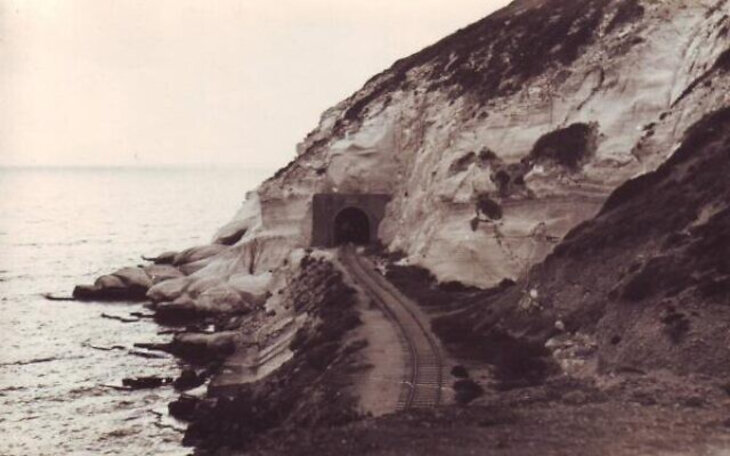 The former British Cairo-Istanbul railway tunnel photographed in 1964 in Rosh Hanikra (Wikimedia commons)
Once the train passed through the tunnels of Rosh Hanikra, the survivors of Bergen-Belsen saw for the first time kibbutzim, Jewish farmers, and signs in Hebrew. They realized that they had just arrived to the Land of Israel! Emotions ran high, women burst out into tears, and the whole group collectively sang Hatikva (“The Hope”).
On July 10, 1944, the train arrived in Haifa. Relatives of the hostages who waited anxiously at the train station for hours finally embraced their loved ones whom they hadn’t seen in many years.
They had made the dramatic journey from Bergen-Belsen to the Land of Israel, from captivity to freedom, over an 11-day journey by train. While millions of Jews were being put on trains bound for extermination camps, these 283 Jews were put on trains that took them to the Holy Land. The freedom train had arrived at its final destination.
Featured image: A group of children Holocaust survivors, released in the Bergen-Belsen-Palestine Prisoner Exchange, at the Atlit Reception Camp, 14 July 1944. Photograph by Zoltan Kluger.













Wow!
I have never heard or read about a Nazi exchange.
Live and learn !
Today!
Thank you for sharing this fascinating story. Solidly researched and well-told.
One small correction: Bosporus Strait, not straight. A Strait is a narrow water passage. The Strait of Gibraltar is probably the best-known.
Thanks you for sharing.
Wow! Learning such things after so many years. Thanks for telling this story. One’s heart breaks over the unspeakable grief the Jewish people experienced. Almost impossible to adequately express my emotional turbulence over their suffering.
Not in any way to diminish the horrors of the Holocaust, which was committed by Nazi Germany, a certain fact remains: Nazi Germany's goal, up to the onset of the war, in September 1, 1939, was to rid Germany and Europe of the Jews, in any way possible, including emigration. It was closure of most avenues of escape for the vast majority of the remaining Jews of Germany, Austria and occupied Czechoslovak, as well as the Jews of the conquered countries, which set off the policy of extermination. The policy of extermination was a decision by Hitler, and designed at the Wansee Conference, in January 1942.
The fact, there were instances of Jews in the German custody released to freedom, in a small way illustrates the fact of the original policy towards the Jews.
It’s amazing how so many years later, new accounts keep coming to light.
So the inequitable hostage exchange comes right out of the Nazi tricks book. Jihadists are faithful students of Mein Kemp.
Totally, totally fascinating, I had never heard about this, thank you for such a detailed write-up
Wow unbelievable!
This proves anything's possible.
Thank you for this. I had never heard of this incident before.