





 For 44 years, Yehuda Katz’s Family Refused to Give Up Hope

5 min read
9 min read
3 min read



6 min read


Before my daughter's wedding, I discovered the hardest part of loss isn't the big day, it's the week before.
A week before my daughter Tali’s wedding, people kept saying to me, “You must be so excited!” And of course, I knew I should have been. Tali and Ariel are a lovely couple who had been dating for two years, including while they were both serving in the army. They met through one of those wonderful examples of Jewish matchmaking: Tali went on a trip to Poland together with Ariel’s mother and sister, and somewhere along the way they looked at her and thought, Have we got a son and brother for you! They were right.
The wedding was a week away, everything was falling into place, and friends kept telling me how excited I must be. But the truth was that I was sad. I discovered something that week that psychologists who deal with bereavement know well: sometimes the most painful part of a celebration isn’t the celebration itself. It is the days leading up to it.
The build-up to a daughter’s wedding is when her mother should be there, fussing over every detail: the dress, the flowers, the seating plan and the thousand tiny decisions that suddenly seem enormously important. But Tali’s mother, Lucy, wasn’t there, and Tali would have given anything to have her two sisters, Maia and Rina, there too. Lucy and two of our daughters were murdered in a cold-blooded terror attack while driving through the Jordan Valley during the week of Passover in April 2023. There was a gaping hole in the preparations because this was precisely the time when the three of them should have been most involved.
Thank God, Tali was amazing, excited and getting on with everything. Her sister Keren stepped up magnificently, doing all the things a sister — and sometimes a mother — would normally do: organizing her bachelorette party, taking her to the mikveh and being there beside her throughout the preparations. My new wife, Aliza, was also incredible, throwing herself into the details and helping Tali wherever she was needed. Yet despite all that love and support, three people were sorely missing, and for me their absence was most painful in that strange vacuum before the wedding.
Of course Lucy, Maia and Rina were in our hearts, and always will be, but loss was not the defining emotion of the wedding. Joy was. Love was. Gratitude was.
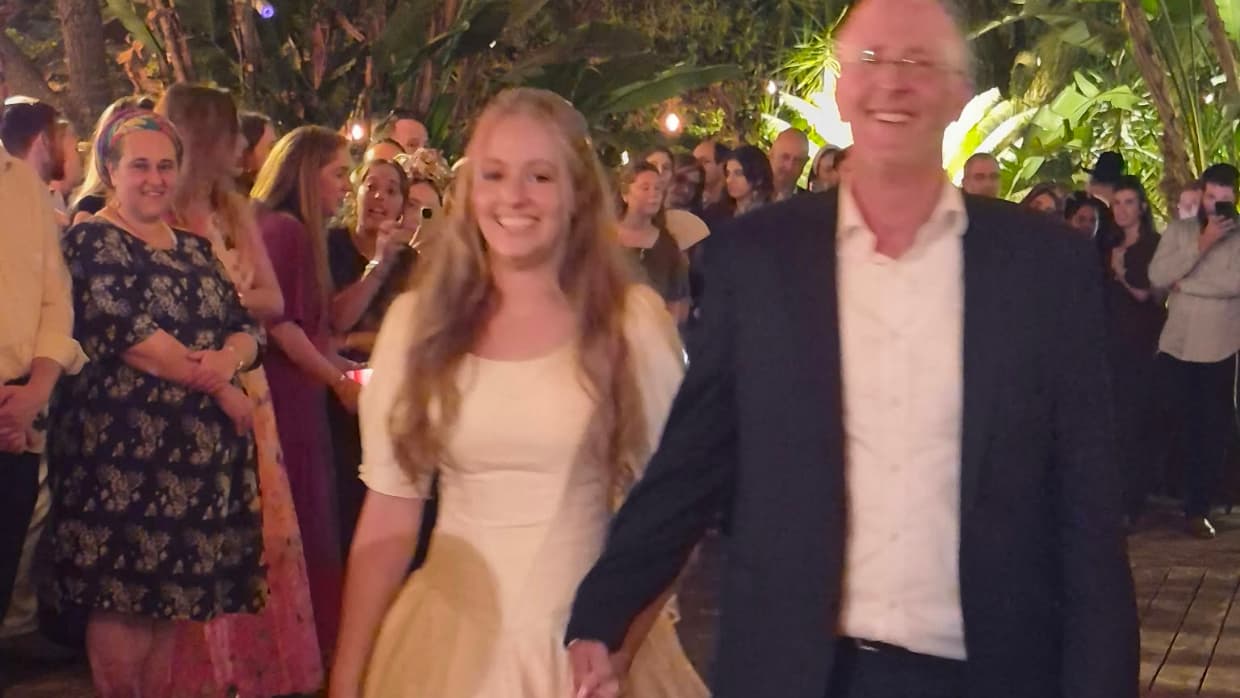
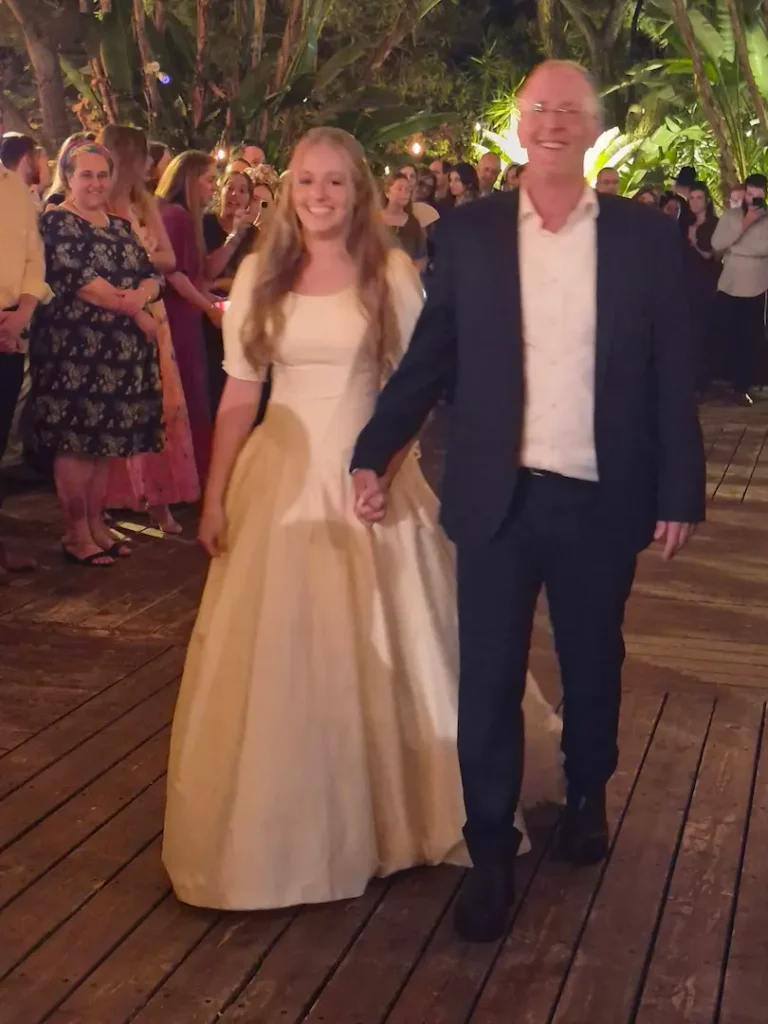
And then the wedding came — and it was completely different. It was simply overflowing with simcha, joy. Hundreds of friends and family surrounded Tali and Ariel with dancing, singing, laughter and love. Instead of being dominated by the three people who were missing, the evening was dominated by the hundreds of people who were there. Of course Lucy, Maia and Rina were in our hearts, and always will be, but loss was not the defining emotion of the wedding. Joy was. Love was. Gratitude was. We were celebrating two wonderful young people beginning their lives together, and the happiness was real and overwhelming.
Perhaps that shouldn’t have surprised me. Before a major event, we are surrounded by reminders of the people who should have been helping us prepare for it. Every decision can become a grief trigger: She would have known what to do about this. He would have gone shopping with me. I would have called her about that. But once the event arrives, suddenly the room is full. Friends and family appear, the music starts, people hug us and talk to us, and we are swept into what is actually happening. They entertain us, distract us and surround us with love, but more importantly they bring us genuine joy. The person we have lost is still missing, yet there is so much life happening around us that grief no longer has the same empty space in which to echo.
I think the same thing can happen before Jewish holidays. We naturally assume that Yom Tov itself must be the hardest time for someone who has been bereaved, divorced, lost a job or suffered some other major disruption in life. And sometimes it certainly is. But Yom Tov can also be full of inspiration, friendship, prayer, singing, children, meals and community. A bereaved person may sit at a beautiful Seder surrounded by friends and genuinely enjoy it. Someone who is divorced may spend Rosh Hashanah with people who love them and find the davening uplifting. Simchat Torah can actually be joyous. Grief and simcha are not mutually exclusive.
We are quite good at remembering people who might be alone on Yom Tov. But what about the week before the holiday?
We are quite good at remembering people who might be alone on Yom Tov. Someone has recently lost a spouse? Invite them for lunch. Someone has gone through a divorce? Make sure they have somewhere for the Seder. Someone has lost their job and is struggling? Include them. Those invitations are enormously important, but perhaps they are only half the mitzvah. Because by the time Yom Tov arrives, that person may already be surrounded by people, while the hardest days were the ones nobody thought about.
What about the week before the holiday? While the rest of us are frantically buying food, cooking, cleaning, changing beds, setting tables and complaining about how much there is to do, someone else may be experiencing an enormous vacuum. The recently bereaved person remembers who used to do the shopping with them or whose special recipe they would be cooking. The divorced parent sees other families preparing together. The person who has lost a job may be painfully aware that this year they cannot buy what they normally bought for their children. These are the quiet moments, before the guests arrive and before the shul fills up, when absence can be loudest.
So perhaps we need to think not only about the empty chair at the Yom Tov table, but also about the empty days leading up to it. Helping doesn’t require anything dramatic. Call them while you are driving to the supermarket. Send a WhatsApp: Thinking of you. I know this week might not be easy. Or simply write: I’m running around getting ready for Yom Tov and just wanted you to know that you crossed my mind.
You don’t need to fix their loneliness or take away their grief. Sometimes it is enough to remind someone that, amid everyone else’s frantic preparations, they have not been forgotten.
We spend enormous effort preparing our homes for Yom Tov, and perhaps part of that preparation should be preparing our hearts for the people around us. This year, let’s not only ask who needs an invitation. Let’s ask the question a few days earlier, when it may matter even more: Who might need support before the holidays?













What an amazing and refreshingly inclusive perspective, penned so beautifully and heartfully. Thank you Rabbi Dee for sharing your heart and your thoughts with us. Mazel tov and Kativa v' chatima tova.
That is beautiful and helpful advice.
Mazel Tov on the wedding.
Thank you for a great eye-opener!