







 The Shofar Is Silent, Remember to Breathe

5 min read
8 min read
5 min read
9 min read





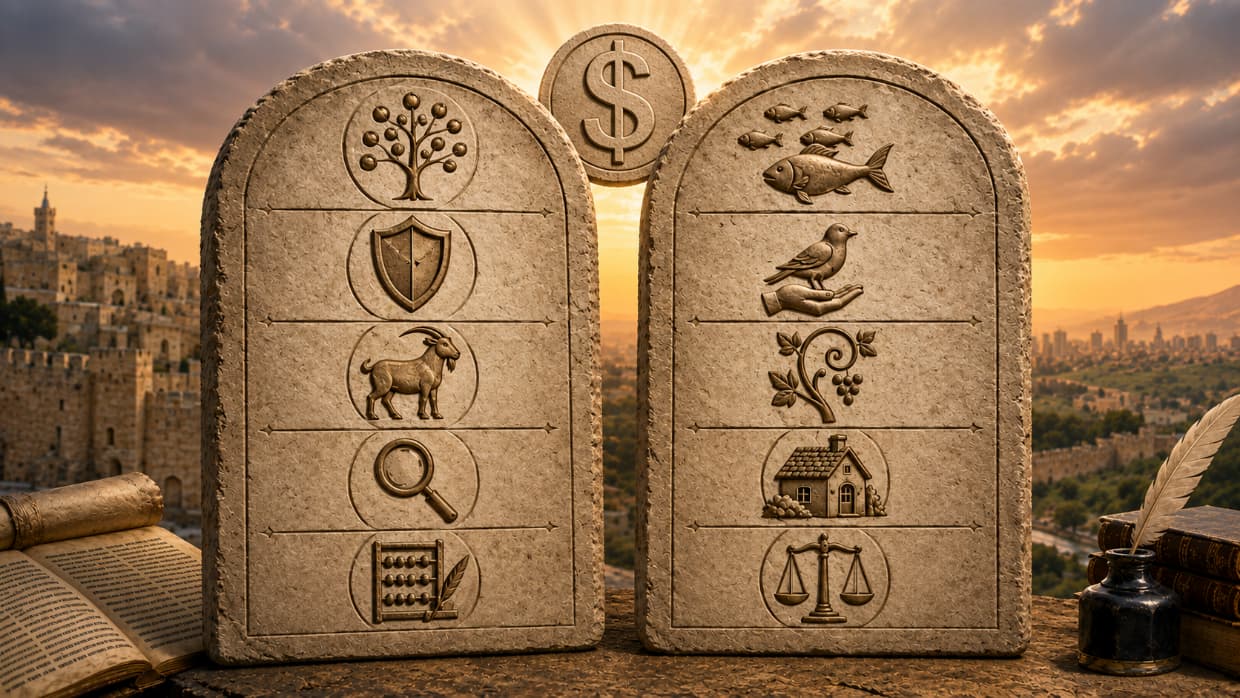
Ten sound investment rules from Jewish tradition, and the modern financial giants who echoed them.
Jewish sources have a lot to say about money. Scattered across the Talmud and its commentaries is a body of financial wisdom that Buffett, Graham, and Munger would only formalize thousands of years later.
Here are ten Jewish rules that still hold up.
The ancient source
“Divide your portion into seven, or even into eight, for you do not know what misfortune may befall the land” (Ecclesiastes 11:2).
A person should always divide his wealth into three — a third in land, a third in merchandise, and a third in liquidity. The Talmud sources the principle with our Patriarch Yaakov, who, fearing Esav, “divided the people who were with him, and the flocks and herds and camels, into two camps” (Bereishis 32:8–9), so that if one camp were struck, the other would survive (Talmud Bavli, Bava Metzia 42a).
The modern echo
Harry Markowitz won the Nobel Prize for Modern Portfolio Theory and summed it up in one sentence: “Diversification is the only free lunch in investing.” Spreading risk across uncorrelated assets lowers risk without sacrificing return. Researchers have tested the Sages’ “thirds” allocation against Markowitz’s model and found the Talmudic portfolio holds up remarkably well.
The ancient source
The Talmud (Bava Kama 7b) observes that while real-estate values dip in the off-season, land does not fall below half of its value. That built-in floor protects the buyer who respects it from being wiped out by bad timing.
The modern echo
Benjamin Graham (né Grossbaum) — Buffett’s teacher and the father of value investing — reduced the discipline to three words: margin of safety. Buy with a wide enough gap between price and value that even your mistakes leave you whole.
The ancient source
“A person should always seek to sell a field and purchase goats” — to benefit from their milk, wool, and offspring — “and a person should not sell goats and purchase a field.” The goat yields year after year; a bare field does not (Chulin 84a). Likewise, when managing a child’s assets, one buys a fruit-bearing tree so the child benefits from the produce (Bava Basra 52a).
The modern echo
In his 2011 Berkshire Hathaway letter, Warren Buffett drew the same distinction. A block of gold, however large, produces nothing; farmland, businesses, and real estate generate output — crops, dividends, rents — year after year. Like the Talmud’s goat, the productive asset compounds; the inert one does not.
The ancient source
It is better to deal in a smaller quantity of merchandise close to home than a larger quantity from far away — the nearby trade is the one you can actually watch and understand. (Pesachim 113a) The Talmud likewise warns that “a person cannot know from which merchandise he will profit” (Pesachim 54b), and to keep a close eye on your own workers. Stay where your knowledge is real (Bava Metzia 29b–30a).
The modern echo
Peter Lynch, who ran Fidelity’s Magellan Fund to roughly 29% annual returns, built his philosophy on four words: “Invest in what you know.” Buffett calls it staying within your “circle of competence.” The edge belongs to the investor who understands the business in front of him and not chasing the unknown far away.
The ancient source
The Talmud is strikingly operational. Collect payment before you measure out the goods. Watch your employees. And — pointedly — one who merely earns back his investment is not really a merchant (Pesachim 113a; Bava Metzia 40b). The details are the business.
The modern echo
Graham taught that investing is most intelligent when it is most businesslike: do the homework, run the numbers, and never mistake a flat result for a real gain. Wealth is built by a careful proprietor, not a gambler.
The ancient source
“In a time when others are scattering, gather in; and in a time when others are gathering in, scatter.” Move against the crowd (Brachos 63a). This pairs with the Torah’s warning, “Do not follow a multitude to do evil” (Exodus 23:2) — independence of judgment is a virtue, in markets as in morals.
The modern echo
This is nearly word-for-word one of Buffett’s most famous maxims, from the depths of the 2008 crisis: “Be fearful when others are greedy, and greedy when others are fearful.” When the herd panics, prices fall to where the patient buyer steps in; when the masses are euphoric, take a step back.
The ancient source
“Butzina tava mikara — a small gourd in hand now is better than a large one later” (Kesuvos 83b). Better the certain modest gain than the speculative larger one (Succah 56b).
The modern echo
Bernard Baruch, who sold out before the 1929 crash, put it plainly: “I made my money by selling too soon.” Chasing the exact top is a fool’s errand; the disciplined investor banks the gain. Buffett made the same point with the old adage, “a bird in the hand is worth two in the bush.”
The ancient source
“One who wishes to become wealthy should engage in raising small domesticated animals” (Chulin 84b) — because they breed quickly, and their offspring beget further offspring. The Rambam captures the same instinct (Hilchos Deot 5:12): aim steadily to improve your position and “to exchange the impermanent for the permanent”. Small gains, reinvested over time, become large ones.
The modern echo
Charlie Munger, Buffett’s partner for half a century, reduced wealth-building to one discipline: “The first rule of compounding: never interrupt it unnecessarily.” Most of a fortune’s growth comes at the end of the curve — if you have the patience to leave it alone.
The ancient source
The Sages advise living below your means (Chulin 84b), and define wealth not by the size of one’s holdings but by the state of the heart: “Who is rich? One who rejoices in his portion” (Ethics of the Fathers 4:1). One is also required to live within his means (Rambam Deot 5:10). The goal of all the above is not accumulation for its own sake, but security, generosity, and peace of mind.
The modern echo
Warren Buffett, one of the wealthiest people alive, still lives in the modest Omaha house he bought in 1958. Great investors tend to be frugal: the fortune you keep depends more on temperament than on returns. Spend less than you have and reinvest the difference.
The ancient source
The first question a person is asked before the Heavenly court is, “Did you conduct your business affairs faithfully?” (Shabbos 31a) Honesty in commerce is not a footnote to the spiritual life — it is the opening question of the final accounting. It is also a Biblical command: “You must fulfill what has crossed your lips” (Deut. 23:24).
The modern echo
Buffett tells his managers the same thing: “It takes 20 years to build a reputation and five minutes to ruin it.” He will forgive lost money but not a shred of reputation. Trust is the most valuable asset on any balance sheet, and the hardest to recover once lost.
Together, these rules describe a disposition: prudent, patient, honest, and aware of what cannot be known. “A person cannot know from which merchandise he will profit” (Pesachim 54b) — so he diversifies, demands a margin of safety, stays within what he understands, and lets time and integrity work.
Modern finance has spent centuries rediscovering this. Perhaps this tradition helped Jews thrive financially through centuries of persecution.












2. Do not blindly enter the market based on rumors or others' recommendations.
Everyone has unique karmic lessons and financial cycles; an investment that yields profit for someone else may not suit you. Edgar Cayce’s readings show that many people lost money by copying others' strategies, failing to consider their own specific energetic alignment.
3. Do not treat investing as a primary occupation to escape your actual job.
Everyone has worldly lessons to learn in the present; one's regular job serves as the foundation for cultivating character and accumulating merit. Investing is a tool for asset appreciation, not a substitute for a primary career; full-time speculation easily breeds laziness and a mentality of wishful thinking.v
Spirit is life, the mind is the builder, and matter is the result.
- Mindsets rooted in the fear of scarcity, the fear of losing money, or a gambler’s mentality attract volatility, financial losses, and missed opportunities.
- Mindsets characterized by stability, altruism, and a long-term perspective are more likely to align with assets that generate steady cash flow.
At their core, all massive financial losses stem from mental projections of fear or greed.
1. Avoid investing with borrowed money or using leverage for stocks and real estate.
Combining debt with investment amplifies fear; a destabilized mindset easily leads to poor decision-making. A market downturn then compounds the financial burden, disrupting one's life.
Excellent essay of biblical wisdom.
Yasher koach!
I like this Bernard Baruch quote:
‘Nobody ever lost money taking a profit’.
It looks like a lot of knowledge comes from written and oral bible, and the 10 investment tips are spot on, even people that are involved in financial advisors and cpas agree with these 10 statements
"Turn and turn the pages, for everything is in it." The Torah.
As a retiree I have been a long term investor. I have read many articles and listened to many podcasts from Warren Buffett, one of the most successful investor of all time. If you matched this article with the many public comments on investment by Buffett , barely anything new by Buffett would remain. I volunteer with “Benchmarking for the good”(B4G)which supports Jewish schools on how to improve. While the BFG doesnt guide schools on content it gets feedback from the schools. It helps them evaluate their performance. It would seem this article should be mandatory reading for high school and college students. It doesn’t prescribe specific stocks but how to evaluate investments over a long term. Thanks for sharing.
As a CPA and previous Financial Advisor…Excellent rules for investing! Who knew it was from the Talmud!
Everything comes from the Talmud, it seems. 💙
My family has done well. These are the principles we live by. It's pretty simple, isn't it?