 Those Shameful Thoughts and What They Really Say about You





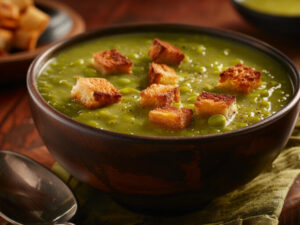
What bracha (blessing) do you say on soup with croutons?
It depends on a few factors. Normally, when two foods are mixed and eaten together, a blessing is recited on the primary food alone – which here is clearly the soup. The exception to this is foods made out of the five grains (wheat, barley, oats, rye, spelt). These grains, which in Jewish law are considered the staples of a typical diet, are almost by definition considered primary. When they are made into bread, they are the primary food of the meal, and once we recite ha’motzi on them, we do not make blessings on most of the other foods of our meal. Even when the five grains are made into foods other than bread – such as pasta or croutons, they retain a degree of primacy. They are usually considered the primary food of a mixture, and we recite a bracha on them alone.
Soup is a little more complicated because the noodles and croutons are typically added only to enhance the flavor and/or texture of the soup and are clearly not the main part of the dish. It therefore depends how many you add to your bowl. Here are the basic rules.
(1) If you add a significant amount of soup nuts to your soup and are interested in eating those as well, then you say mezonot alone. The soup nuts, since they are from the five grains, become primary and exempt the rest of the soup. Note that this is true even if you get a spoonful here or there without any croutons. We view the entire food as a single mixture – even the parts of it which do not contain the main ingredient. Even so, when you take your first spoonful and recite the blessing, you should make sure that spoon contains at least some croutons.
(2) If your main intention is the soup, and you just add a relatively small amount of croutons to enhance it and improve the texture, then you say two blessings – she’hakol on the soup and mezonot on the croutons. Although ordinarily we recite a single bracha on a mixture – on the primary ingredient alone, since five-grain foods are always significant, the soup nuts (or noodles) are not included in the other bracha but require their own. An additional point is that in this case you should first say the she’hakol on the rest of the soup (taking a spoonful without croutons) and only after mezonot on the croutons. The reason is because there is a possibility that the mezonot covers the soup, so if you’d say mezonot first, you would no longer be able to say she’hakol on the soup. (It’s even better to say a she’hakol on a different food altogether since again, there is a possibility that the soup really doesn’t require its own bracha.)
(3) If the croutons or noodles are very insignificant, you should not say a bracha on them at all. This could be the case if you are served a bowl of soup with a couple of noodles in it that you hardly notice and certainly don’t consider a significant part of it. Another example is if you’re given soup with a tiny sprinkling of croutons at the top – seemingly more there for decorative purposes than to actually add to the dish.
Before closing, let’s quickly address two other relevant issues. What is the bracha on the soup itself? Chicken soup and meat soup will generally be she’hakol (although again if they come with noodles, the above rules would apply to them). Vegetable soup will generally be ha’adama, but if it’s a watery broth or the vegetables are pureed, she’hakol.
Lastly, chicken soup in particular is generally eaten as part of the Friday night Shabbat meal. Since that meal begins with challah and ha’motzi, we do not recite a bracha on the main course foods eaten in that meal at all, including the soup.
(Sources: Shulchan Aruch O.C.205:2, 208:2; Mishna Berurah 205:11, 208:23; V’Zos HaBracha, pp. 117-118.)
→ Ask the Rabbi a Question ← Click here to comment on this article