








 What Repentance Really Means in Judaism








Dragged before a sultan in 1834, Solica was told: convert to Islam or be executed. The 17-year-old girl paid the ultimate price, and her refusal continues to echo across generations.
In Fez, Morocco, there is a large, beautiful, 200-year-old Jewish cemetery. Among the pristine white graves sits a blue-tinted tomb venerated by both Jews and non-Jews. It is that of a 17-year-old girl known as Solica Hagouel (Hatchuel) or Sol HaTzaddikah (“Sol the Righteous”), who was executed by Muslim authorities in 1834 for refusing to renounce her faith.
Solica’s tomb, with three green-topped turrets and a horseshoe arch, includes an epitaph in both French and Hebrew. The French version says:
“Here lies Miss Solica Hatchuel, born in Tangier in 1817. Refusing to convert to the Islamic religion, Arabs killed her in Fez in 1834. She was torn from her family and the whole world misses this saintly girl.”
The Hebrew says:
“The gravestone of the righteous Solica Hagouel, a virgin maiden who publicly sanctified the Name of Heaven and was martyred in the glorious city of Fez in the year 5594. Here she is buried. May her merit protect us. Amen, may it be God’s will.”
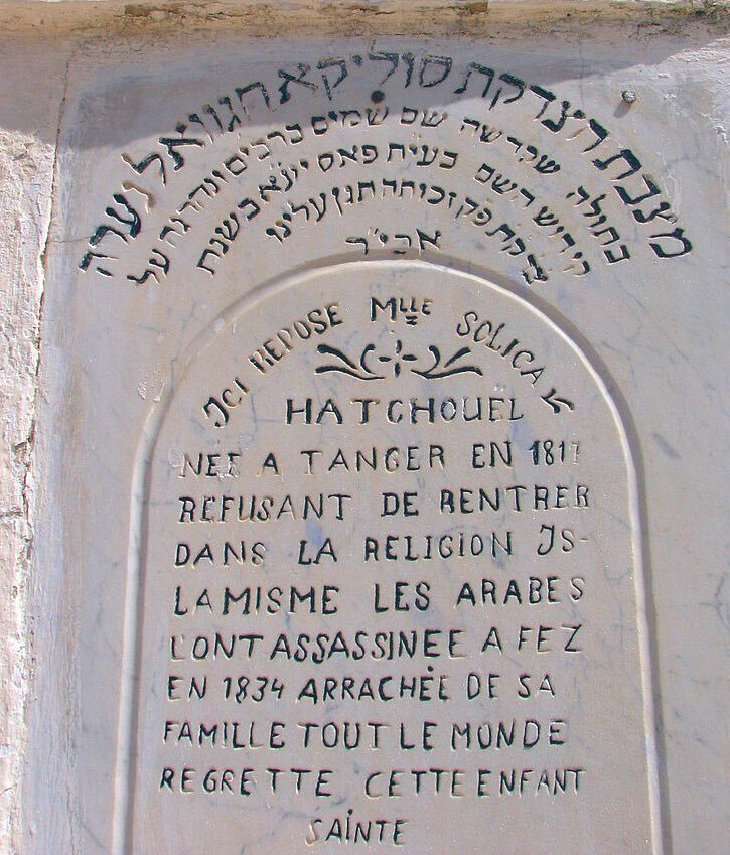 Epitaph at Solica’s tomb
To properly understand Solica’s incredible story, we need to first place her life in its broader historical context.
Jewish life in Morocco, like in much of the Diaspora, swung between flourishing and persecution. One of its brighter chapters came under King Mohammed V, who reigned during World War II. Defying the Nazi-aligned Vichy regime, he refused to deport Morocco’s 225,000 Jews, protected their rights, and preserved their synagogues and cemeteries — a legacy honored decades later by Jews in New York.
But that legacy stands in contrast to earlier eras. Morocco’s first independent Muslim ruler, Idris I, violently suppressed Jews, while his son Idris II adopted a more tolerant stance, turning Fez into a hub of Jewish life. That stability shattered in 1033 with a massacre of 6,000 Jews under Abu’l Kamal Tamim. Persecution returned under the Almohads in the 12th century, forcing conversions and exiles. The Marinid dynasty that followed offered relative tolerance but confined Jews to walled ghettos, or mellahs.
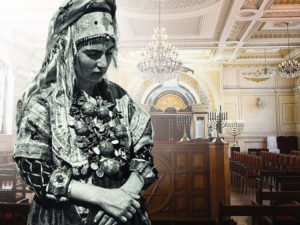
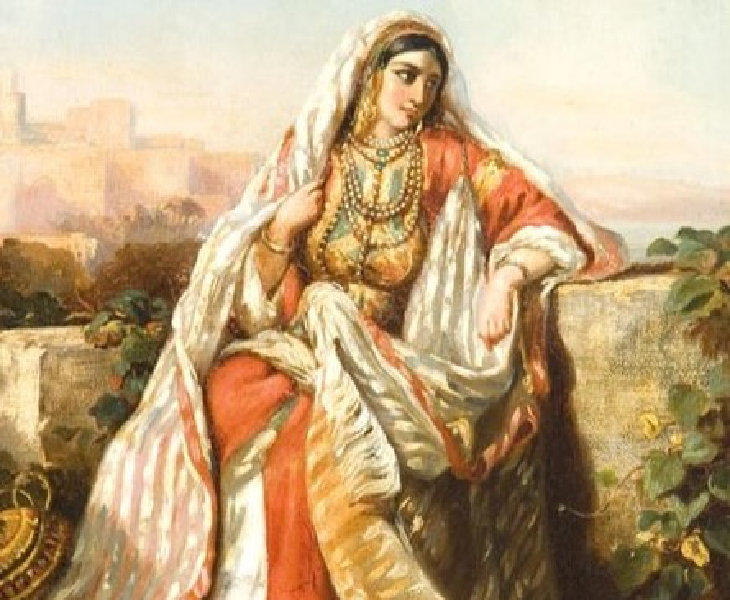 A Jewish woman in Morocco
Periodic violence continued — including mass killings in the 1400s — though Jews fleeing the Spanish Inquisition briefly revived Moroccan Jewish communities. Sultan Mawlay al-Yazid (1790–1792) renewed the brutal choice: convert to Islam or die. His successor, Sultan Moulay Abd al-Rahman, ruled from 1822 and enforced the standard discriminatory laws of dhimmi status, without curbing local persecution.
It was into this fraught world that Solica Hagouel was born — and where, at just 17, she would be asked to choose between Islam and death.
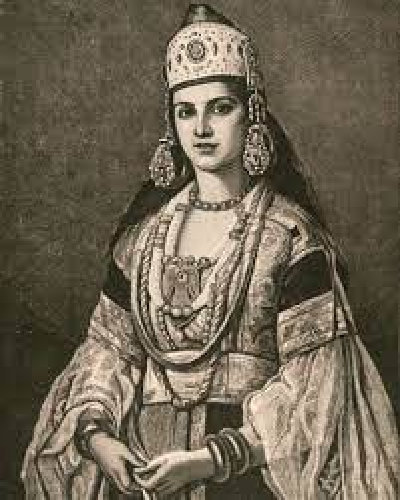
Solica (“Sol”) was the daughter of Haim and Simha of Tangier, and little sister to Yissachar. Writing in 1863, the Romanian Jewish explorer Israel Joseph Benjamin said that her Arab neighbors thought it was “a sin that such a pearl should be in the possession of the Jews....” Similarly, the Spanish writer Eugenio María Romero wrote that Solica’s “surpassing charms gained her the homage of crowds of admirers, who thought themselves happy in obtaining even a passing sight of this prodigy of Nature’s work....”
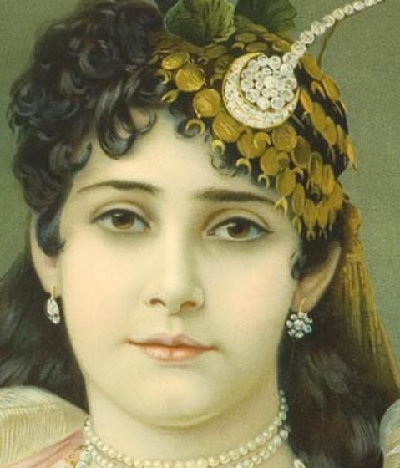 Lalla Sol ha’tsaddiqa (Solica), by Prosper Trojman
Romero wrote one of the most detailed accounts of Solica’s final days, El Martirio de la Jóven Hachuel, ó, La Heroina Hebrea, after returning from a trip to Morocco. First published in 1837, it is based on interviews with Yissachar, Haim, Simha, and other eyewitnesses. It is from this source that we will draw most of the story that follows.
Haim was a businessman, as was his son, while Simha kept the family home running smoothly. In that role, she insisted her daughter Solica remain fully engaged in household chores and off the streets, which led to some strain in their relationship. In search of a sympathetic ear, the young 17-year-old found herself periodically visiting the home of a Muslim neighbor named Tahra Mesmudi and sharing what was on her mind and in her heart.
As Romero notes, “Amongst the Arabs, the conversion of an infidel (by which name they designate all those who do not conform to their creed) is esteemed an action in the highest degree meritorious. This conquest to their faith, therefore, they make wherever an opportunity is open to them, by the most indiscriminate and unscrupulous means….”
So Tahra took full advantage of Solica’s tears to suggest that salvation from her mother’s unfair treatment was to be found in conversion to Islam.
The innocent Solica refused, according to Jewish sources.
But that was not the end of Tahra’s efforts. She went to the pasha (governor) of Tangier and claimed that the young Jewish maiden was on the verge of accepting Islam – if only she could be removed from the influence of her family. A soldier was immediately sent to tear the girl away from her parents and bring her before the pasha.
In a private audience, the pasha declared, “The great Allah has sent forth a ray from his transcendent light to win you to his religion, and to turn you from the errors of your own. This hour gives birth to your happiness.”
When Solica remained silent, the pasha was surprised and confronted her with Tahra’s claims regarding her desire to convert to Islam and gain his protection.
With characteristic forthrightness, Solica responded: “You have been deceived, sir. Never did I express such a wish. Never did I yield to the entreaties and proposals of Tahra Mesmudi. I was born a Hebrew and a Hebrew I desire to die.”
The pasha would not be appeased. Based solely on the Muslim woman’s testimony, he declared Solica “convicted of a crime that death itself could scarce atone for.” However, he sent her to be confined in his own opulent residence, hoping his family and their wealth would make an impression on the young Jewish woman.
For three days, members of the pasha’s household tried to coax Solica with promises of a rich, powerful husband, a thousand slaves, and “all the precious things of Asia and Arabia” if she would but convert to Islam.
Still she refused. “Never will I abandon my God.”
Hearing of her response, the pasha again ordered Solica to be brought before him. If the carrot would not work, perhaps the stick would.
“I will load you with chains,” he threatened. “You will be torn by wild beasts and see no more the light of day. You will lie, perishing with hunger, and lamenting the rigor of my anger and indignation, for you have provoked the wrath of the Prophet, and slighted his laws.”
Solica replied, “I will submit tranquilly to the weight of your chains. I will allow my limbs to be torn asunder by wild beasts. I will renounce forever the light of day. I will die of hunger. And when every torture you can command has been endured, I will scorn your anger and the wrath of the Prophet since they are unable to conquer even a weak woman, and do but show your impotence in the sight of Heaven, whose strength you boast, to gain one proselyte to your creed.”
With that, the pasha condemned her to a dungeon on the edge of town. A narrow window in her tiny cell overlooked the street and it was through this that Solica one day heard the desperate voices of her parents. She called out to them and quickly reached through the bars to grasp their hands, weeping bitterly.
After some time, Haim and Simha gently asked if Solica intended to accept Islam.
“Never!” she answered, saying that she regarded her suffering to be atonement for failing to respect her mother.
Bribing the Muslim guard to look the other way, Haim, Simha and Yissachar spent the nights speaking with Solica through the bars.
Romero describes the scene poetically:
“Who shall describe these afflicting interviews? Tears, sighs, broken words, every emotion of love and pity succeeded each other in quick succession; but the night vanished as rapidly as the day had wearily withdrawn, and the moment of separation arrived – the Muhammadan prison-keeper admonishing them to depart. They did so, torn with emotions that none but those who have loved, none but those who have suffered, none but those who are parents, can comprehend, and this night, and the day that followed, were spent in grief and agony.”
When Solica once again refused to convert to Islam, the pasha ordered further torture. Chains bound her hands and feet, an iron collar was placed around her neck, and she was dragged to a dark, dank subterranean cell. Though she was in constant pain, unable to stand, and her only bed was the damp ground, Solica was not broken.
In the meantime, the Hagouel family sought the assistance of anyone and everyone who could help get their daughter released. Eventually, they approached the Spanish vice-consul in Tangier, Don José Rico, who was touched by the suffering of the teenage captive. He petitioned the pasha on her behalf, noting ominously that the public was already very agitated over Solica’s fate.
The pasha, for his part, said that the matter was out of his hands. The Sultan of Morocco himself, Moulay Abd al-Rahman, had taken an interest in the case and demanded that Solica be brought before him in Fez. The pasha then called in Haim Hagouel, informed him of the situation, and coldly demanded that he pay the costs of transporting (and possibly executing) his imprisoned daughter. Hearing this, the righteous José Rico paid the required sum.
Five soldiers were assigned to convey that one young Jewish woman to her fate. But there was another, undercover escort as well. The family had hired a man to travel along with the odd caravan and keep an eye on Solica.
As Romero wrote, “About three miles of the journey were completed when there encountered them, as though by accident, a man who joined himself to the travelers.” Saying he was a trader on his way to Fez, he feigned interest in the prisoner’s story and even appealed to her to embrace Islam “as he himself had done.” But the supposed trader revealed to Solica through hand signals and Hebrew expressions the true goal of his presence there, while she asked him to convey her love and concern to her parents.
“All who saw the prisoner on the road, and were made acquainted with the particulars of her situation, earnestly exhorted and even implored her to become a proselyte to their faith,” according to Romero. “She heard them with quiet diffidence, and replied modestly to all the arguments directed to her that she would rather sacrifice her life than change her religion. So much courageous perseverance was the admiration of all who conversed with her, and her situation excited the greatest interest and sympathy wherever she passed.”
After six days, the entourage arrived in Fez and Solica was taken to the women’s quarters in the royal palace to rest, bathe, and prepare to meet the Sultan. After questioning the prisoner, the Sultan appointed a qadi (a judge in Islamic law) to rule on the obstinate Jew’s case. The qadi, realizing that intimidation by Muslims would not work, summoned a delegation of local rabbis to appeal to the girl. He added a threat of his own against the local Jewish community for good measure. One version of the rabbis’ interaction with Solica says that they indeed suggested she pretend to convert, while another version has it that they encouraged her to remain faithful to Judaism. In any case, she once again refused her captors’ exhortations.
Before the qadi announced his ruling, one of the Sultan’s sons was reportedly so taken by Solica’s beauty that he intervened to offer her the option of marrying him and becoming a princess – on the familiar condition that she accept Islam.
Yet again, Solica rejected the offer and said she would not betray her God.
The execution order was handed down immediately thereafter. Solica was to be publicly beheaded in the center of Fez. Romero described the atmosphere: “The Moors, whose religious fanaticism is indescribable, prepared, with their accustomed joy, to witness the horrid scene. The Jews of the city... were moved with the deepest sorrow, but they could do nothing to avert it.”
Before landing the fatal blow, the executioner used his blade to draw a little blood and then offered Solica one last chance to convert.
“Do not make me linger. Behead me at once,” the brave young woman called out, “for dying as I do, innocent of any crime, the God of Abraham will avenge my death!”
Solica HaTzaddikah was brutally martyred in 1834, but her legacy lives on in many ways. First and foremost in the many people around the world who carry her name and descend from the Hagouel family of Morocco. They may be called Sol or Solica and bear the family name Hagouel, Hatchuel or even the English-sounding Hatchwell.
Arab and Berber Moroccans refer to the Jewish teenager as Lalla Solica (“the holy lady Solica”) and believe that her tomb has the power to bring healing and fertility to the afflicted. For Jews, of course, the tomb is a site of prayer and veneration spanning generations.
Over the years, Solica’s story has been captured in various artistic and literary forms. While Romero’s account is a 19th-century documentary, there have also been novelizations, poems, ballads, artwork, and stage performances in a variety of languages commemorating her self-sacrifice.
The Jews of Morocco were a frequent subject of the mid-19th-century French artist Alfred Dehodencq, who lived in North Africa for an extended period of time. One of his most well-known paintings is called Exécution d'une juive, au Maroc (“Execution of a Jewess in Morocco”), of which he created multiple versions. Many art historians and scholars believe it was inspired by Solica’s well-known martyrdom, as it was being told and retold among the Jewish and Arab Moroccans he met.
 Execution of a Jewess in Morocco, by Alfred Dehodencq
Today, we can all take inspiration from the 17-year-old Jewish woman who demonstrated unwavering loyalty to her people and her faith.










What a wonderful woman!
I sincerely enjoy reading all of the comments posted as it opens new avenues of thought, with that said we are commanded " To Live by the Laws, loving G-d etc. NOT DIE by the laws of loving G-d with all of our might."
Might signifies Heart felt belief, G-d fearing etc. not necessarily to die as it's NOT what G-d is expecting or wants.
While this is primarily true, and a Jew is in most cases instructed to violate the Torah to save his life - there are notable exceptions, for example we must die rather than murder. And we must die rather than reject our G-d.
What are you quoting? Please reference your assertions.
Thank you
Unclear as to "We must die rather than murder"
As Per HALACHA we have the right to retaliate as stated providing its a PURSUER and if murder occurs than so be it.
See this book by the historian Sharon Vance,
The martyrdom of a Moroccan Jewish saint / by Sharon Vance.
Published Leiden ; Boston : Brill, 2011.
The story of Solica HaTzadikah brings to mind the argument that has lasted since the Spanish Inquisition. On one side, there are those who believe that giving one's life for one's faith is the highest form of sainthood. On the other hand, there are those who believe that. when given the choice to convert or die, converting to another faith gives the person the chance to continue living and, eventually returning to our faith and continue the Jewish lineage. Neither one is right or wrong.
The Torah actually states that the "right" thing in this instance is to give one's life.
Please tell us where the Torah states that.
It is a gemara in Sanhedrin - which if my memory serves me correctly derives it from the verse in the "Shema" (in the Torah) which states that "You must love your G-d with all your heart and all your nefesh (life)" - loving G-d with all of our "life" is understood to imply that if somebody demands that we reject our G-d's teachings or else give our life we must give our life.
Where in the Torah? What is the commentary and counter commentary?
NO. A foundation of Judaism is, if a Jew is given a choice of whether to be converted to another faith, or to die, he or she should joyfully choose death. As Rabbi Noah Weinberg said: "Think of what you are willing to die for - and live for it!"
Every Chanukah, we remember of the story of Chana and her seven sons. Each son was given this choice by the Syrian-Greek king, and every son chose to perish for his faith. When the youngest son's turn cain, and they can realize he was going to lose again, he brought the little boy close to him and whispered into his ear, "I am going to drop my ring near you. Bend down, pick it up, and it will look like you bowed to my idol." The little boy refused, and he and his brothers are remembered as heroes, over two millenia later.