




 How the Jews Changed the World

5 min read
7 min read
5 min read




15 min read


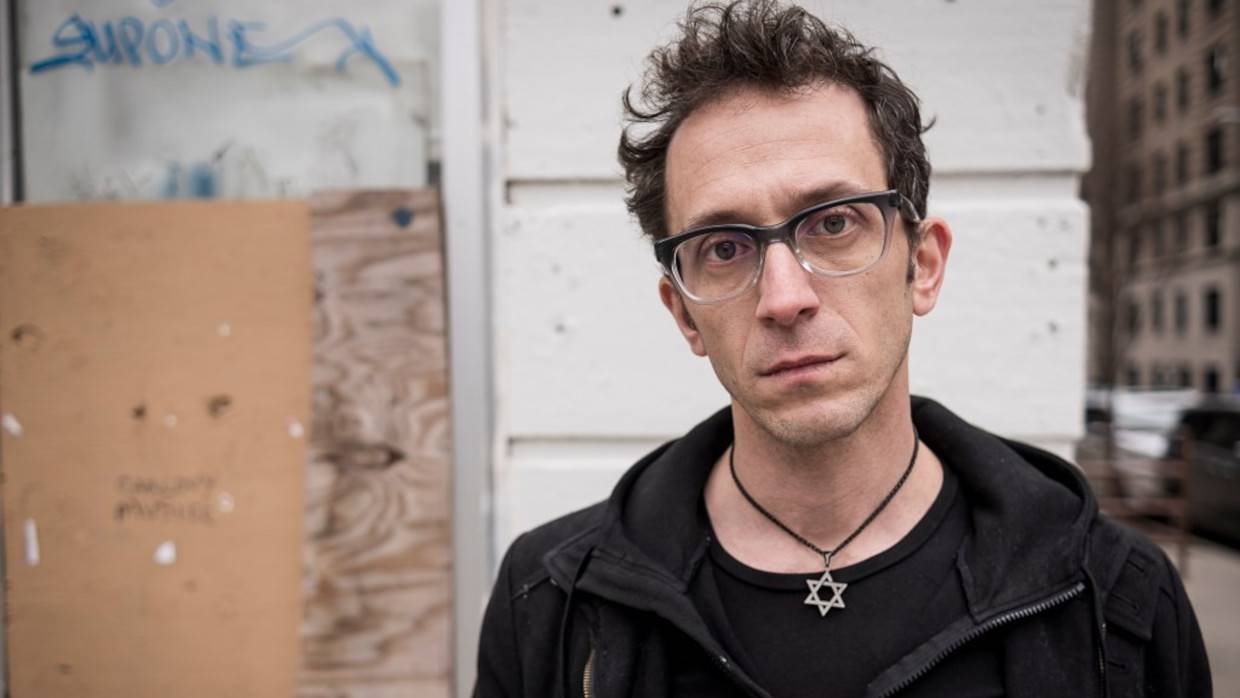
The Columbia Business School professor, who is presently barred from campus, encourages everyone to lean into their Jewishness and to stand up against hate.
A rare voice of reason in the current political climate, Dr. Shai Davidai, an Israeli Columbia University Business School Assistant Professor, has emerged as one of the leading voices speaking out against antisemitism and anti-Zionism since October 7, 2023. Through social media, interviews, articles, and most recently his podcast, Here I am with Shai Davidai, Shai holds up a mirror to American society - especially on college campuses - calling out double standards on Israel and critiquing the ways that school administrators often give a pass to extreme anti-Israel actions.
Shai grew up in a high-achieving, intellectual family outside of Tel Aviv. After high school, he served in the Israeli Navy, married, and moved with his wife, Yardenne Greenspan, to the US for school. Yardenne eventually did a master’s degree in creative writing at Columbia University; Shai graduated from Cornell then completed a Ph.D. in social psychology at Columbia. The couple have two children, speak Hebrew at home and visit Israel for months at a time, while their kids attend US schools.
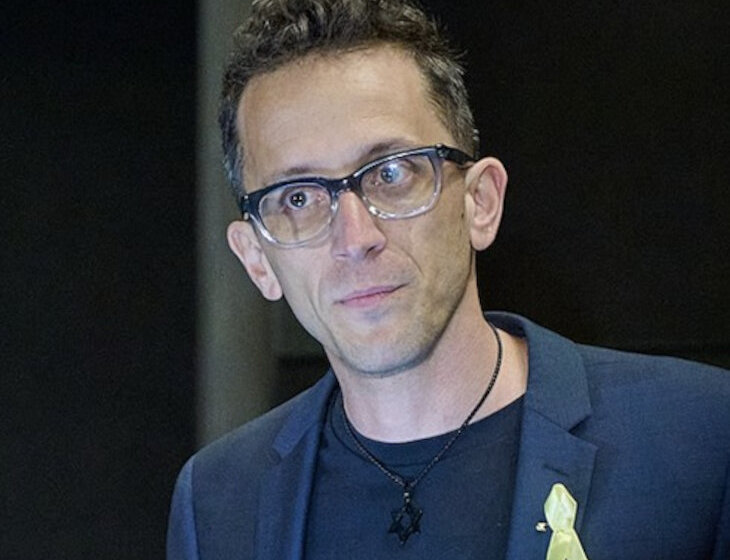
After teaching at Princeton, Shai took a job in Columbia University’s Business School in 2019. Though he loves teaching, he began to notice a double standard in American academia that’s often applied to Jews. “Inside academia, I never experienced much antisemitism,” Shai recalls in an exclusive Aish.com interview. But when it came to talking about prejudices that were directed at various groups, Jews never seemed to merit consideration. It was a conspicuous omission.
Antisemitism was seldom mentioned. “I used to have lots of conversations about important issues like racism, sexism, transphobia and other forms of prejudice. We had sensitivity training on these issues. But antisemitism was never brought up.” Shai noticed that antisemitism was left out of social justice discussions even during some of the most traumatic events for Jews in recent years, like after the Tree of Life synagogue shooting in 2018 and the synagogue shooting in Poway, California in 2019. “It was as if people were pretending antisemitism doesn’t exist.”
In the aftermath of George Floyd’s murder in 2020 and subsequent nationwide anti-racism and Black Lives Matter protests, Shai had been in so many discussions about the need to speak out against racism. The inability of his fellow academics to apply these lessons to hatred against Jews shocked him. After colleagues forcefully declared that “silence is violence” when it came to other groups’ struggles, Shai watched in disbelief that “all of a sudden we had open hatred against Jews on prime time TV and nobody said anything.” Shai posted his thoughts on social media, but they gained little traction.
Looking back, Shai realizes the marginalization of Jews was well under way before Hamas’ deadly attack.
While thousands of Hamas terrorists were still inside Israel, raping women, murdering civilians, abducting men, women and children on October 7, 2023, some groups on American campuses began to applaud Hamas’ actions.
At Harvard, a coalition of 33 student organizations signed a letter on October 7 “hold(ing) the Israeli regime entirely responsible for all unfolding violence,” thereby giving Hamas a pass for the horrific crimes its fighters were committing.
Columbia Professor Joseph Massad wrote a jubilant article that day - it appeared online October 8, 2023 - celebrating Hamas terrorists as an “innovative Palestinian resistance,” denigrating Israeli towns as “settler colonies,” and glorying in Hamas’ depravity. (In a sick irony, Columbia has assigned Prof. Massoud to teach a class about Jewish thought and Zionism during the current academic school year.)
Demonstrations at Columbia and other colleges just days after the attack praised October 7 as a “historic” victory and called for “glory to our martyrs”.

Amidst the nearly 100 encampments on American campuses and dozens of schools overseas, hate speech directed at Jews and Israel was common. The ADL catalogued over 2,000 “anti-Israel of assault, vandalism, harassment, protests/actions and divestment resolutions between June 1, 2023, and May 31, 2024, a staggering 477% increase” over the previous year.
At Columbia, antisemitism was rife. In a demonstration on April 17, 2024, protestors screamed “Al-Qassam (Hamas’ fighting force) you make us proud, kill another soldier now!” “We are Hamas”, and “We will never let up and we will never let down until Palestine is free, Zionism is destroyed, and Zionists start to hide like the Nazis.”
A few days after that protest, on Shabbat, students who looked visibly Jewish were harassed on Columbia’s campus. On April 21, 2024 Rabbi Elie Buechler, director of the Orthodox Union - Jewish Learning Initiative on Campus, advised students to leave campus for their own safety: “The events of the past few days…have made it clear that Columbia University’s Public Safety and the NYPD cannot guarantee Jewish students’ safety in the face of extreme antisemitism and anarchy…. It deeply pains me to say that I would strongly recommend you return home as soon as possible and remain home until the reality in and around campus has dramatically improved….” he wrote to over 290 Orthodox Jewish students.
A few days after October 7, 2023, Shai appeared at a Columbia University demonstration and asked students to film him. For ten minutes, he spoke from the heart, putting into words what Jewish students and parents across the country were thinking. He was speaking not as a professor, Shai explained, but as a father who was worried for his kids. In impassioned tones, he criticized university presidents and administrations for failing Jewish students by not taking strong action against anti-Israel demonstrations and groups.
I have two beautiful children and I’m speaking to you as a dad and I want you to know: We cannot protect your children from pro-terror student organizations because the president of Columbia…because the president of Harvard University, the president of Stanford, the president of Berkeley, they will not speak out against prot-terror student organizations.
And yet to the pro-terror student organizations on campus, here and at Harvard and at NYU, and at Stanford and at Berkeley and Northwestern…my two year old daughter is a legitimate target of resistance. That is what they are saying, you’re allowed to murder and kidnap my two-year-old daughter in the name of resistance and none of the presidents of universities all around the country are willing to take a stand….
Imagine not being able to go to your work because your boss does not value your life, because your boss supports pro-terror organizations…
This dramatic cri de coeur went viral. “I don’t have a word to describe what I was feeling other than pure and raw pain,” he recalls. “Something inside of me had cracked and my entire being was spilled out…. I had to speak up and had to make the world aware of what was going on. The fact that so many people saw themselves and heard their feelings resonate in me is very difficult. I’m grateful that other people see me as that voice, but for me that wasn’t my plan.”
In the weeks and months since that first impromptu video, Shai has become more and more active, calling out antisemitism at Columbia and at other college campuses.
“It’s almost like there were three different Columbia Universities that splintered on October 7,” Shai explains. “There were Jewish and Israeli students who were shocked and grieving. Their pain was palpable: whoever you talked with, it was like sitting in a communal shiva.
“Then you had the opposite extreme: you had this excitement and glee among students and staff and faculty” who oppose the Jewish state. Shai notes that he personally considers himself pro-Palestinian and would like to see a two-state solution, but “that wasn’t what we were seeing on campus” where attacking Israel and Israelis seemed to be celebrated by people who glorified in Hamas’ violence.
Most people on campus fell into a third group, who didn’t feel as personally affected by Hamas’ attack. From this majority on campus, Shai describes, came “complete silence” and a “moral vacuum.” Most people failed to condemn Hamas forcefully, allowing the most radical anti-Israel voices to dominate campus.
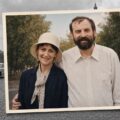
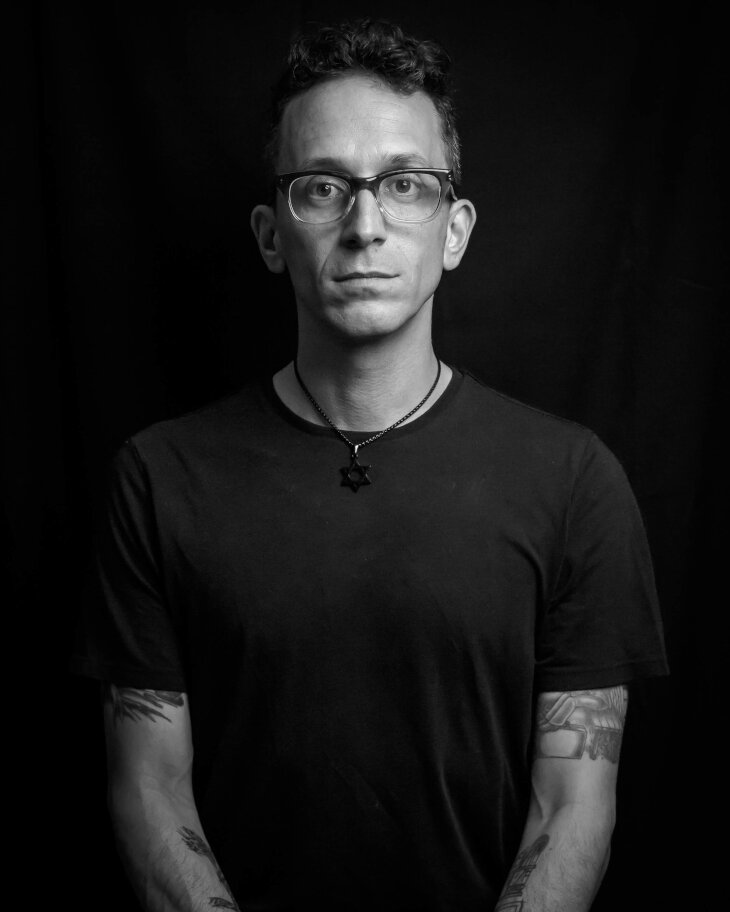 Prof. Shai Davidai (photo by Elyte Barzilay)
Shai blames academics and other professionals for not taking a strong stand against Hamas. “Even those who saw Hamas for what it is, a US-designated terrorist organization, were afraid to say anything. They were afraid to speak up about what they were seeing on campus. This went from the president of the university to the board, all the way down to the professors.” Colleagues emailed Shai offering sympathy, but again and again these same professors failed to take a stand.
He spoke with one senior administrator who told Shai that he agreed with him: it was shocking and wrong that some professors and students on campus were glorifying Hamas and justifying the October 7 attack. “I told him if you agree with me why aren’t you saying anything?” Shai recalls. “He said the optics are bad. That really shocked me. The optics were bad because you had a cis-heterosexual male calling a woman of color (Dr. Minouche Shafik, the then President of Columbia University) a coward.” It was as if Jews were expendable.
Shai has been banned from campus for speaking out. The first time came last year. After he threatened to enter students' self-declared "liberation zone" on campus in April 2024, Columbia deactivated Shai's security card for a month, preventing him from accessing Columbia's main campus. It was reinstated, he described, with "no apology" and "no explanation."
Now, Shai finds himself banned again.
On October 7, 2024, the one-year anniversary of Hamas' deadly assault, Shai watched in horror as hundreds of Columbia students walked out of classes to protest Israel's war against Hamas. Gathering on campus, protesting students wearing keffiyehs and with masks over their faces waved signs reading "We will honor all our martyrs," "Free Gaza free speech," "Break the chains and let them fall," and called for boycotting and divesting from Israel. As the crowd swelled, Shai found Columbia's Chief Operating Officer Cas Holloway and Assistant Director of Public Safety Bobby Lau, and filmed himself questioning them heatedly, asking why they were allowing this mass walkout, in clear contravention of Columbia policy.
"You are indifferent, and you know what?" Shai asked Mr. Holloway angrily, "Hatred happens when people like you are indifferent. You are the Chief Operating Officer of Columbia; do you realize that? ...You have to do your job. And I will not let you rest if they won't let us rest. You have Israeli students crying."
After these and other exchanges, Columbia University barred Shai from campus, insisting that he undergo "appropriate training on (Columbia's) policies governing the behavior of...employees" and sign a gag order about the training before he could return. Shai declared that he would undergo training in university protocol but refused to sign a gag order about it. While professors who flouted university rules by calling for violence against Jews and Israel face little or no repercussions, Shai remains barred from entering campus.
Shai’s professional research focuses on forces that shape people’s perceptions and opinions of the world. His academic background has equipped him to analyze some of the extreme antisemitic and anti-Israel hatred around him. He sees a confluence of factors.
“In the US, for the past 15 years I think we’ve been seeing a shift towards radicalism as a goal, not a means. The goal is disruption,” Shai notes. “They say burn it all down (and)....the system is corrupt at its core.” Unlike in some student causes of previous eras, today’s anti-Israel protests often have no tangible goal beyond shock and disruption.”
Another issue Shai observes is some radical professors who are deliberately indoctrinating students and implicitly encouraging campus confrontations.
He also notes that the rise of social media helps narrow people’s views. “Most students are receiving news from social media sites, including TikTok,” Shai explains. This promotes a simplistic view of complex realities.
Finally, he notes that peer pressure plays an outsize role in radicalizing students. “We know that peer pressure is strongest between ages 15 and 25, when the need for social acceptance is highest.” With extreme anti-Israel demonstrations the norm on some college campuses, it’s inevitable that students will take part in order to fit in.
Even though the current academic year has seen many fewer anti-Israel demonstrations, Shai explains there are still deep problems on college campuses. At Columbia, for example, 2025 began with masked protestors bursting into a class on the History of Modern Israel and filming themselves denouncing Israel and distributing copies of offensive flyers. One depicted a boot stepping on a Jewish star and the slogan “Crush Zionism”. Another showed a picture in a keffiyeh burning an Israeli flag with the slogan “Burn Zionism to the Ground.” (One student has been suspended and the university is continuing disciplinary hearings of the others.)
In January 2025, Columbia Business School adjunct professor Avi Friedman resigned, citing a hostile campus climate for Jews. He also cited having Prof. Joseph Massad, who enthusiastically celebrated Hamas’ attack, teach the class “History of the Jewish Enlightenment” during the current semester, as a factor creating a poisonously antisemitic atmosphere and a reason for his resignation.
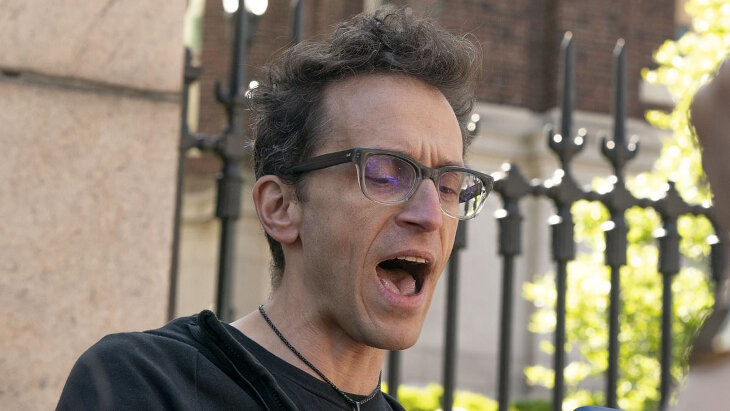
Though fewer in number, Shai observes that anti-Israel activists are becoming even more radical. “They say we stand with armed resistance, they read out (former Hamas leader Yahya) Sinwar’s last will and testament in a student event recently. Just because you don’t have takeovers of buildings and encampments doesn’t mean the problem is gone. I don’t believe we would set the bar so low - having a lack of violence on campus - for any other community.”
“Israel will never return to October 6, 2023,” Shai explains. “If it does, then it means the leadership of Israel has failed.” Israel must emerge from Hamas’ attack stronger - and so, he believes, must the Jewish community. In their own home, Shai and his wife have made a number of changes over the past year and a half. Though they never considered themselves religiously observant, they are now embracing many Jewish traditions.
If you don’t work to preserve your Jewishness - and that means different things to different people - both in the family unit and in the wider Jewish community, then your Jewishness will disappear.
October 7 “hasn’t changed my (Jewish) identity,” Shai notes, but “it’s changed my practice. I like to think of it this way: my Jewish identity was kind of fuzzy, and October 7 gave me a pair of glasses. I can see my identity in higher resolution. One thing that has come into focus is the idea that if you don’t work to preserve your Jewishness - and that means different things to different people - both in the family unit and in the wider Jewish community, then your Jewishness will disappear.”
For Shai, that means he now makes Kiddush on Friday nights and is embracing aspects of a traditional Jewish Shabbat that he never thought of engaging in before. Shai no longer works on Shabbat, and makes sure he doesn’t use his phone on Shabbat the way he used to. He’s found that his kids appreciate their family’s new routines. “They look forward to Shabbat dinner. Now that we make Kiddush, we bless the challah…there’s a little more anticipation on their part for Shabbat. For me already on Wednesday there’s a little bit of ‘oh, I can't wait for Shabbat.’”
He doesn’t stress too much about where his new Jewish practices might lead. “I treat it as a work in progress.”
 (Photo by Daniel Davidai)
He’s keeping up his busy schedule, teaching, writing, and showcasing Jewish, Zionist, and Israeli voices on his podcast. He’s also working on a book. “I promised my wife around May or June 2024 that I would make myself redundant, that Jews and non-Jews would speak up. I feel I am slowly succeeding; I feel there are people who are aware of what is happening in the universities and are beginning to speak up.”
How can we all stand up against antisemitism and anti-Zionism? Shai has three concrete suggestions for steps we can all take.
Jews in the Diaspora are engaged in a battle too, today: a battle to convince others that Israel has a right to exist. Shai advises students and others to hold mock debates with family and friends about hot-button issues related to Israel. “If you can’t convince your friend that Israel’s not committing genocide then there’s no way you’ll be able to stand up to a professor and 20 protestors in keffiyehs and convince them.”
View this post on Instagram
Facing rising antisemitism? Find your voice and community with United Against Antisemitism (UAA) on Aish+. This safe online space empowers Jewish students and young professionals with resources, expert guidance, and a supportive network to navigate today's challenges and build a stronger Jewish future. Click here to join and turn adversity into strength.
Featured Image by Stefano Giovannini









Given the history of anti-Semitism at Columbia going back to the institution of numerus clausus under Nicholas Butler and the blatant tirades of Edward Said, why is anyone surprised? Meyer Shkolnik had to change his name to Robert Merton in order to join the Columbia faculty; Alfred Kazin wrote about the difficulties he faced as a Jewish professor there. Columbia should hang its head in shame.
As tragic as 10/7 was, the best thing to come out is so many Jews are returning to their heritage. I had no idea Shai and his family became more observant. That brought me to tears. He is truly the Mordechai of our generation. All it takes is one Shabbat and we will all be redeemed.
Your homework assignment: Read "Ross Perot, Foot Soldiers, and Bringing Redemption to the World"By Areyah Kaltmann
Available online; free.
Great article that explains this crisis well. One sentence is problematic: "Jews in the Diaspora are engaged in a battle too, today: a battle to convince others that Israel has a right to exist." Do NOT engage on this topic. Doing so indulges the haters. "Israel has a right to exist" is not up for debate. Do people debate about whether China, Iran, Sudan, North Korea, France, etc have a right to exist? No. Instead, debate the lies. Israel is not, in fact an apartheid state.
Similarly, do not debate if Israel has a right to defend herself. No other country has to defend such a right.
I am a conservative, evangelical Christian who would like to help and support Dr. Davidai in his fight for the right of the people and the land of Israel, no matter what nation they reside in. I am DISGUSTED that this is happening in the United States and want to know what can we do in a tangible way? Does he have financial support? Is he able to pay his bills and take care of his children. We, behind the lines, must help and support those on the front, fighting the battle, and I believe many of us are willing to do so.
I am an instructor at a midwestern conservative, secular college. Our students are afforded free speech but not at the cost of others. Our leadership and administration would never allow this. The rot is at the top.
Were someone to define semitism for me I would decide whether I am for or against it. What exactly is semitism? Who are the semitic peoples and what does semite mean?
Semitism, as such, does not exist. Semitic people are people who speak any of the Semitic languages, which include Hebrew, Arabic and Aramaic, all of which are phonetically related. They’re called “Semitic” since biblically all the people who speak them are descended from Shem, Noah’s third son.
Antisemitism is a term invented to denote Jew-hatred specifically. It was invented by a European, who either didn’t know or ignored the fact that there are other Semitic peoples in the world.
I hope that he sues that cesspool posing as a higher learning institute and I hope others also take legal action against Columbia. Their Arab president condoned and encouraged antisemitism and going after them financially can make them pay for their hatred.
I remember listening to Shai on some podcast just before last Pesach. He was saying a lot of good things, but then would return to being pro-2 state solution, meaning, taking the only JEWISH state on the planet & dividing it half so the 22 Arab (& 50 Muslim) states can have another state. This means ANOTHER HAMAS STATE would be on Israel's border, just like Gaza was when they activated the Oct 7 Massacre. Ahmad Shukan Saudi Amb to UN (1956), Awni Abd al-Hadi Sec Arab Higher Comm to Brit. Peel Commission (1937), Hamas Foreign Min Mahmoud Zahhar (2008), Syrian Pres Hafez al-Assad (1976), PLO leader Zahir Muhsein (1977) ALL ADMITTED there IS NO PALESTINIAN PEOPLE, so why is Shai in favour of chopping Israel in two & giving to a non-people?
Since 1948, 1,200,000 Israelis left Israel for USA, most disappearing. Why would it take PERSONAL PHYSICAL attacks/atrocities to make Shai understand that if his OWN Judaism isn't preserved, it will disappear? Shai's Judaism was initially some sort of nationalism that evolved into religious observance. If all Israelis would just go live in America, like Shai, then Israel could just disappear & everyone would be happy. Why is Israel needed? If it is needed, why isn't Shai there? Kiddush doesn't keep Israelis Jewish. If Jewish kids aren't in a Jewish school, they have a high chance of disappearing as Jews in America. Why wasn't kiddush & shabbat important for Shai when he lived in ISRAEL? IDF elites are blocking independent investigation of the IDF's Oct 7 failure.
Sometimes it takes a tragic disaster to make people wake up.
Without understanding the deep rift between secular Israelis—most of whom regard Israel as just another geopolitical entity on the map, which happens to have a majority of Jewish residents—and observant Jews—for whom Eretz Yisrael is the biblically promised Jewish homeland—one cannot hope to understand where Shai is coming from.
His recognition of the importance of identifying as a practicing Jew can't be appreciated without realizing what a great leap this is from his (probably) anti-religious background.
However, I agree that it's incongruous that he hasn't renounced the suicidal two-state "solution" after his firsthand experience with the vicious, unwilling-to-compromise enemy we have.
Give him time. Rome wasn’t built in a day. He is doing much more speaking out than most of us are. I’m thrilled he’s returning to his roots.
There was a two-state solution. In 1947/1948, at partition, two states were created, based on demographics, sized proportionally: Israel, a homeland for Jews living in the mandated territory, and Jordan/Transjordan, for Arabs living in the mandated territory. The so-called "Palestinians" were Arabs who didn't want to live in the Arab homeland, because Jordan was ruled by a Hashemite king, and they didn't want to be ruled by that king.
Too many students have received virtually no education in world history. When I was in HS in NY, we had to take 1year of American history and 2 years of foreign history.
Many students today have no grounding in that subject, so they buy the first information that they get. We need to educate all students about history and civics. This is not woke, it’s common sense in a democracy.
I attended a high school where white students were in the minority. The anti Semitism was never acknowledged. In fact, the Jewish kids went around chanting power to the people. I deeply resented being shunned as I was back then. When people spoke of minorities they NEVER acknowledged the Jews. Thank you Professor Davidai for speaking out as you have. Columbia University has become part of the poison ivy league.