







 Assimilation Disguised as Jewish Authenticity


6 min read
5 min read




Like the Macabees, Jews need to stand firm in the values Judaism brought to the world.
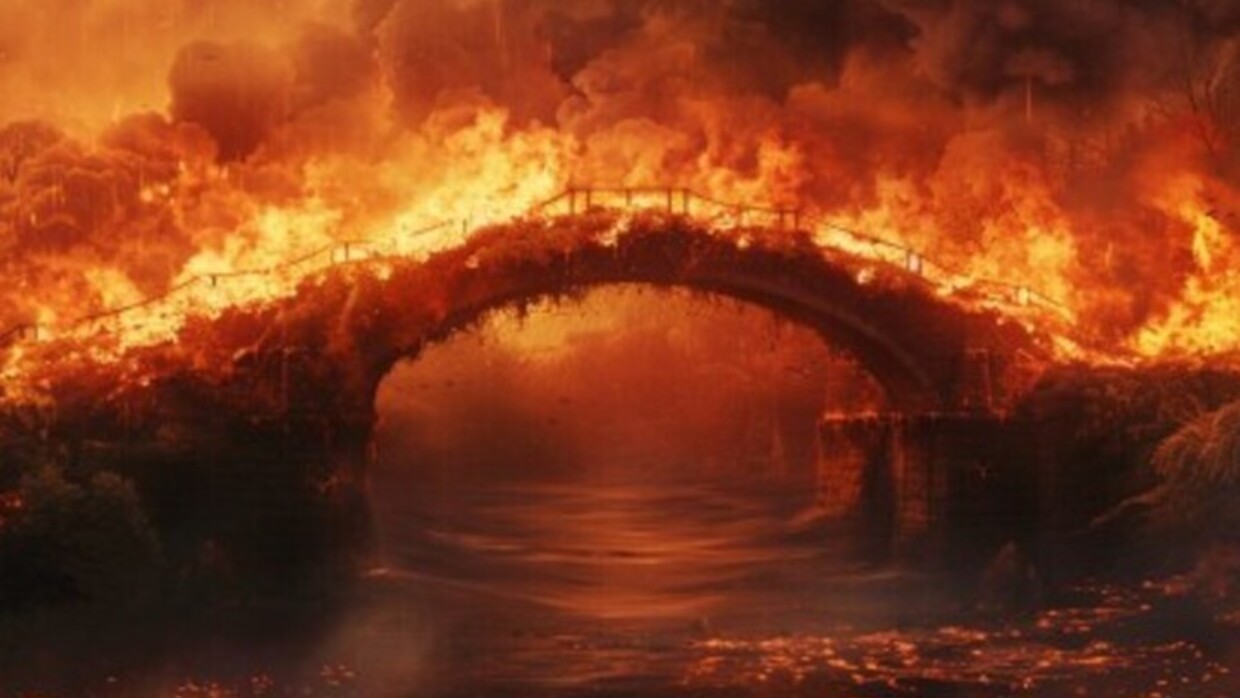
“May the bridges I burn light the way.” It’s a bold statement from Dylan McKay on Beverly Hills, 90210. The line resonates, not just for the rebellious bad boy who said it, but because it reminds us that standing firm in our values – even at the cost of comfort, relationships, or opportunities – isn’t about destruction. It’s about blazing a trail of truth, following it boldly, and illuminating it for others.
That’s exactly what the Maccabees did.
As the first flames of the Hanukkah menorah flicker tonight, we reflect on an ancient victory that carries profound meaning today. The Hanukkah story is more than a tale of military triumph; it is a spiritual manifesto recounting the clash of two worldviews: the Hellenistic glorification of power and beauty, and the Jewish ethos of divine purpose and ethical living.
This ancient conflict wasn’t merely about land or resources but about humanity’s purpose.
The Greeks sought to extinguish the light of Torah – the Jewish framework of sanctity, ethical monotheism, and moral responsibility. They banned Shabbat, circumcision, and Torah study, attacking the pillars of Jewish identity, purpose, and continuity. Their campaign wasn’t just against Jews; it was against the values Judaism brought to the world.
A recurring pattern
We see this pattern across history. From Pharaoh’s enslavement to Haman’s plot, the Inquisition, the Holocaust, Soviet purges, and today’s Islamist terrorism, evil always finds the Jews and seeks to eradicate their values.
Adolf Hitler (may his name be erased) understood this eternal values war with chilling clarity. He despised Judaism not just for its people but for its principles, which he saw as the antithesis of his ideology of might and conquest.
In Mein Kampf, he wrote: “If Germany frees itself from this embrace [of Jewry], this greatest of all dangers to the peoples can be regarded as crushed for the entire world.” He saw Jewish principles of compassion, love, and universal dignity as a direct threat to his vision of dominance and survival of the fittest. This recognition, in his mind, demanded a “final solution.”
In a 1941 conversation with the Mufti of Jerusalem, Haj Amin al-Husseini, Hitler explained, “This was the decisive struggle… Ideologically it [the war] was a battle between National Socialism and the Jews.” He viewed the war not merely as military but as a clash of opposing worldviews.
Antisemitism is not merely economic envy or social tension. It is a rejection of the moral and spiritual message Judaism embodies.
Radical Islamists, beginning with the Mufti who spent the war years as Hitler’s guest – and ally – in Berlin, and continuing until today, have taken up this mantle in the modern era, seeking to destroy Israel and Jewish influence as part of their war against the West and its ideals rooted in Judeo-Christian ethics.
Antisemitism is not merely economic envy or social tension. It is a rejection of the moral and spiritual message Judaism embodies.
Raphael Shore explores this dynamic in his book Who’s Afraid of the Big Bad Jew?, showing how Jew-hatred’s persistence, intensity, and universality demand we look beyond conventional explanations that cast Jew-hatred as just a regular bigotry or a need to find a scapegoat.
Jew-hatred reflects a recognition – often subconscious – of the transformative power of Jewish drive and values, which challenge oppressive ideologies and moral complacency.
Hanukkah teaches us not just why Jews are hated but how to respond. The Maccabees refused to despair or assimilate. They fought to preserve their identity, restoring the Temple and rekindling the menorah – a symbol of spiritual resilience. Their victory wasn’t just military; it was a triumph of light over darkness, of meaning over materialism.
This message feels urgent today. In an era of rising antisemitism, we must respond with moral and spiritual courage. Lizzy Savetsky has experienced this firsthand and has chosen to stand proudly as an unapologetic voice for Jewish values and identity. By doing so, she reminds others of the importance of embracing who we are and living our traditions with pride.
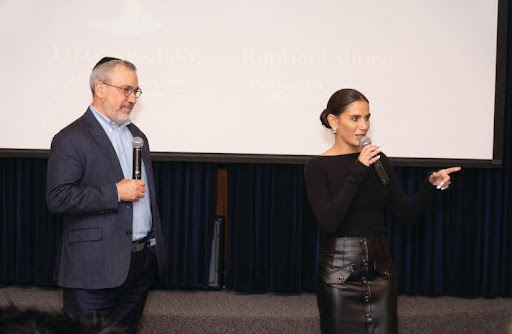
The writers take questions from the audience after a screening of ‘Tragic Awakening: A New Look at the Oldest Hatred,’ in New York City.(photo credit: HEIDI GREEN)
Hanukkah calls on us to recognize that embracing our identity is not just survival – it is our mission. This is the deeper meaning of “May the bridges I burn light the way” and of being “a light unto the nations.”
The Hanukkah story is about a small group with conviction standing against overwhelming odds. They risked everything to protect values greater than themselves. They burned the bridges of conformity and apathy, knowing what they stood to lose paled next to what they stood to protect.
This understanding shifts the conversation. If antisemitism is a rejection of Jewish values, then our response cannot be limited to physical survival or political advocacy. It must involve a rededication to the very principles that have made Jews targets throughout history.
As we light the hanukkiah, we remember: The battle between light and darkness is ongoing. The Jewish people have a sacred mission, and every generation – and each of us – must rise to it.
This means seeing today’s war against both Islamists and global double standards as not an isolated incident but as part of the oldest hatred. It means sharing Jewish values in a world starving for moral clarity. Jew-hatred is not a reason to retreat but a call to engage more deeply with our faith.
The Maccabees didn’t just fight for themselves. They fought for their values, their future, and the light that still burns today.
Each of us can be a vessel for light that dispels darkness. And we’re not just talking about taking a stand on social media – we’re talking about having conversations with friends, neighbors, and colleagues, even when it’s uncomfortable.
It means bringing traditions alive in our homes, not just as rituals but as acts that connect us to spirituality, meaning, and our identity. Lighting the menorah is not just festive; it’s a meditation on the living miracle of Jewish survival and the responsibility to keep that flame alive.
The Maccabees didn’t just fight for themselves. They fought for their values, their future, and the light that still burns today. As we honor their legacy, let’s stand together, proud and unafraid, burning the bridges that hold us back and illuminating the path forward.
One small light can push back a world of darkness. Today, despite the frequent hypocritical condemnations, Israel is shining a giant spotlight into the world. Together, let’s make that light shine ever brighter.
This op-ed originally appeared in the Jerusalem Post











I have never before read anything that states something so valuable, real, and amazingly significant in each sentence. This speaks to us Very LOUDLY! Thank You very much Aish! I have never related to anything this much and this speaks to who we are and what more we can become. Yasher Koach to the amazing authors.
To K.H., Chana, and Daphna: Thank you for your insightful responses. My compassion for the innocent victims of Hamas’ October 7th savagery is immeasurable. However, I cannot condone the sacrifice of Gaza children’s lives by Israel in support of beliefs that, to me, contradict the values of Judaism.
To Al tishoI: You not only made a false assumption about my motive for asking the question, but you attacked me personally for asking it. I remind you that a healthy discussion is characterized by a respect for diverse viewpoints.
As a pro-Israeli Jew, I’m having a difficult time reconciling our value of compassion and the indiscriminate bombing in Gaza that has unnecessarily killed innocent children. Please advise me how I may reconcile my dilemma.
Do you view the bombing of Dresden according to the same standard? What would have happened if Nazi Germany had not been defeated by the Allies?
And how about the US bombing of Tokyo (even without Hiroshima and Nagasaki)? The Japanese were the people who committed the atrocities in Manchuria, Korea, Nanking, Singapore, Bataan, Corregidor, San Juan de Deos Hospital in Manila, et cetera; should the US have invaded Japan and attempted to surgically excise the Japanese military (which surely would have cost hundreds of thousands of US military lives)?
Hamas's barbarity places severe limits upon compassion!
Unfortunately, at this late point in history, your compassion must first be extended to your Jewish brothers and sisters in Israel, who have extended themselves to the point of self-sacrifice, have given them Gaza, Hebron, Beit Lechem (which all, historically, were taken from the Jews), and have, nonetheless, been forced to live under military guard for 75-plus years just to exist. The stated mission of the Gazans and their pals is to destroy Israel, Israelis, Jews, indiscriminately. Israel does not bomb indiscriminately, but the Gazans undiscriminatingly put their own children and families into the fray, rather than trying to protect them. Your compassion for these poor children should properly lead to rage at the Gazans and their leaders, whose blind mission is to destroy your people
Your a priori conclusion of indiscriminate bombing is either born of ignorance or, far more likely, just you using a straw man to make an attack against Israel appear legit and born of noble intentions. Pull that stunt on the pages of The Forward with the other communists.
Please have in mind that we are dealing with an enemy who, as Golda Meir put it, hates us more than they love their children. Our enemies blames us, and so the western meida resonates, that we bomb children, schools, hospitals, mosques etc. Bud does the media mentions that they launch missiles from these places? that they harbor terrorists in these places (they even hid hostages in hospitals), that hospitals became Hamas headquarters, that terrorist move from place to place using ambulances?
They use every symbol of safety, of shelter and intentionally turn it into a place of war.
I also must add that a 14 year old Gazan militant has no moral superiority over a 19 year old Israeli soldier! but in case the former dies in combat, the media will report on the death of a child.
The first thing that changed my mind was learning what was built on the Temple in Jerusalem. And babies burned alive. And teaching 3 year olds to hate Jews. And a “ bible” that says kill everyone Jewish and Christian because they don’t believe like us. If this doesn’t make you think twice- I don’t know what will help you see facts and Truth. The hate is unbelievable- they want you dead only because you are Jewish.
Rabbi, you suggested we see a pattern across history, from Pharaoh’s enslavement to Haman’s plot, the Inquisition, the Holocaust, Soviet purges, and today’s Islamist terrorism, evil always finds the Jews and seeks to eradicate their values. Is it possible that Hashem gave the reasons you mentioned and for the nations at war with Israel to this day? With no land of peace, milk, and honey as promised on entering Canaan.
Could God have given reasons for these events in (Devarim 31:15-18) Thanks for your insight.
Clarity!
This is so very true. The Jewish nation is called to be a light unto the nations. In so doing, the customs of the nations are not to be lifted up. For example, the notion of santa breaks the first 3 commandments; and yet, within Israel this lie is often lifted up. It ought not to be! It is not harmless fun. It is a form of replacement theology: the God of Abraham, Isaac and Jacob is replaced by a false god who preys on our children.
Re: Santa being a false god. I agree with you 100%. As a child I never doubted that he was just a man in a costume. Even with the non existent religious education I had, I knew he was not part of my true belief.