Click here to buy
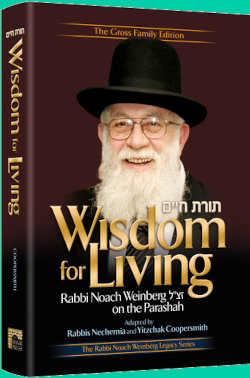
Wisdom for Living
Rabbi Noah Weinberg on the Parashah





We are in the month of Elul, which is an acronym for Ani l'dodi v'dodi li – I am for my Beloved and my Beloved is for me.
But would it not have been more appropriate to call the month Dalul, for Dodi li v’ani lo – my Beloved is for me and I am for my Beloved? This would seem to be a more accurate description, since Hashem, our Beloved, is the One who initiated the relationship with us, the Jewish people.
The reason why it is named Elul – Ani l'dodi v'dodi li – is because the way we relate to God defines how we perceive the way He is relating to us. Relationships are reciprocal, as King Solomon teaches, “Kamayim hapanim lapanim ken lev ha’adam la’adam – As water reflects a face back to a face, so one’s heart is reflected back to him by another” (Proverbs 27:19). When we love someone, we feel that they love us back, and likewise, when we resent someone, we feel that they resent us.
This principle applies to our relationship with Hashem as well. Ani l'dodi, if you love the Almighty, v'dodi li, then you'll see that the Almighty loves you. But if you have resentment – Hashem, You didn't treat me right, You don't appreciate what I've done for You, You are making my life so difficult – then you will think Hashem does not love you.
The spies are an example of this dynamic. After the spies returned from scouting the land of Israel and gave their evil report, they complained bitterly, as the verse says, "You slandered in your tents and said, 'Because of Hashem's hatred for us did He take us out of the land of Egypt, to deliver us into the hand of the Amorite to destroy us" (Devarim 1:27). On the words, "Besinas Hashem osanu – Because of God’s hatred for us," Rashi comments: “In reality He loves you, but you hate Him. As is commonly said, 'What is in your own heart about your friend, you project is in his heart about you.'”
What you feel about your friend is what you imagine he feels toward you. The same principle applies to God. If you hate Hashem, then you think He hates you. And likewise, if you love Hashem, you will feel that He loves you. That is the meaning of Ani l'dodi v'dodi li. Therefore, one of the main areas to work on during the month of Elul is loving Hashem, and in turn feeling His love for you. And this week's parashah gives us a powerful tool to accomplish that: gratitude.
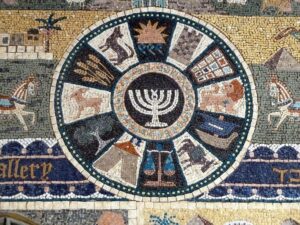
The beginning of the parashah introduces the mitzvah of bikkurim, bringing the first fruits of the seven species for which the Land of Israel is praised to the Beis Hamikdash. "You shall come to whoever will be the kohen in those days, and you shall say to him, 'I declare today to Hashem, your God, that I have come to the Land that Hashem swore to our forefathers to give us'" (ibid 26:3). “Hashem,” you proclaim, “I came to recognize that You gave me this Land and the gift of all these abundant fruits.” But that’s not all you say. On the words, "ve'amarta eilav – and you shall say to him,” Rashi explains that when you bring bikkurim, you should actually inform the kohen that you are not a kafuy tov, an ingrate.
Why do you have to tell that to the kohen? Isn’t it enough not to be a kafuy tov? No, you must articulate it and say it out loud. Speech is a bridge from the internal to the external. Speaking something out concretizes your thoughts and makes them real. Therefore, you have to say in the Beis HaMikdash – in the presence of the Almighty, to a kohen who lives with the reality of Hashem – that the Almighty has given you gifts with no strings attached. You have to look the kohen in the eye and convince him that you have genuine gratitude. He can tell if you mean it or not, if you are full of joy and think life is gorgeous – or not. And saying it out loud enables you to see where you are really holding, as well. There are no more pretenses.
After you state that you are not an ingrate, and you thank Hashem for bringing you to the Land of Israel, the kohen takes your basket of fruit and puts it on the altar. Then, you say out loud for everybody to hear, "Arami oved avi, an Aramean tried to destroy my forefather…" (v. 5) – the famous section that forms the backbone of the Pesach Haggadah, and describes how Hashem took the Jewish people out of Egypt and brought them to Israel. An essential part of a Jew’s hakaras hatov, appreciation, is giving thanks to Hashem for being part of the Jewish people, the one nation that is charged with the mission of bringing morality and wisdom to the world. "You shall rejoice with all the goodness that Hashem, your God, has given you" (v. 11) – including the privilege of being part of this great nation.
Gratitude is the foundation for every loving relationship, including our relationship with Hashem, and it is the first step to tapping into Elul's power of Ani l'dodi v'dodi li.
The parashah also contains the list of blessings that the Jewish people will receive if they fulfill the mitzvot, as well as the Tochachah, the litany of curses that describe the horrific consequences that will befall the Jewish people if they reject God and His Torah. The custom is for the baal korei in shul to read the Tochachah quietly. That forces us to wake up, pay attention, and really listen. If we listen to the Almighty, we will merit all the berachos.
In the midst of threatening the Jewish people with terrifying misfortunes, the Almighty says, “They will be a sign and a wonder, in you and in your offspring, forever, because you did not serve Hashem, your God, amid gladness and goodness of heart, when everything was abundant” (ibid 28:46-47). The Torah is stating the reason for all these terrible tribulations: because you did not serve the Almighty with joy.
The Rambam (Hilchos Succah 8:15) explains that even if you fulfilled all the mitzvot, learned Torah day and night, and worked hard on your service of God, if you did not do it with joy, you are worthy of retribution and deserve all these curses. To some people, this may seem like a shocking statement. Hashem, what do you want? I did all Your mitzvot; I worked diligently for you. Where is the justice? All this work, and this is what I get, just because I did not do it with joy?
It is critical to remember: God does not need our mitzvot. He is infinite, perfect, and there is nothing we can do for Him. He created us to give us the greatest pleasure and meaning possible. He gave us His Torah and mitzvot for our enjoyment and benefit. We mistakenly think that we are somehow helping God, doing Him a favor, by keeping kosher and observing Shabbos. And we wonder, “Where is God’s gratitude?” We are like the ungrateful child who complains that he has to hold the ice cream.
Life, Torah, mitzvot – it’s all for our benefit. Gratitude and joy are the name of the game. If we complain and kvetch, if we think we are doing God a favor, we are missing the entire point of existence. Ani l'dodi v'dodi li. We have a Creator who loves us, who made us and sustains us every instant. It is essential to remember that the Almighty loves us.
You wake up in the morning and the first thing you say is, “Modeh Ani – Thank God I am alive." Do you mean it? Tell it to the kohen. Speak to the Almighty, not to the wall. Don't just recite it as a formula. Recognize that life is gorgeous – and then thank the Almighty! Don’t be a kafuy tova. Look what He gave you: He gave you life, He gave you a Torah to teach you how to maximize life, and He charged you with a unique mission in the world. And He made you part of the Jewish people, who bring meaning, wisdom, and values to the world
Ani l'dodi v'dodi li. Appreciate how wonderful it is to be alive, how wonderful it is to have a relationship with God, and how wonderful it is to have a Torah. That is real teshuvah. Live with gratitude and joy, and you will receive all the berachos.
The shofar is blowing. It says: Wake up and be real; don't do things as a robot sleepwalking through mitzvot. Feel how gorgeous life is. For the remainder of Elul, when you wake up in the morning, say Modeh Ani with real intent. Convince the kohen that you mean it. Thank the Almighty for giving you the opportunity to serve Him. Connect to His love and be grateful for all the good He has given you. Say it, mean it, and it will change your life. Ani l'dodi v'dodi li.