







 What Two Hebrew Words Reveal About Israeli Democracy

17 min read
11 min read





No synagogue, no rabbi, no community. Just a family in the Idaho wilderness reading Jewish texts and figuring it out for themselves.
Joseph Cox’s parents discovered Judaism while living on a homestead on the banks of Salmon River in Idaho’s wilderness, off the grid and far away from any other Jews. His mother was raised as an atheist Jew, and his father was raised as a religious Christian.
“My parents had a good friend, Danny Gershenson, who was a professor of classics in Israel,” Joseph explains. “He was religious and suggested that reading the Code of Jewish Law was a great way to understand how to live in a pre-technological era. It tells you what to do: about washing things, where to put your bathroom, all kinds of stuff that we basically ignore nowadays because we have running water and electricity, and a lot of it is irrelevant.”
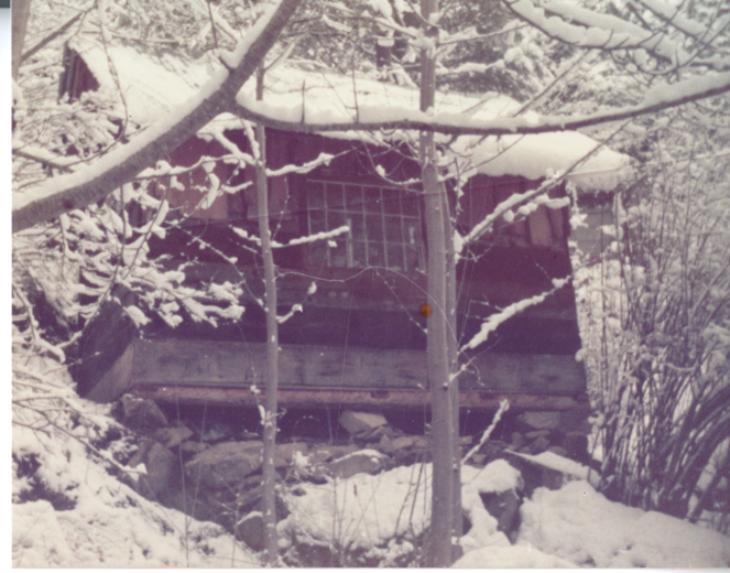 The shack my parents lived in
In the wilderness, the Coxes had to figure out how to harness the nature around them. They built their own house and even their own hydroelectric dam. They found the book on Jewish law helpful for practical reasons. “When they came across things that were spiritual in nature, they just ignored them because they weren't relevant to them,” says Joseph. Among the instructions the Coxes read and dismissed as “spiritual” was not to drink water left uncovered overnight. The book said something obscure about “evil spirit” that might settle in the water.
The next morning, when Joseph’s mother poured water from a pitcher left uncovered overnight, she discovered a dead rat at the bottom of the pitcher. The family was convinced of the wisdom of Jewish law. “That's how they came to the first mitzvah that they kept,” says Joseph.
From then on, the family took the book’s instructions much more seriously. They also added another Jewish practice: reading the weekly Torah portion. “They needed something to mark time because they just weren't able to keep track of the date,” explains Joseph. “Reading the Torah portion was very grounding and you could keep track of seven days.”
Joseph says, “My mother was very much a believer in reading texts very carefully. She was a philosopher, and she taught us how to do textual analysis in a very particular way. So the way in which they related to the text would have been quite a bit different than probably anybody else on the planet.”
All this took place before Joseph was born. The fourth child in the family, Joseph grew up religiously observant. He explains that while living in the wilderness in Idaho, his parents became more religious, “but it wasn't based on community or a desire for community. It was a very direct relationship with the Torah.”
Joseph’s mother, Chana (nee Berniker) Cox, was working on her Ph.D. in philosophy at Columbia University when she met her future husband, Rodney. Though descended from a prominent Rabbinical family from Poland, she grew up in a Jewish atheist socialist home in Detroit. Her native language was Yiddish.
Chana was well on her way to becoming a university professor when she married Rodney, a fellow Ph.D. student, and followed him to the Idaho wilderness.
Descended in part from Native Americans and in part from White Europeans who came to North America back in colonial days, Rodney Thomas Cox grew up as a religious Christian. Joseph says, “My father was kicked out of his own confirmation because he started laughing. He did not fit in that world.”
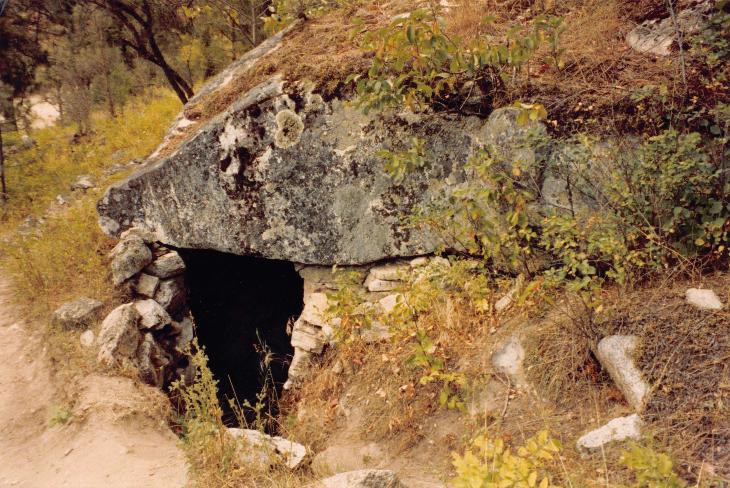 The dugout where my great grandfather lived
Born in Kansas, Rodney moved to Portland, Oregon, as a child. There, he met only one Jew – a boy who was adopted by a non-Jewish family in his neighborhood. “My father remembers thinking that there was something wrong with this situation, even though he couldn’t explain what exactly,” says Joseph.
Deeply spiritual, Rodney did not find fulfillment in his native Christianity. Inexplicably, he felt drawn to Judaism, but he didn’t want his conversion to be a meaningless formality. Even after he met Chana, “he didn't convert for my mother,” says Joseph. “He refused to. He considered that cheating.” Their wedding ceremony was secular.
Years later, as Rodney learned more about Judaism, he made a conscious decision to undergo conversion. The process was not simple for him. As much as he tried to learn basic Hebrew, he was unable to make much progress due to learning disabilities. The rabbis he’d approached were hesitant to convert someone without a rudimentary grasp of Hebrew. But Rodney persevered and eventually succeeded.
Unconventional in his learning style, Rodney was “brilliant, but he also didn’t think like those around him,” wrote Joseph in his autobiographical book, A Multi Colored Coat. “He didn’t get what others got. He couldn’t explain himself.” Often misunderstood as a child and young adult, Rodney found his happy place in his uncle’s cabin in rural Idaho.
Rodney’s uncle, Sylvan Hart, AKA Buckskin Bill, was a legend. Known as the last of the Mountain Men, he lived alone on the banks of the Salmon River in Idaho for decades. Rejecting civilization, Buckskin Bill built his own home, fished and hunted, and made his own clothes from hides, which gave him his nickname.
As a teenager, Rodney spent his summers with Uncle Sylvan. “There was an orchard across the river, and he would guard the fruit trees,” explains Joseph. “He would sleep under the fruit trees. The underside of a bear smells extraordinarily bad. When the bears came, they would stand up to reach for the fruit. And my father would smell them and wake up and alert my great-uncle that the bears were there. And then he would fire shots into the air, and the bears would run away.”
This quiet lifestyle, away from a judgmental society, appealed to young Rodney, and he convinced Chana to begin their married life in the wilderness. “My father is a deeply charismatic man. He is a force of nature,” says Joseph. Rodney persuaded Chana to visit the homestead, and “she fell in love with it. There was this idea of creating your own world. That was a big part of why they did it, and I think also why they ultimately had to leave. Because we're not here just to create our own world. We're here to change the world around us. And so they did eventually leave.”
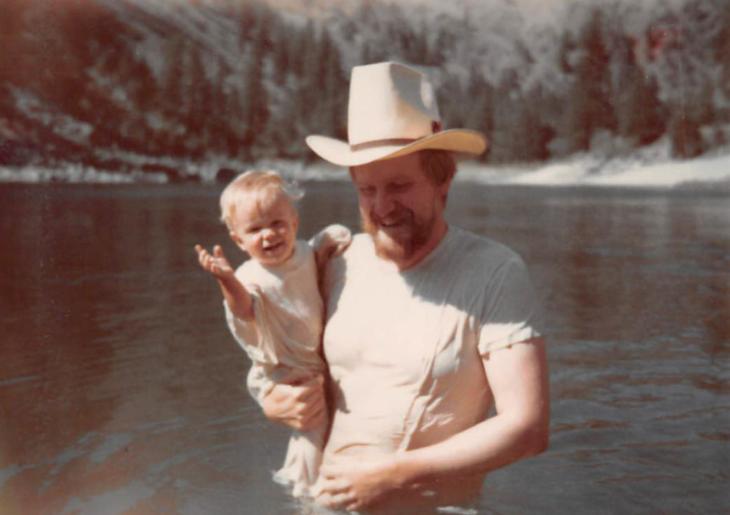 My father with Jeremiah
The impetus to leave the wilderness was a tragic accident. The Coxes’ oldest son, Jeremiah, fell off an all-terrain vehicle and was killed. Born a year after his oldest brother’s death and given the middle name of Jeremiah, Joseph has carried the effect of this tragedy throughout his own life.
By the time Joseph was born, the Coxes had moved from Idaho to a hill in rural Oregon. They had a family business, and Chana taught at a university. They could still enjoy their independence, but they were now within a short drive of the nearest Jewish community in Portland, Oregon.
The Portland synagogue was warm and welcoming. The Coxes attended the synagogue only on weekdays, because it was too far to walk on Shabbat. And they continued practicing Judaism in their own way, based on their own reading of Jewish texts.
Though the Coxes had distanced themselves from society, they cared deeply about other people. They often hosted guests: some for a Shabbat meal, some for a few days, and others for weeks or months at a time.
“Our Shabbat dinners weren’t like what most people are used to,” recalls Joseph. “It was this hillbilly combination. We'd have students and professors, and all sorts of internationally known preachers. My father would just meet people on a flight and invite them over, like a few hours before Shabbat.”
An average Shabbat meal at the Cox home was attended by about 15 people. Some of them were Jewish, and others weren’t. For the Coxes, it didn’t matter. And for the guests, it was a unique experience regardless of their background. “We'd throw the challah,” Joseph recalls. “It was part of the game, to surprise people. But my father also would take his knife out, cut the challah, then stab the knife into the table, because it was fun. We'd make the Grace After Meals the loudest possible thing you can imagine. We’d bang on the table so much that everything would jump and clatter. And it was just an extremely lively thing.”
Some of the Coxes’ Shabbat guests were regulars, showing up every week. There were also guests who stayed for extended periods of time. Joseph writes in his book:
[A] kid lived with my parents in Idaho, just after they were married. He lived in a dugout (literally a hole underground). He came in a troubled youth and after a summer of torching spiders with his lighter, left and became a successful airline pilot. More kids followed. Dozens of them. The vast majority left better than they arrived.
The therapeutic process, if you want to call it that, started with a simple ingredient: My father would convince these kids that their lives could have meaning.
Part of the experience in the Cox home was manual labor. Joseph’s father “believed that everybody, absolutely everybody, needed to make things.” Joseph’s cousin, who’d stayed in their home the longest, “dug our mikvah (ritual bath). By hand. Oh, and he also passed his GEDs.”
The guests enhanced Joseph’s own education. He feels that he learned a lot from them.
Joseph and his siblings were homeschooled, which resulted in a very broad education. He writes, “[W]e lived on a hilltop, but that didn’t mean we didn’t see other parts of the world as well. When we did travel, we never did the touristy things. Instead, our father would take us to see stock exchanges and banks.”
Joseph learned to read during the family’s weekly Torah readings. He recalls, “I would sit on my dad's lap, and he'd point at a word. He'd move my finger, and he'd start reciting them, and I would learn how to say the words. I couldn't read ‘garage,’ but I could read ‘Providence’ because I recognized that word.”
For elementary school, the Cox children received school curriculum and were expected to work through it on their own. Joseph writes:
Instead of actually working, we were reading magazines tucked in between the pages of our books. We’d slip them under the books if we heard our parents were nearby. Of course, the only magazines my parents had around were things like Forbes, Aviation Week, the Economist and the like.
I didn’t realize… that that had been the plan all along. My parents wanted us to feel like we were getting away with something when actually we were learning exactly the way they wanted us to.
Later, Joseph attended a private high school and took university courses. Then he attended the University of Pennsylvania and majored in Intellectual History, which “is all about how different people have thought about the world’s biggest questions across time and culture. Intellectual History taught me how to take a step way back in examining problems.”
Going to college and seeing society up close rather than from a distant hilltop was an eye-opening experience in many ways. Growing up, Joseph had met many different people who came to their home, but “there was definitely a sense that if you bent to social conformity, then you were abandoning truth,” he says. “So there was a very independent streak in my parents and in my siblings. Now, of course, it really limits what you can do in the world because you have to work with other people to change the world.”
This realization led to much soul searching. Joseph recalls, “It took me a while to understand that it wasn't a moral badge of honor to be a weirdo. My first girlfriend put it well. She said, ‘Be strange for reasons that are good, not just to be strange.’ She was right. We broke up shortly afterwards.”
Dating was another learning experience. With his unconventional background, Joseph soon realized that his search for a spouse would require unconventional means. At age 25, Joseph met Rebecca from Melbourne, Australia, online at an Aish Hatorah dating site.
Rebecca’s story is very different from Joseph’s but unique in its own way. She grew up in a Jewish home with a secular mother and a religious father. Her parents married later in life, and they somehow made their marriage work. Joseph says, “It was very important for my father-in-law that the kids make their own choice about what they were going to do.”
Rebecca made her decision at age 19, when she went on Aish Hatorah’s Jerusalem Fellowship Program. Inspired, she has remained religiously observant since then.
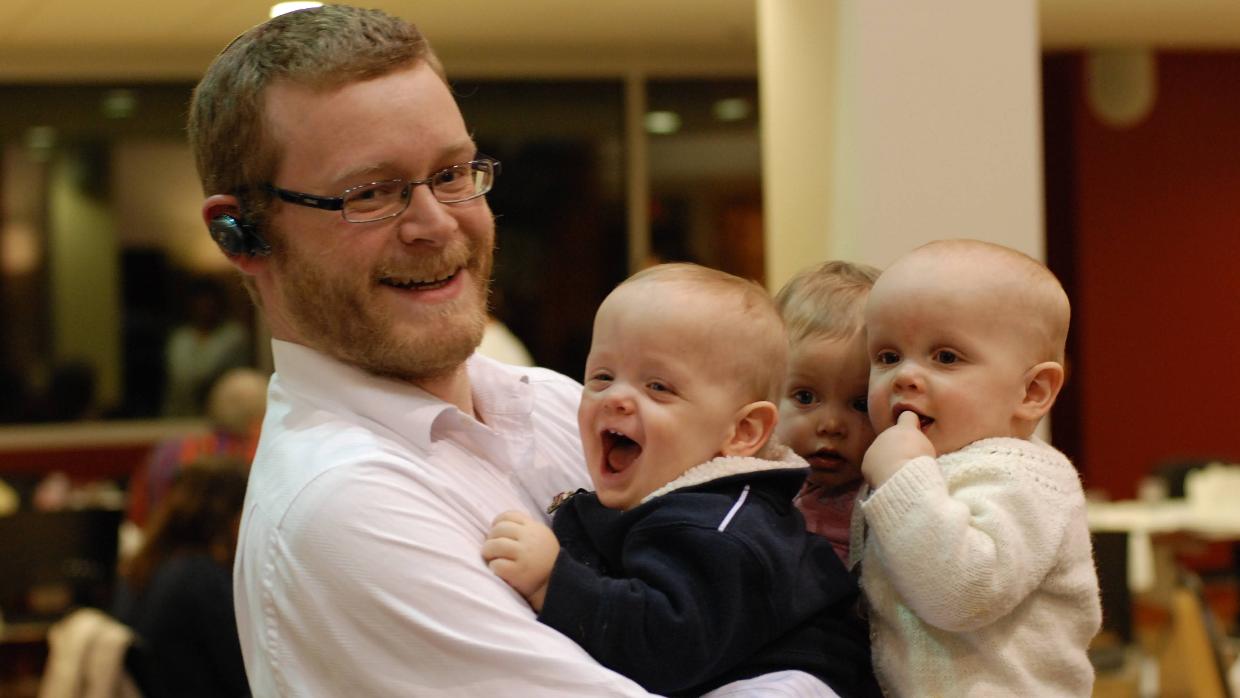
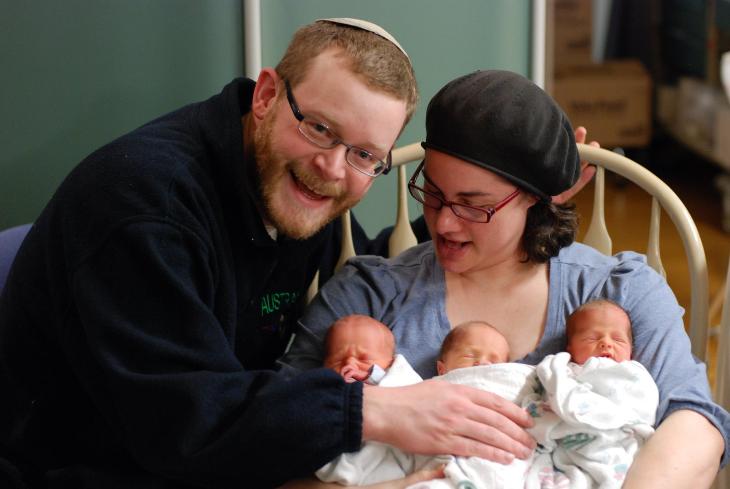 Joseph and Rebecca with their triplets
Joseph’s and Rebecca’s relationship began long-distance, first by email, then over the phone. “It started off intellectual,” says Joseph, “though not so intellectual, because I would describe the sunset each morning. But it was nothing personal, nothing physical. We called it a self-arranged marriage. We had this idea of figuring out what values were important to us. The most important thing we established was mutual respect for what each of us had to bring to the figuring life out puzzle and living it appropriately. For me, there was this intellectual side of things, but for Rebecca, there's this deeply practical intelligence. She just makes the world work. And she is an incredibly kind and thoughtful person.”
Among their mutual values was starting a family, but it took years to bring this dream to fruition. Joseph wrote, “It was the biggest challenge we’ve faced. It is also a struggle we talked about freely. We wanted people to know the challenges we were facing as we faced them. We didn’t want people going through similar issues to somehow feel ashamed or alone.”
After over five years of treatments and disappointments, Joseph and Rebecca had their first child, a daughter. Less than two years later, they had a set of triplets. Then they had two more children. They feel very blessed with their large family.
When Joseph’s oldest daughter was 6, he and Rebecca decided to move the whole family to Israel. Joseph describes their motivation as “mundane. We were in Oregon, which is the forefront of liberal thought in America, and we realized that we couldn't raise our kids there, specifically our boys. So we decided to come to Israel for cultural reasons, because it would be a better place for our kids. There was no religious Zionist intent in it at all.”
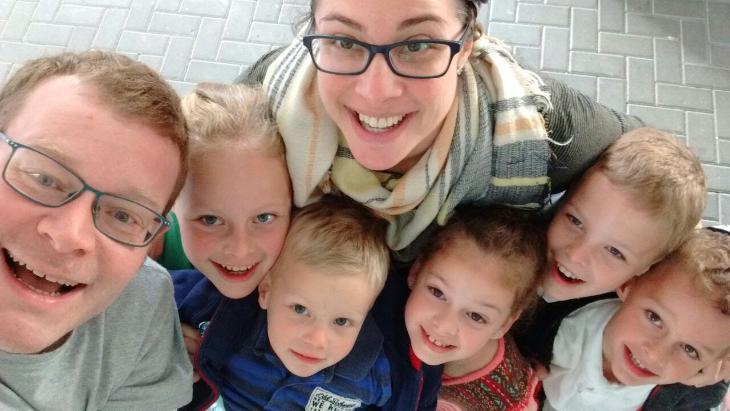
They moved to Modiin, because the city is very diverse: “the voting patterns here are the closest to the actual Knesset. So it's representative not of one ideal, but of the broad spectrum of ideals in Israel. We wanted our kids to be exposed to a variety of cultures.”
Joseph describes the move as “the best decision we’ve ever made.” He feels that living in Israel has been beneficial not only for his children but for himself as well. He says, “So far since we've been here, I've written 10 books and an enormous number of articles and speeches. Israel, whether it's the land, or the tension, or the energy, has resulted in me realizing and discovering an entirely different level of things that I can accomplish and do with my life personally.”
Joseph’s books are mostly fiction, in which he explores “how the world can be made better.” When he is not writing or speaking, Joseph works as a handyman, utilizing the skills he learned from his father.In his work and in his family, Joseph strives to perpetuate his parents’ legacy. His children are “very strong and very willing to do what's right, even if it's not what's socially expected.”







Wonderful story... I'd love to meet them, if they ever come to Shiloh
We were 7 people invited to dinner while living in Scappoose, OR. Channa was really angry but came through really well. We became life long friends after this. We never regretted it. With each visit we learned something new.We have a friend who made pizza for them while on the Salmon River. I have made a lot of furniture for them. We really miss Chana.
I had no idea this was how you met! But typical.
Another Portland connection. I was acquainted with the coxes when I was spending time in the Kesser Israel community in about 2002-2005. I knew they were an interesting family but I didn’t know the back story. Great to read!
This is incredibly inspiring and eye-opening! When I went to Israel with NCSY in about 1989, there was a Nechama Cox from Oregon as part of our group. I wonder if she's related...
Yup, my sister 🙂
Yes, Nechama is Joseph's sister
thank you for the article. I knew the Cox family during the times they interacted with the Portland Oregon community, where we have lived about 44 years, Our kids played with their kids, we visited for Shabbos, went to a daughter's wedding, and we're still in touch with Benjamin, one of their sons.
Jewish singer Eddie Fisher would have loved this. He was very proud of being Jewish. I met him many times and we was very nice.
I am so inspired by this dear family’s story! Thank you so much!!!
My husband & our 3 children live in rural Cocolalla, Idaho. We are currently Noahides (ex christians) studying the weekly Torah portions & reading Jewish books & wholeheartedly serving HaShem out in the woods. The closest Jewish community we have found is in Spokane, Washington.
We have been rejected by many christians because we celebrate Shabbat & Chanukah & the Festivals instead of xmas & easter. But, there are also a few friends who are very drawn to Shabbat and the festivals, & you can tell their inner sparks light up within them when we share about Torah, Rosh HaShana & other set apart days. HaShem is so kind & merciful to scoop us up and reveal His truth.
Stephany, you might enjoy my mom's book about Idaho. Doesn't talk much about Judaism, but it does share a lot about wilderness life on the Salmon River! I firmly believe there are many paths to Hashem. I hope you find success and meaning on yours!
Thank you so much! I would love to check out her book! It sounds so delightful. And thank you again for your encouragement!
It is A River Went out of Eden by Chana Cox. She wrote a number of books but this one would be most up your alley!
Just don't get so enthusiastic that you start thinking of or calling yourselves Jews until you convert through a real rabbi.
I've heard of too many "ex-christians" who believe that in finding the joy of Judaism, they're also free to adapt the faith to suit themselves. Most disrespectful, I think.
I fully agree. We want to serve and protect the Jewish people & Jewish culture from any appropriation. We want to support them in their mission to be lights to the nations. We know that we are not Jewish (conversions are not a casual thing). We gentiles are not “lights to the nations” & not a part of the family of Jacob & not able to participate in the promises that only belong to the legal descendants of Jacob.
We want any of our good deeds to be in the merit of Israel. On behalf of other ex-christians who’ve behaved inappropriately & given Noahides a disrespectful reputation, I apologize. Please forgive us. I know christians have contributed to so much pain, trauma, & religious persecution. We want to be a part of the repair, not further the damage.
I firmly believe Bnei Noach are not meant to be Jews lite. Everybody can walk in the path of G-d in their distinct ways and with their own emphasis. I believe the Torah says so little about the Bnei Noach because there is space for a great deal of variation and development. This is a discussion for another forum, but never think of yourself as second class in your relationship to G-d. You're just flying a different airline.
Thank you so much, Joseph, for your clarity & insight! I would deeply appreciate more of your wisdom on this subject if you ever have the time. We are currently joining Rabbi Chaim Richman’s Zoom classes on the book of Ezekiel & we enjoy sitting under his authority (even though we only interact online). It truly is challenging to find information & instructions for Bnei Noach outside of Chabad & the three part video series on Noahide laws by Efraim Palvanov. Thank you again for what you said about not viewing ourselves as lower class in our walk with HaShem. 😊
You can look me up at Stories that Celebrate
Shalom Joseph,
Thank you so much for sharing your inspiring family story! I was happy to read about how you found your life partner and have built a beautiful family together in Modiin. I've passed through Modiin many times during my visits to Israel, but I've never visited because I don't know anyone who lives there. I hope to be back in Israel again very soon when the inbound flights resume. I would love to meet you for coffee and share thoughts about life and your experiences! I have many friends in Judea and northern Israel. It would be great to have a new friend in the middle! 🙂
For now, I wish you and your family a safe, happy, and meaningful Passover!!!
Have a meaningful Passover as well! Look me up when our world opens up again 🙂
On a quiet dead end in the tranquil hills of Portland, we grew up across the street from the Cox family. I can still picture Rodney and Chana's extraordinarily well behaved children lined up on our couch, like little angels. Rodney's unsolicited advice to my parents, shouted from across the street: "Why don't you move to Tel Aviv?"
That was across from my grandparent's house 🙂 I don't recall us ever being angels though.
☺️
Yes and your mother and my grandmother shared experiences of what it was like to have religious Jews in the family.
I can imagine that, Nechama.
Wonderful article! Thank you!
If Joseph's mother was Jewish, why did he need to convert?
I didn't. My father did.
Right. And this is how Jewry has survived for so long when so few Jews wished to be Jews: converts. I don’t see why you’re so fixated on genetics when Jewry’s is clearly
mixed, to put it mildly.
I think 'spiritual genetics' are far more relevant and a little population diversity can help there too!
It is a very interesting story to hear, about this family's journey to Judaism, and the next generation
You might enjoy the book 🙂
Thank you for this wonderful profile!
So much relate to this saga. Secular upbringing, West Coast, Tshuva from the Torah directly, rural living, Aliyah, the children causing us to be woven into the fabric of Torat Yisrael, Am Yisrael, Eretz Yisrael. Kol Hakovod!
It does sound like there are a lot of similarities!
This family is full of awesomeness; and, this article too.
Great job, AISH! Well done. You let in a lot of sunlight through the window of AISH today!
More, please.
Very nice article. I am glad this family was able to relocate to Israel. It is very true that the political systems in the US are only marginally accepting of Jewish people, and only on the terms specified by the media and the talking heads.
Happy Pesach to everyone.
This is a beautiful story. Reminds me of 2 dear songs to me that should be played this time of year back to back......'Exodus" by Bob Marley followed by "Hatikvah". Happy Pesach everyone.
Great story! Interesting life and family.