








 What Two Hebrew Words Reveal About Israeli Democracy
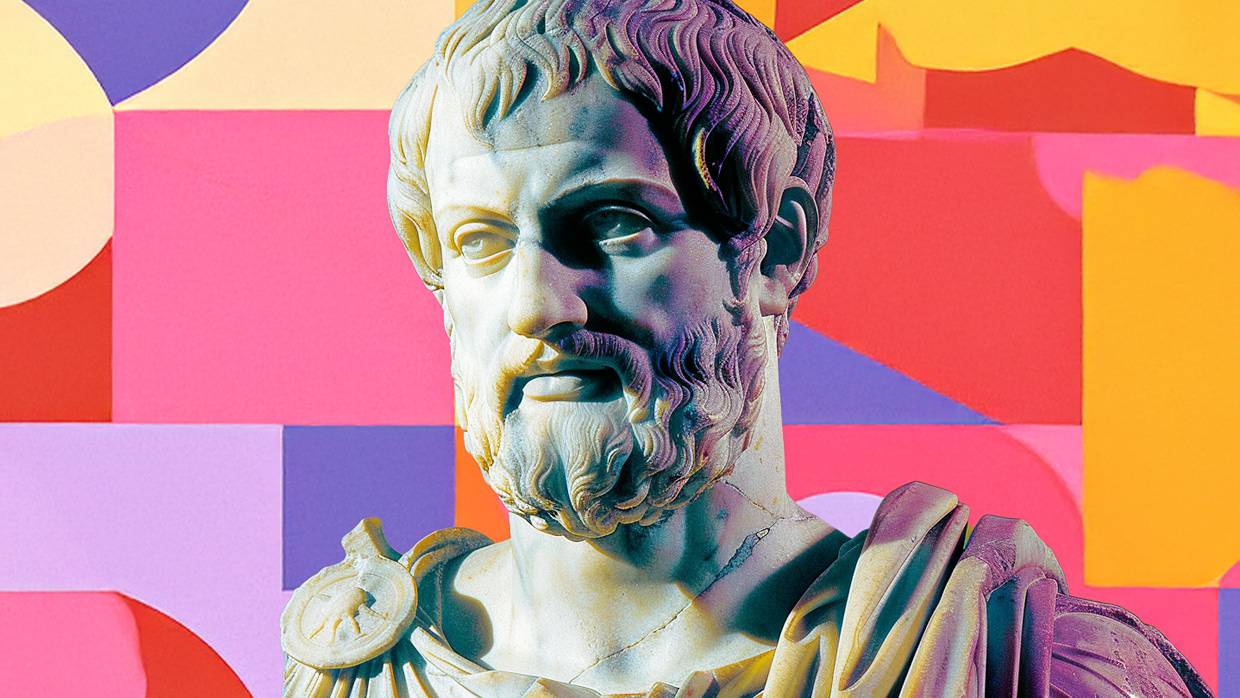






Aristotle, Genesis and the underlying philosophy of Hanukkah.
Don’t feel bad about the menorah’s modest flame getting drowned out by the dazzling array of Christmas lights. There’s a hidden depth beneath Hanukkah’s unpretentious lights that encapsulates the world’s first ideological battle between the mighty Seleucid Greek Empire and the small Jewish nation 2200 years ago.
During Passover, the Haggadah retells the Exodus story. On Purim we read aloud the Book of Esther twice, conveying in stunning detail the intricate story of how Queen Esther and Mordechai saved the Jewish people. But on Hanukkah, somehow the flames of the menorah are enough to tell the whole story. What, in fact, was the essential ideological battle between the Jews and the Greeks, and why does the flame encapsulate Judaism’s philosophical victory?
To arrive at an answer we need to go back to the beginning of all beginnings, the “Breishit bara Elokim – in the beginning God created” that opens the Book of Genesis.
Greek philosophy rejected the idea of creation. They believed the universe had always existed. Aristotle, the most famous of the Greek philosophers, maintained that the cosmos is eternal, stretching back forever. There was no beginning, no moment went it passed from non-existence into existence, and likewise there is no end. As he wrote, "The universe, in its totality, has always existed and will always exist." (Physics, Book VIII).
Aristotle rejected the idea of creation ex nihilo (creation out of nothing), asserting that something cannot come from nothing. Therefore, the world must have always existed, and will necessarily continue to always exist. This eternal chain means there is no "first moment" of time to which the past can be traced, nor a final endpoint that defines the future. There is no beginning or end to the past or future; they are infinite in both directions. The continuity of time implies that the past, present, and future are not discrete entities but are bound together in an endless sequence. And since they are eternal, there is no need to posit a Divine Being who created time and put it into motion.
Removing the Infinite dimension from the equation, Aristotle viewed the finite universe as being self-contained whereby the human being can use his rational thought to understand everything there is to know. He wrote, “The intellect is in a sense potentially all things” (De Anima, 429a18), suggesting that the human intellect has the capacity to comprehend all aspects of reality, able to form concepts corresponding to everything in the universe.
Judaism rejects this viewpoint, as the Torah proclaims with its very first word, “Breishit! In the beginning…” – time and everything that exists in the universe has a starting point. It began. But how could something come from nothing? It didn’t. It came from the Infinite Creator Who exists beyond time and space, the First Cause who is eternal and has no beginning. Time isn’t eternal; God is.
Time isn’t eternal; God is.
Like the author of a novel who constructs a world full of characters who exist only if the author creates them, every iota of existence stems from the ongoing and continued sustenance of the Creator, without which everything would cease to exist. Every moment of existence is a new act of creation, wholly independent from what preceeded it.
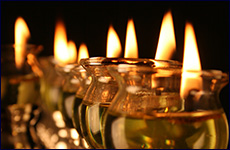
This is the deeper meaning behind the flame of the menorah, the central symbol that represents the victory of Hanukkah.
From a child’s perspective, a flame appears to be a static entity that continuously burns. What appeared a few seconds ago is the same thing that appears right now, and will continue to appear in a few seconds from now.
Now look deeper. The fire is consuming the oil. The flame from a few seconds ago is already gone. Every instant in the present moment is a new flame that requires new fuel to exist, and the future has not yet been created.
Every second of the flame’s existence is an act of new creation that is distinct and separate from what came before it.
The flame reflects the reality of existence. Every second is an act of new creation that is distinct and separate from what came before it. Pierce behind the veneer that enables one to mistakenly view life, like the flame, as just one continuous entity that was, is and will be, and perceive the transient nature of reality as one that is constantly being willed into existence every single instant as a new act of creation by the Infinite Source of everything.
After lighting the menorah, it is customary to recite the short prayer “Hanerot Halalu – These lights” which states that the entire purpose for kindling the lights is “to look at them in order to express thanks and praise” to God. Giving thanks highlights an additional outcome of the Jewish people’s victory over the Greeks and their philosophy. According to the Greek worldview, if existence is eternal and uncreated, to whom is there to give thanks? You are not a recipient of a benevolent Creator; you’re just the next cog in an endless stream of eternal cause and effect that has no Prime Mover.
According to the Jewish worldview, however, every instant is a new act of creation bequeathed by the Creator. Like the flame that exists anew only in the precarious present moment, Judaism is mindful that every breath we take is a gift from God. As the Medrash says, "Rabbi Levi in the name of Rabbi Hanina said, ‘For every breath that a person breathes, he needs to praise the Creator, as it says in (Psalms 150:6): Let every soul [neshama] praise Him, all breath [neshima] will praise him’” (Midrash Rabbah, Genesis 14:9). Not only is your soul, your neshama, a gift created by God, every single breath, neshima in Hebrew, is a gift not to be taken for granted.
The ephemeral flame of the menorah reminds us that every moment is a new gift from God, bristling with unlimited potential and meaning.
This article is based on an essay by Rabbi Moshe Shapiro, obm.








Breishit! is not “In the beginning… “ but In the beginning of…” —a very important important difference noted already by RASHI.
not so important for the purpose of this article, is it?
And read Rashi again and you'll see he brings both peshatim