Click here to buy
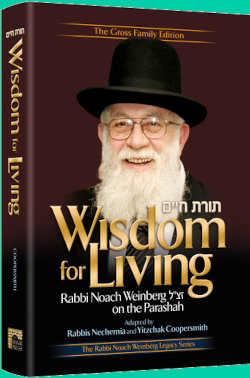
Wisdom for Living
Rabbi Noah Weinberg on the Parashah





This week's parashah contains the tochachah, the series of horrific punishments that will befall the Jewish people if they do not listen to Hashem and if they continue to ignore His admonitions. What is the primary cause of the intensification of these punishments?
The Torah says:
If you behave with Me happenstance (keri) and refuse to heed Me, then I shall lay a further blow upon you…
"If despite these you will not be chastised toward Me, and you behave with Me happenstance (keri), then I, too, will behave toward you happenstance, even I, seven ways for your sins" (Vayikra 26:21, 23-24).
What does the word "keri" mean?
The Rambam defines “keri” as denying God's orchestration of events and instead viewing them as random accidents. He writes (Laws of Fasts 1:3):
But if the people do not cry out [to God] and sound the trumpets, and instead say, "What has happened to us is merely a natural occurrence, and this difficulty is merely by chance," this is a path of cruelty and causes them to continue in their wicked deeds. And this time of distress will lead to further distress.
This is what the Torah says: "If you behave with Me happenstance, I will behave toward you in a fury of happenstance." The implication of the verse is: When I bring difficulties upon you to encourage you to change, if you say it is a chance occurrence, I will add to your [punishment] as an expression of anger for that indifference [to Divine Providence].
The Rambam calls ignoring Divine Providence "a path of cruelty." Why does he call it cruelty when the essential problem with this approach is that it is heresy? The Rambam does not need to tell us that this is heresy – that is obvious. Instead he is focusing on the root cause for the heresy – namely, cruelty, because attributing painful occurrences to random forces positions God as an uncaring, vindictive Father. Only a cruel person could imagine a father actually abandoning his children to the treacherous whims of fate and allowing them to be hurt for no reason.
Furthermore, reducing difficulties to mere accidental occurrences ensures that people will not do teshuvah, which causes Hashem to bring upon us even greater difficulties. This is another manifestation of cruelty. It is like taking away a person’s life preserver, the one thing that can save him while treading water in the middle of the ocean.
The parashah's central message is that there are no accidents. Nothing just happens. God is running the world, and everything that occurs is a Divinely calibrated message from Hashem. He is constantly communicating with us, and we need to stop and ask, “What is the Almighty teaching me?" Something happens in Israel, there is a major economic downturn, someone close to you gets ill – ask yourself: “What am I supposed to learn from this?” Do not think it is an arbitrary occurrence, a chance happening. Realize that Hashem is the ultimate cause behind everything that happens in the world, and He is very articulate. If we genuinely want to understand His message, we will hear Him and save ourselves a lot of grief.
Instead of complaining or questioning God's ways, we need to focus on hearing His message and paying attention to Him.
A student travelling the world once met me and said, "Rabbi, I don't need a yeshiva! You see, God and I are very close. He does miracles for me."
I eyed him a little suspiciously. "Would you mind describing a miracle or two?"
"Sure,” he said. “Recently I was riding my bicycle up a winding mountain road. A Mac truck swerved into my lane, coming straight at me. Having no choice, I drove off the side of the mountain, over a sheer cliff, and fell fifty feet onto jagged rocks. I screamed out, 'God!'
"Rabbi, as I hit the ground I felt God's hand cushioning me. I got up without a scratch! It was a total miracle! So you see, God and I are very close."
Rabbi Weinberg leaned in, looked the fellow in the eye and said, "Tell me, my friend, who do you think pushed you off the cliff?"
The young man was speechless.
Rabbi Weinberg explained, "God isn't Superman, waiting until you stumble off a cliff and then flying in at the last moment to save you. He controls everything in your life: the problems and the solutions. First He sends a truck to force you off the cliff, and then He saves you. The question you need to ask is, why would God throw you off a cliff and then catch you? Clearly, He wants to get your attention. What does He want to teach you? You need to work on your relationship with God by going to yeshiva!"
A Sign of Love
When God sends a message to get our attention, it is an expression of His love and concern, even when that wakeup call entails some pain.
Imagine that you are driving your car and suddenly a seven-year-old boy darts into the street chasing his ball. You screech to a halt and just narrowly miss him. Then, you roll down your window and yell at the boy, “Hey, be careful! I almost hit you!” You are about to drive off when you see a man chasing the boy and tackling him to the ground. The man is screaming at him, “Are you crazy!? You almost got yourself killed!” And then he gives the boy a potch.
Who is that man who actually chased the boy down and was not satisfied with a mere finger-wagging?
It’s the boy’s father. He loves his son so much, he will not stop until he is sure that the boy gets the message never to run into the street again, even if it means giving him a potch to get the point across. It is a sign of his love and concern, not his abandonment.
God is our Father in Heaven, and because He loves us deeply, He won’t give up on us. He will send us a wakeup call if necessary, and if He does, we need to remember that it is a sign of His love.
In order to hear God’s message properly we need to first connect to the reality of His love for us and realize that His message is for our good. If one’s relationship with God is steeped in mistrust and anger, Hashem’s message will get distorted through that subjective lens, since it is the emotional context of a relationship that largely determines how we interpret our interactions.
For example, Rachel has been working for the last four years on completing her Master’s degree. Tonight is the graduation. She tells her husband, Michael, "Meet me there at 8:00 p.m. and please – don't be late."
"Don't worry,” he assures her. “I'll be there on time.”
"You promise?"
"Promise."
Eight o'clock rolls around and he's not there. Rachel starts getting agitated. It's ten after eight and still no show – now she's mad. At 8:30 she can't believe he let her down again. She feels hurt and dejected.
Now let's take a look a second couple, Sarah and David. Sarah is also graduating tonight, and she tells David to be there at eight and to try not to be late.
"This is such an important evening,” he says. “I wouldn't want to miss a minute of it!"
Eight o'clock rolls around and he's not there. What does Sarah think? Maybe he’s stuck in traffic. Ten after eight...she starts to worry. Maybe something happened. At 8:30 she leaves the auditorium, in a state of panic, and starts calling the local hospitals.
Same situation, two very different reactions. When the relationship is one of resentment and mistrust, the action is interpreted through that negative lens. When the relationship is one of love and trust, that same action is viewed in an altogether different light.
When we are unaware of God's unwavering love, we will necessarily misinterpret His message. Therefore, the initial challenge is to ensure that our relationship with Him is rooted in trust and love.
Hashem does not lash out in anger, inflicting pain because of His own frustration and lack of impulse control. He is not a dysfunctional parent. Everything He does stems from His love, which is infinite and boundless, greater than all the love in the world. As the Torah says, "As a parent will chastise his son, so Hashem, your God, chastises you" (Devarim 8:5).
But how do we connect to God’s love for us and put our relationship with Him into a positive context? By building gratitude.
Acts of kindness build love and trust in a relationship. But in order for the bonds of love to be strengthened, the acts of kindness needs to be appreciated and recognized. If the kindness is taken for granted and the recipient is not grateful, then no emotional deposit is made and the two parties will miss out on the opportunity to be drawn closer.
We are all recipients of an overwhelming abundance of gifts from the Almighty: our life, our eyesight, our legs, our children, our clothing, our homes, our food, every single breath – it is really endless. The problem is that we often take God’s innumerable blessings for granted and forget that we are the recipients of His myriad precious gifts. In order to feel His love for us, we need to actively pause and appreciate the countless, ongoing demonstrations of that love . By recognizing His unceasing involvement in our lives, both past and present, we can build a loving context for our relationship with God.
This was one of God's essential messages to the Jewish people when He introduced Himself at Mount Sinai. "I am Hashem, your God, who has taken you out of the land of Egypt, from the house of slavery" (Shemos 20:2).
God could have introduced Himself by declaring, "I am Hashem, your God, who created the heavens and the earth." What could be more impressive than that? But He wasn't interested in showing off His power. He wanted to show His fledgling nation that He is there for them, committed, loving, and caring. "Yes, it is I, your God, who overturned nature to liberate each and every one of you, the One who saved you and freed you from slavery and chose you to be My people."
The following exercise can help you appreciate God's active, loving role in your personal life. If you take the time to do it, it will transform your relationship with Him.
Write down 50 blessings you have in your life (e.g., your sense of smell, your spouse, your health…).
Now write down 50 more (your morning coffee, your son’s smile, your car…).
Every day, write down one new blessing you have received in your life. Do this every day for a month. On Shabbat, ask your family and guests to share one thing for which they are grateful.
By building your gratitude muscles, you will begin to recognize and appreciate God’s boundless love for you, which is the essential prerequisite to understanding the messages He is sending you.