Click here to buy
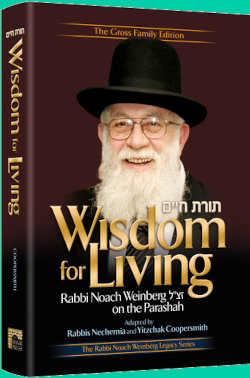
Wisdom for Living
Rabbi Noah Weinberg on the Parashah



7 min read


At the end of the Book of Numbers the Torah portion revisits the five daughters of Tzelafchad, who were instructed by God to marry within their tribe of Menashe in order to ensure that their father's ancestral inheritance would remain within the tribe. Let's review how they inherited their father's land in the first place.
The daughters of Tzelafchad, son of Chepher, son of Gilead, son of Machir, son of Menashe, of the families of Menashe son of Yosef drew near… and they stood before Moshe, before Elazar the Kohen, and before the leaders and the entire assembly at the entrance to the Tent of Meeting, saying: "Our father died in the desert, but he was not among the assembly that was gathering against Hashem in the assembly of Korach, but he died of his own sin; and he had no sons. Why should the name of our father be omitted from among his family because he had no son? Give us a portion among our father's brothers." (Bamidbar 27:1-4)
The daughters of Tzelafchad petition Moshe, Elazar, and the Sanhedrin that they should be the heirs of their father's land because he died without leaving behind any sons. Moshe does not know the answer and consults with Hashem, Who replies, "The daughters of Tzelafchad speak properly.” They are right.
Rashi says that they saw with their eyes what Moshe Rabbeinu could not see. They understood what Moshe Rabbeinu and the Sanhedrin did not understand.
When they presented their argument they said, "Our father did not have a son." Rashi explains: "But if he had had a son, they would have made no claim at all. This teaches us that they were smart women." These were not simple women; they were learned and intelligent. But why does the Torah need to go out of its way to tell us that they were smart women? Of course they were smart! They saw what Moshe himself could not see!
There is another difficulty in the first Rashi on this chapter, where he explains why the Torah traces the lineage of Tzelafchad’s daughters all the way back to Yosef. Rashi says this teaches that just as Yosef cherished Eretz Yisrael – as demonstrated by his commanding his children to bring up his bones from Egypt for burial in Israel, 210 years after his death – so, too, the daughters of Tzelafchad cherished the Eretz Yisrael, as the Torah says, “Tenu lanu achuzah – Give us a portion” (v. 4).
How do these words prove that they loved the land? If someone told you that you have an inheritance in Nebraska, wouldn't you ask for it? You may never want to step foot in it, but you will certainly take ownership of your rightful property and profit from it. So why does the daughters' asking for a portion show they loved the land of Israel?
The answer is that the reason the daughters of Tzelafchad saw what Moshe Rabbeinu did not see was not because they were smart. That would not have sufficed. The reason they saw what he did not was because they loved the land. They happen to have been learned, so the Torah tells us that, but it was not their brilliance that empowered them to make their argument; it was only their love of Eretz Yisrael. They saw what Moshe did not see because they so badly wanted a portion in the land. They dug deeper and persisted until the right argument came to them.
The secret to excelling in anything is to be passionate about what you are doing. If you want to succeed in learning Torah, you must cherish the Torah. If you want to bring back Am Yisrael and connect them to the beauty and meaning of our heritage, you must passionately love your fellow Jew. If you love them you will find a way to reach them.
I once met a man who owned a nursing home in Baltimore. He was familiar with my efforts in kiruv, and he said to me, "I really admire your accomplishments. You know, I also made someone into a baal teshuvah."
"That's terrific," I replied. "Who is this person?"
"She is a 95-year-old woman whom I convinced to stop eating treif."
"A 95-year-old woman!" I exclaimed. "My friend, you are the expert, and I am the student at your feet. Teach me, how in the world were you able to reach her? Most elderly people – certainly those in their nineties – are not open to changing their lives. What is your secret?"
"I'll tell you,” the man answered. “I own a nursing home outside of Baltimore. The clientele is almost entirely non-Jewish. Of the 300 residents, I had three Jews. I fed the non-Jews non-kosher food, since it's much cheaper than kosher food. But I couldn't feed the three Jews treif, so I brought them catered kosher meals. Every day they got special meals wrapped in containers. It cost me an arm and a leg, but I had no choice.
"Everything was fine, until one day an inspector came from the State of Maryland. I showed them all our records on the patients, and thank God the inspectors were very pleased. They were about to leave, when this 95-year-old Jewish woman approaches one of them and says she has a complaint. ‘What's your complaint?' the inspector asks. She says, 'He gives me different food. I want to eat like everybody else. He's discriminating against me.'
"The inspector comes over to me and asks, 'What's going on? You know you're not allowed to discriminate.' I try to explain to the inspector that I'm a religious Jew, and I can't feed a Jewish patient non-kosher food. Even though it costs me a fortune, I give her kosher food.
"The inspector says, 'Listen, buddy, you can't force your religion on anyone else. This is America. Either you feed her like everybody else, or I will be forced to shut you down.' So I go over to this 95-year-old woman and tell her, ‘The treif food is very cheap. The kosher food I'm getting you costs almost ten times more!'
"'Save your money,' she says, 'I want to eat like everybody else.'
"'Ma'am, everyone knows that kosher food is tastier. It's prepared with greater care.'
"'I'm 95 years old! You think I can taste anything? I just want to eat like everybody else.'
"'Ma'am, everyone knows that kosher food is healthier. This treif food is bad for you. Kosher food is healthy, and it's government inspected.'
"'I'm 95 years old. The sooner I go, the better. I want to eat what everybody else eats.'”
The man from Baltimore turned to me and said, "Now, she washes her hands before she eats. She gets up in the morning and says Modeh Ani. She recites Tehillim, lights candles Friday night, and she's shomer Shabbos. She does everything!"
"That's fantastic," I responded. "But tell me, what did you say to her?"
"I already told you," he says.
"No, you didn't."
"I told you that the inspector said he would shut me down. Ich hub gehat a breirah? I had no choice! The inspector was going to shut me down. I don't know what I said, all I know is that now she says Modeh Ani and makes berachos."
Because he simply had to find a way to reach her, this nursing home owner became a master at kiruv. I spent my life reaching out to Jews of all backgrounds and was never successful in reaching a nonagenarian, yet this inexperienced fellow from Baltimore succeeded in reaching a 95-year-old.
Our mistake is that we think we have a choice. If we really want to, we can do it. If we love the Land of Israel the way the daughters of Tzelafchad did, we will see things that even Moshe could not see. We just have to want it badly enough.