







 Those Shameful Thoughts and What They Really Say about You

17 min read
8 min read





The Hebrew word for dog, kelev, hides two words inside: kol lev, a whole heart. A lifetime of dogs taught me, an anxious kid from a lonely home, what that means.
Loneliness is an expected byproduct of being raised by lonely people, the kind who shared a home without ever quite finding each other inside it. In some homes it is never named, only performed around, everyone moving carefully as though the wrong word might shatter something already broken.
I grew up in such a home and carried it into my adulthood. But God did not leave this unaddressed. He gave me companions through the remarkable creation of dogs who played a surprising role the night the Jewish people walked out of Egypt.
The Torah records the Exodus in sweeping terms: the plagues, the miracles, the outstretched arm of God. And yet, inside the narrative of the tenth plague, there is a fascinating detail: “Not a dog shall whet its tongue against any of the children of Israel” (Exodus, 11:7). The dogs did not bark.
The dog’s essence is to steadfastly remain by our sign, the loyal companion who gives everything without negotiation or reservation, with a whole heart.
The Jewish people walked into the night of their freedom, as the dogs stayed silent, serving as a supernatural sign of divine protection, demonstrating God’s control of nature, allowing them to leave peacefully and with dignity. As a reward, the Torah instructs us to give non-kosher meat to the dogs.
It’s no wonder that dogs are man’s best friend. Consider the Hebrew word for dog: kelev. Break it open and you find something hidden inside: kol lev, a whole heart. The dog’s essence is to steadfastly remain by our sign, the loyal companion who gives everything without negotiation or reservation, with a whole heart.
I was raised in a home where Jewish identity was felt more than practiced. I spent many years reaching for stability in whatever form I could find. Dogs have been present at almost every turn, steadying me through the earliest chapters when I had little else to hold onto.
The first dog I remember as a child was not mine. He belonged to my beloved aunt. He was a Pekingese named Schnecken, small and imperious. He stayed with us occasionally when I was a very small boy. In those years our apartment ran on a current of tension that everyone in it had learned to navigate.
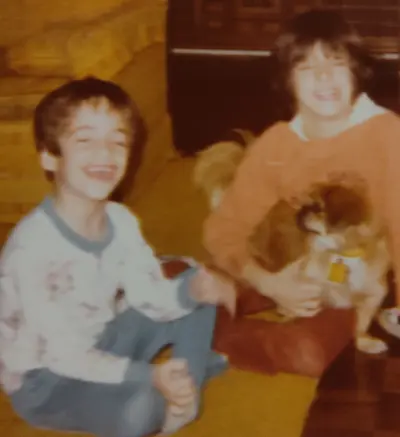 Me with Schnecken sitting on my brother’s lap
My father, of blessed memory, was a mercurial man whose emotions often arrived in the room before he did, which frightened some and became background noise to others. I was among the latter, though I understood early that the air was rarely neutral. Schnecken understood something I did not yet have words for.
He knew, with the particular intelligence of a dog who had read a room and made his decision, which child needed him most. He knew I needed to be taken out of that room with the particular genius of a being who understands with his whole heart comfort as a calling.
On one memorable visit, Schnecken discovered my father's dental bridge in the night. By morning it was gone, and my father, surveying what remained of his dignity, understood immediately what the day had become. He expressed himself on the subject at a volume that reached every apartment on our floor. Schnecken, who had heard him express himself loudly before and had formed his own views on the matter, remained unmoved.
My parents, to their credit, eventually gave in to my demands for a dog. They insisted he would teach me the responsibilities required of caring for one. They were right. Chopstick was a Shih Tzu, bred from an ancient lineage whose only calling was to be near the ones who needed them.
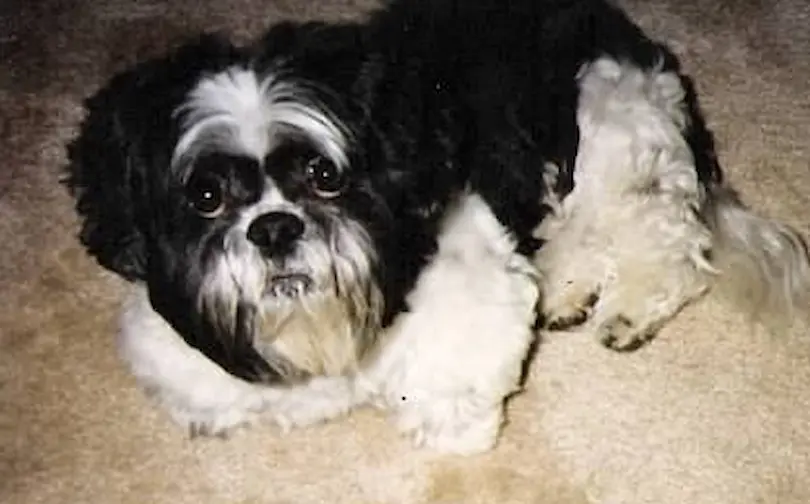 Chopstick
He settled beside me with the purposeful precision of a being who had identified his king and intended to serve him faithfully. Chopstick knew I was anxious. There was no performance in what he offered. He simply read my moods, adjusted, and remained close. He lived long enough to see me through to college, and he died while I was away. I felt his absence the way you feel the sudden loss of something that had quietly been holding you steady.
Dogs are not a replacement for human connection but a gift for the moments when it falls short.
Dogs do not carry the holy soul that distinguishes us from them, and the sadness that attends their loss, though real, is not the grief we reserve for human beings. Time moves differently for them, which means our relationship with them is always asymmetrical in ways we have to accept honestly. Dogs are not a replacement for human connection but a gift for the moments when it falls short. On those days they can be, with their whole hearts, essential.
There have been other dogs along the way, each one a different education in patience, in the demanding art of meeting another where it is. It was exactly what I had always needed from my own species. By the time Peaches came, during the pandemic, I had long since stopped thinking of them as incidental. They were part of the texture of my interior life, each one having softened something in me that needed softening.
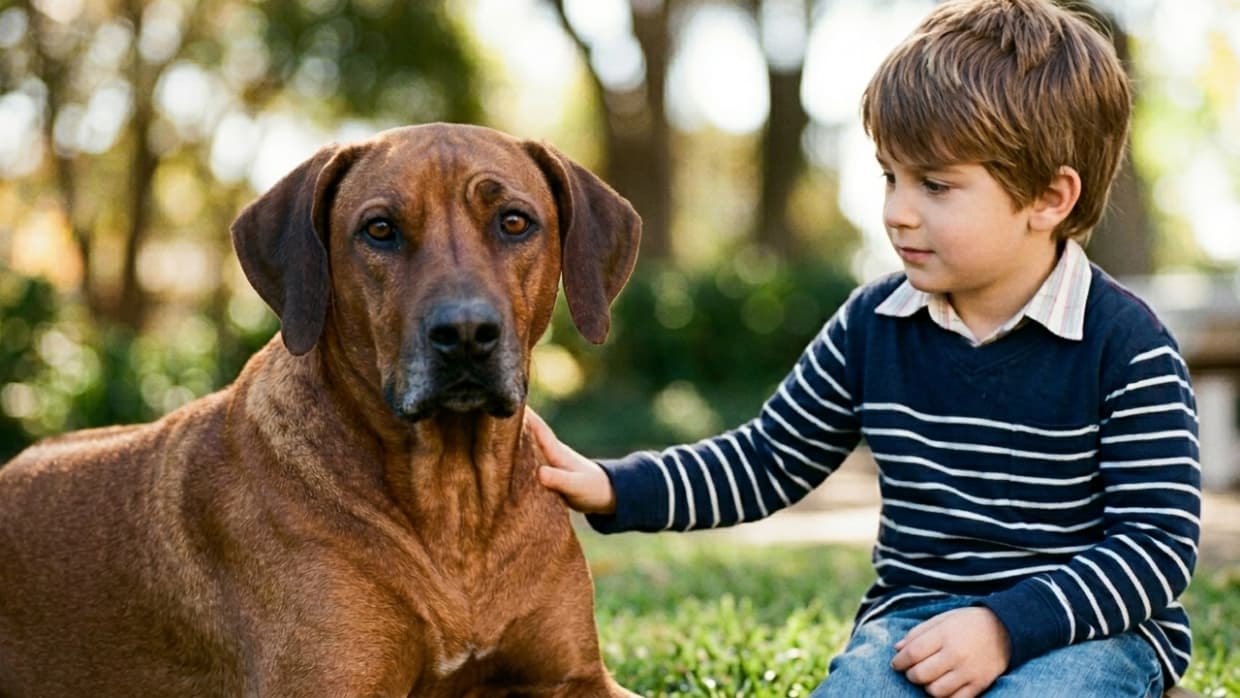
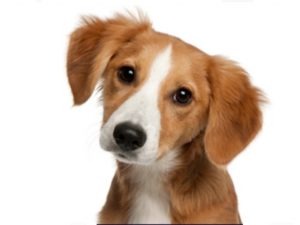
Peaches is a shepherd lab mix, a rescue, with warm amber eyes and the disposition of an animal who has decided to forgive the world for whatever it did to her before me. The depression that has shadowed me since childhood has never really left, and she has been with me through a period when it has sometimes made ordinary existence feel like an act of sustained courage. Getting up, going outside, being in the world for another day. Peaches requires all of these things, with the cheerful insistence of a dog who understands, with her whole heart, that her person needs to move.
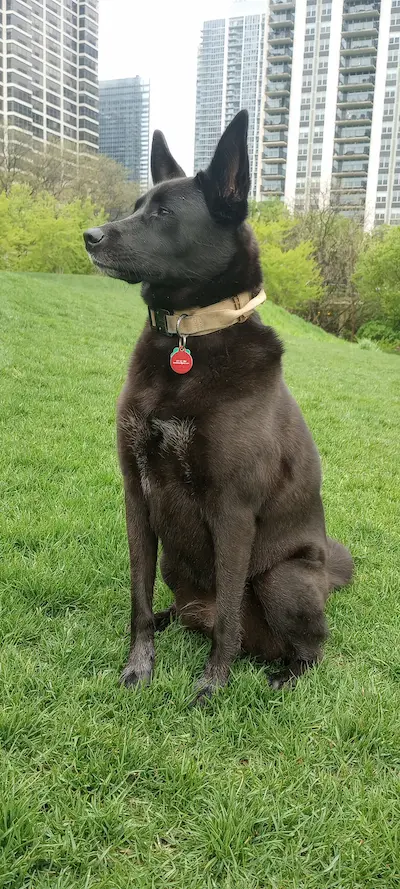 Peaches
Not long ago, I arrived at the door of a Hassidic rabbi I deeply respect, there to meet a mutual friend who was visiting him. Peaches was with me and we waited together on the step, where I fully expected us both to stay. In my experience, religious homes and dogs occupy separate worlds, and in some cases there is a fear or even disgust that goes largely unexamined.
When the rabbi opened the door and saw her, I braced for the kind of polite acknowledgment that keeps a dog on the other side of a threshold. Instead, his face softened and he stepped aside to let her in.
His hospitality was total and drew no distinctions.
The sages teach that the journey out of Egypt is not only historical but personal, the ongoing work of every Jewish soul moving toward its freedom. The dogs were with us then, and they are still with us now, the relationship older than any of us remember and closer than we sometimes acknowledge.
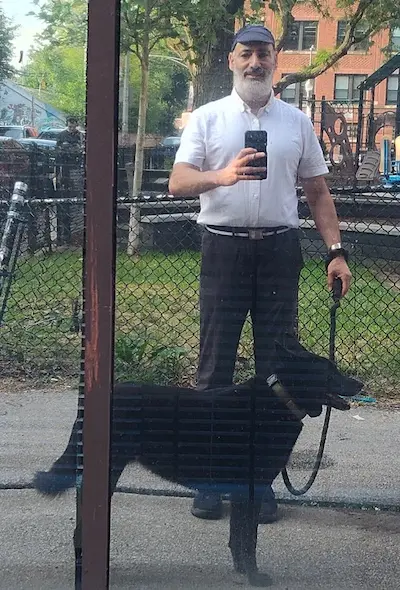 On a stroll with Peaches
The dogs in our homes today ask more of us than the dogs of Egypt did. They require walks, feeding, veterinary bills that arrive at the worst possible moments. It is not a small undertaking.
On the mornings when Chicago is merciless with cold and Peaches and I are outside together, I find myself thinking of the dogs who remained silent on a consequential night in our history, of what we owe them. The least I can do is zip my coat and hold my tongue from barking my frustrations.








Dog is the word G-d backwards.
have had 4 dogs and have treated them like kids wrapped in fur. In the Torah it says to feed your dog first before yourself. I always did that without knowing. I had 4 puppies and one was a rescue. Next time I will definitely get a rescue. I adore dogs and would love a sanctuary for them.
I read that dogs are a life saver for kids with special needs, the family that was religious was not on board first about having a dog, then someone in the field for special needs give a try, in the end the family was happy that they had the dog, and really praised the dog afterwards maybe they said a angel with fur and paws, because he helped the child very much
I don't know how I would have made it through many situations in my life if not for Gretchen, Mousie and now Gracey. Living in Israel as an observant woman with a dog was a challenge. Especially for housing. There is something written in Kabbalah about not having a dog in the house as it creates strife. Many people believe that a dog carries tumah. Personally, I believe the sages were talking about Canaani dogs who are very wild and, to my mind, similar to dingos. Dogs have always been there for me. I am very grateful to HaShem for making such lovely beings.
This piece was beautifully done. I felt as though it charted my own life. My thanks to Matt Brandenstein for giving expression and meaning to how dogs may tether us to this life. Such beings point to a form of love that may only come from above.
Thank you! I feel much the same way.
PETS backwards is STEP
Perhaps pets, like dogs, can help us to keep moving, with interest, STEP by STEP?
I see people walking their dogs, and perhaps it is the dog, walking the person, more.
(Can you comment? Thanks so much for your insights. Matt)
Another backward word to ponder is dog itself. For those life's little moments when G-ds love seems to be concealed He created the dog to make His unwavering love a constant visable, tangible presence in our lives. They are a tremendous example of love, devotion, forgiveness, compassion and encouragement that too many people are surrendering or devaluing as traits to strive for. Basic humanity traits that dogs express freely and people conceal or all together cancel by choice. Ah but the beautiful things dogs can naturally draw out of people are inspiring!
A true anecdote sparked by your comment: I was walking to shul one Friday afternoon with a friend. As we were walking I mentioned to him the joke line "did you hear the one about the agnostic insomniac dyslexic who stayed up all night pondering the existence of dog?" I had no longer finished the line when a local dog ran up to us barking in a somewhat threatening and aggressive way. We kept on walking and once we were out of his territorial space he went back home.
Thanks for sharing! I neglected to mention that yes they can be territorial for what they perceive is theirs, but they protect what they love with unwavering and sometimes fierce loyalty. May we be blessed to love and care for each other as such! Be happy be well!
Actually, Calev is a name in the Torah which is like a heart or a whole heart, dogs teach loyalty and their family is their pack, also dogs guard sheep all through history
Loved this as a dog person!
No. The Jewish take on companion animals is nearly identical to Islam. Datiim don't have pets. In a former life, I spent a lot of time in Bnei Brak; nary a dog there. Christianity has a different attitude towards pets—and nature, generally.
People have had symbiotic relationships with all sorts of animals for centuries. In the Arab world, camels, horses, donkeys and mules carried people and goods. (I call horses the original self-driving vehicle.) Cats have been present in many cultures to keep barns and homes free of rodents. Dogs can be taught to lead the blind and sniff for things as varied as explosives, drugs, truffles, and cancer! Because dogs crave human connection, they live with their handlers.
Just because some animals are not kosher nor halal for human consumption does not lessen their importance to us in other ways. They, too, were created by Hashem.
Dogs are service animals, and also can detect cancer , and they also work for the police and the IDF, when I was in Israel for a summer, the person in the moshav used to be in the United States military so he had a dog when the Jews were present he was quiet, when the dog smelled a Muslim Arab the dog barked, it looks like the dog can sense danger, Dogs also detect when someone will have a epilepsy seizure, or low blood sugar and revive the person, when my mom( obm) was in Israel where she( obm) stayed had a dog when my mom( obm) fainted the family's dog went to revive my mom(obm) and called the owners, also when the dogs humans are in danger they rescue them, on 9/ 11 the blind owner said to the dog save yourself but the dog didn't not leave his owner for one minute
That’s factually not true. In northern Israel where I live, plenty of haredim have pets. I have a dog and my children know well the Halacha that you must feed your animals before yourself. Religious Jews who have children with special needs will tell you that having a pet is very good for their children. Saying “datiim don’t have pets” is judging a whole lot of Jews negatively.
Why would we want to emulate Islam? We are Jews!
Beautifully written!