




 Greece’s Minister of Health is Baffled by the Jews

7 min read
6 min read




4 min read


Spielberg's new film asks whether alien life destroys faith in God. Here’s a Jewish approach to the question.
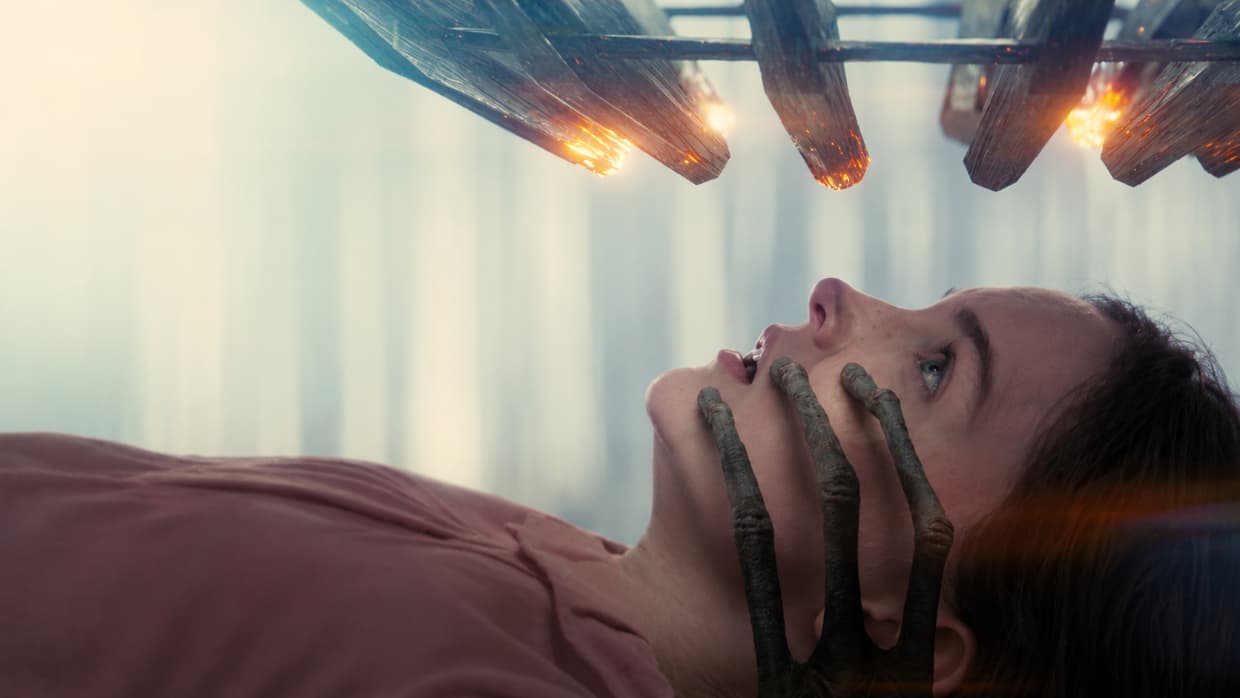
Steven Spielberg's latest visit with little green men has landed in theaters, and it carries the same classic themes that made his films ET and Close Encounters cultural phenomena. Like its predecessors, Disclosure Day follows a handful of rebels protecting alien life from cruel and obtuse government agencies and a frightened public. And as always, someone insists that the existence of alien life must, for the good of the people, be kept absolutely secret.
But Disclosure Day adds a new twist: a religious one. In the opening scene we meet Dr. Daniel Kellner, a former hacker turned cybersecurity specialist at WARDEX, a shadowy corporation with deep government ties. He steals advanced alien technology and classified files that expose decades of secret human-extraterrestrial contact, including events like Roswell. Overnight he becomes a whistleblower, determined to reveal the cover-up while staying one step ahead of the people hunting him. It's exciting stuff.
Her fear is that the awe of an alien intelligence will dethrone God as sovereign of the universe.
Kellner has a girlfriend, Jane Blankenship, a former nun pulled into the chaos after the theft. When Daniel tells her the truth—that aliens are real and the government has hidden it for decades—she balks at his plan to tell the world. Her fear isn't the mass hysteria that might follow. It's something deeper: that awe of an alien intelligence will dethrone God as sovereign of the universe. The aliens, she worries, will become literal idols. Humanity's whole sense of itself and of reality will be shaken to its core.
Jane spends most of the film helping Daniel anyway but her misgivings linger until a pivotal conversation with her old mentor, Sister Maura, Abbess of the Monastery of St. Clare of the Dawn. Asked whether alien life could exist, the wise and broad-minded sister explains that Genesis calls humans the pinnacle of life on Earth—but says nothing about anywhere else, leaving the rest of the universe wide open. "Why else would God have made it so big?" she asks.
It's a good question, and one Jewish thinkers have wrestled with for centuries. The Book of Judges contains a strange, almost cinematic line: "Curse Meroz... curse bitterly its inhabitants." Who was Meroz? The Talmud preserves a striking opinion—that Meroz was not a town at all, but a star, a whole world whose inhabitants failed to come to Israel's aid. The 18th-century Sefer HaBrit takes this and runs with it, affirming that other planets may well be inhabited.
He's in good company. Centuries earlier, Rabbi Chasdai Crescas devoted a chapter of his Ohr Hashem to arguing that nothing in the Torah rules out life on other worlds, citing "Your kingdom is a kingdom of all worlds" (Psalms 145:13) as a hint that God reigns over more than one. The Zohar, Judaism’s chief mystical text, speaks of "worlds without number" and links the stars to separate inhabited realms.
So Sister Maura, it turns out, is on solid ground.
There simply isn't hard evidence for alien life, whatever we make of its implications. The Pentagon's own declassified files admitted as much: these remain "unresolved cases," with the government "unable to make a definitive determination."
So for now, the cosmos is silent. And here's the twist Jane never saw coming. She feared that some great intelligence out there would dethrone God—that people would trade their awe of the Creator for awe of His creatures.
But the silence cuts the other way. Look up at that vast emptiness. The awe Jane feared doesn't go away—it just lands somewhere else, on God Himself.
There may be no alien mind running the stars, but there's good reason to believe in the Creator who made them, and the dark between them, and the one tiny blue planet where someone looked up at the cosmos, filled with awe at the disclosure of a universe that points to God.











The prophet, Isaiah, would beg to differ with the speculation as he wrote:
"All the stars in the sky will be dissolved and the heavens rolled up like a scroll; all the starry host will fall like withered leaves from the vine, like shriveled figs from the fig tree."
I know who I would believe, and it’s not the musings of Spielberg
If a Jew doesn't believe there is intelligent life out there, in other galaxies and planets then the are limiting Hashem's abilities, there are hints that everything praises Hashem say beings on other planets and/ or galaxies are also praising Hashem, say are some religious people say if you believe in aliens you don't believe in Hashem, I feel the opposite if you don't believe Hashem made a vast universe, then your believe in Hashem is questionable in my opinion and view
Psalm 8 !
"When I see Your Heavens, the work of Your Fingers, the Moon and the Stars which You have ordained - what is Mankind that You remember us and each person that You involve us?"
I am of the opinion that must be life on other worlds. As Sister Maura in the movie said, "Why else would (HaShem) made it so big". For many, it is easier and more ego boosting to think that G-d threw away the mold when He created humans. Why limit HaShem's powers? Frankly, I hope that one day we can make a peaceful and beneficial contact with other inhabitants of other worlds. Meanwhile, I'll continue to marvel at His power.
I really enjoyed reading this article :-). I firmly believe there is more life in the universe then what we possibly can even comprehend, maybe on a physical level, like it is in our dimension, or maybe other dimensions that are beyond our perception. In any case, even the most advanced and sophisticated alien life was once created somehow, and it just proves even more that something created all of this, and there is no absolutely any doubt in my hearth that there is a 'PRIMAL GOD' ( in lack of a better term to describe it) that oversees and runs all this. Ancient civilizations on our planet may have bumped into more advanced aliens and perceived them as Gods (all the Greek and Roman mythology, as for example), but ultimately, everything in existence originated from somewhere\something.
I briefly read some things I didn’t know well about Christianity. Never could understand how they could go from having an amazing religion to giving up most of it to pray to a man who died. Since or Lord is always and everlasting, wouldn’t that be a bit of a selling point?? Obviously not much. But more people acknowledge much if the New testament is from Torah the changing the words has often changed the meaning. Look forward to hear excellent responses. My belief has always been it’s easier to follow a trending religion than one that isn’t trending, tho conversion to Judaism is far, far from rare the past 8-15 years.