




 The Only Orthodox Jew in the Room





6 min read


After 85 years, the 18th century silver cup is returned to the owner’s great grandson.
Rosa Marx’s choice to remain in Germany, leaving her family at the Munich train station instead of escaping the Nazi regime with them, led to her eventual murder in Theresienstadt. Rosa was photographed at the station alongside them before their departure, but for unknown reasons she stayed behind.
That fateful farewell was just weeks before Kristallnacht, the series of pogroms in November 1938 that destroyed Jewish homes, businesses and synagogues and was a critical turning point in the Nazis’ persecution of Jews.
Beginning in February 1939, German Jews were forced to surrender their precious metals at pawnshops and other designated places, which sold almost all silver—135 tons nationally —to melting companies, mainly for the war effort.
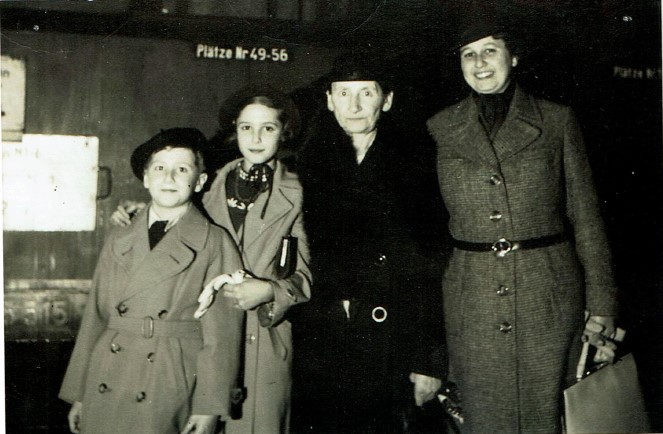 At Munich train station. From left: Robert Marx (Peter's uncle), Helen Marx (Peter’s mother), Rosa Marx (Peter’s great-grandmother), and Gretl Marx (Peter's grandmother, Rosa's daughter-in-law.)
But some museums bought select pieces. The Bavarian National Museum in Munich acquired approximately 350 objects from the city pawnshop, which had kept ownership records. Among them was an 18th century silver cup belonging to Rosa Marx.
While the museum restituted most items to claimants years ago, Rosa’s cup and 110 other pieces languished in storage for eight decades until curator Matthias Weniger undertook aggressive efforts in 2019 to track down their heirs through databases and other resources.
Weniger traveled from Germany to the U.S. recently to hand over Rosa’s cup to great-grandson Peter Saulson and his wife Sarah. Peter’s then 12-year-old mother had boarded that train in Munich, on a journey which ultimately took the family to America and saved their lives.
The Saulsons invited me to a restitution ceremony at their Providence, R.I., home, which my late parents, Holocaust survivors, had owned for decades and called their “dream house.” The modest custom ranch represented the security antisemitism had stolen from them in their native Poland, where they had fallen in love before being forcibly separated, brutalized, and miraculously reunited in a displaced persons camp in Germany.
 Peter Saulson with his great-grandmother’s kiddush cup.
I had connected with the Saulsons during Covid through a synagogue webinar Peter hosted from his home study on the bridge between science and religious faith shortly after they became its third owners. A retired physics professor, he was an early member of the LIGO project, which won the 2017 Nobel Prize in Physics for its discovery of colliding black holes.
Peter’s study had once served as a nursery for our newborn daughter when we moved in for a short time to help my father after Mom died suddenly. Over the years, as we lived within easy reach, the house in which I was raised was like a second home to our kids.
My conversations with the Saulsons were often about Judaism and its centrality in my parents’ home. Transmitting its laws and customs from generation to generation was a sacred duty my parents joyfully fulfilled, viewing it as their “personal victory over Hitler.”
The restitution ceremony for Rosa Marx’s cup was as much a tribute to her life, terminated along with six million other Jews when Europe was transformed into a human slaughterhouse. The Marx family, it is assumed, had used the cup prior to the Holocaust for kiddush—a blessing Jews recite over wine, declaring the holiness of Shabbat and Jewish holidays.
Now being restored to its religious use for the first time in 85 years, the cup was crafted by silversmith Philipp Stenglin between 1721 and 1725 in Augsburg, Germany, according to its unique markings, Weniger told guests.
After Peter koshered the cup in a pot of boiling water, we accompanied the Saulsons to the neighborhood mikvah just steps from the house, where Peter immersed it in the pool of naturally gathered water. The submersion, known as tevilah, is a religious ritual that bestows an added measure of sanctity.
“It has taken the cup from being a memento of horror and making it a beautiful object again, spiritually beautiful,” Peter told me. “It has reentered our family’s history.”
 Peter Saulson, after immersing his great-grandmother’s 18th century kiddush cup in the mikvah.
As Peter recited the Hebrew blessing over wine that filled his great-grandmother’s cup, this transformative passage in its journey was strikingly backdropped by a tallit Sarah had woven that artistically depicts the Marx family’s escape from Nazi Germany. It was displayed on the dining room wall where my parents’ breakfront once held our kiddush cups, Shabbat candelabra, and Hanukkah menorah.
With 59 pieces restituted so far in the U.S. and other countries including Israel, Weniger told me he has made it his mission to personally deliver them as a gesture of respect after the degradation original owners like Rosa Marx faced while coerced into queues at pawnshops.
Only months after the worst massacre of Jews since the Holocaust and with antisemitism now spiking to staggering levels, the cup’s return is “a beacon of hope in a very dark time,” Sarah notes.
“It’s the opposite of what’s going on now in the wider world,” Peter says, “that someone coming out of the country that we still rightfully identify as the source of the worst antisemitic episode in all of human history is undoing a tiny aspect of the terrible wrong.”
Gone forever are my parents’ own family heirlooms. Prominent among them was a silver-covered prayer book my father would see his mother clutching, pages yellowed and brittle from generations of tears. But the stolen items are emblematic of a profoundly deeper loss: The decimation of large and robust family tree. My grandparents, aunts, uncles, baby cousins and many more loved ones were murdered—only because they were Jewish.
 The author and her parents at their home, now owned by the Saulsons.
My parents’ continued devotion to Judaism despite this unspeakable trauma was a precious gift to me. Before turning over the keys to their home’s second owners after almost 50 years, I paused amid the empty rooms for a moment of gratitude and reflection as I prayed with their well-worn siddur. I couldn’t have imagined then that I would ever be back inside, much less for a Jewish event so intertwined with their own history.
And as I proudly embrace my identity, I join many others doing so in defiance of the clamorous calls for our elimination. Among us are those previously distanced from Judaism who now wear their kippahs to work, light Shabbat candles and regularly attend synagogue services.
Amid the enmity engulfing us again, my parents would be heartened that Judaism continues to thrive steadfastly in their cherished home and well beyond, as the light of their legacy shines ever so brightly.
View this post on Instagram












So sad. My grandmother & aunt owned a home in Halberstadt, Germany, with valuables. They were murdered and their valuables were robbed by the Germans. Sadly, I can neither know a date when they were murdered, nor can I retrieve the silver candelabras and other many silver items inside their china cabinet.
so pathetic. people's belongings merely taken by greedy Germans who could not appreciate the intrinsic emotional value attached to a religion. My father always commented "G-d bless America which protects religious traditions and righs" . ...............
Very moving and interesting. The Jewish People have been horribly treated, even though they have been a major influence in Western culture. They are owed a debt of gratitude. Beware the current rise of antisemitism.
My grandfather gave his kiddush cup to the neighbors in Germany. It was given to him by his parents in about 1910 when he got married and it's engraved saying that. So my mother's 2nd cousin (with the same last name as my grandfather) was going back and forth to the town where my mother was raised. After many visits the neighbors finally gave the kiddush cup to my mom's 2nd cousin saying "I think this belonged to a relative of yours." This was about 1990, many years after her 2nd cousin started going back to the town. My mother was incensed that it took them that long to give the engraved cup back.
Thank you for sharing.