








 What Repentance Really Means in Judaism



4 min read
5 min read
8 min read




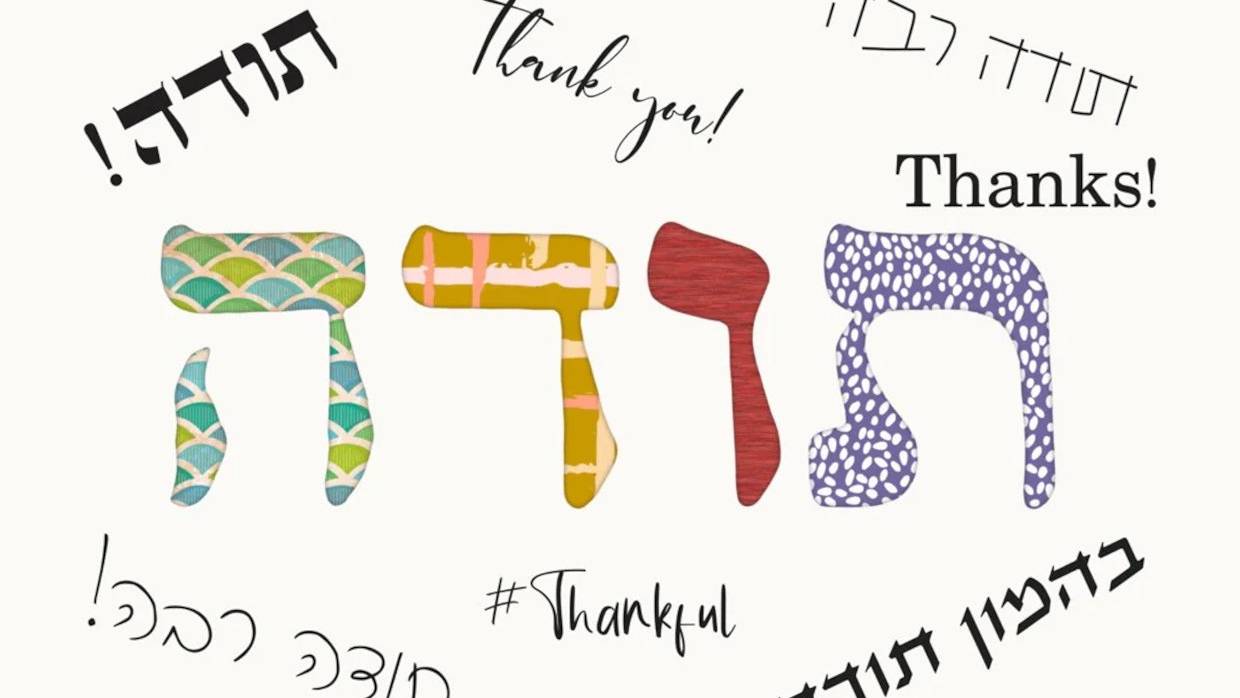
Judaism is filled with beautiful ways to say thanks.
To be Jewish is to live in a world of giving thanks. In fact, the very word “Jew” comes from the Hebrew word for thanks. Jews are named after Judah, leader of one of the ancient 12 tribes. After Judah was born his mother, the Jewish matriarch Leah, “declared: ‘This time let me gratefully praise God;’ therefore she called his name Judah,” meaning “I will thank” (Genesis 29:35).
Given the centrality of giving thanks in Judaism, it’s not surprising that there are many ways to say thank you in Judaism. Here are ten Jewish ways to say Thank You.
Todah is the Hebrew word for thanks, and it has a lot to teach us about gratitude.
Todah comes from the same root with the Hebrew word for acknowledgement, hodu. When we say “thank you” in Hebrew we’re taking a moment to acknowledge what someone has done for us, to appreciate the enormity of our blessings. It’s a way of re-framing our thanks to take a moment and acknowledge what’s good in our lives.
“Thanks very much” in Hebrew is todah rabba, which literally means a great or a big thanks.
Hakarat hatov means recognizing the good, and it’s a fundamental command in Judaism to constantly look for the good in our lives and to savor and appreciate it. In Judaism, we’re encouraged to not take anything for granted, from the fact that we woke up this morning, to the food we eat and air we breathe, and to give thanks for it all.
There are myriad Jewish blessings to help us stop and take the time to give thanks: there are Jewish blessings to say when we open our eyes in the morning and realize we’ve been given another day of life; blessings to say over the food we eat; and more. Getting in the habit of saying “thank you” to specific people - and to the Divine - is a profoundly Jewish concept.
It’s not just Judaism that recognizes the importance of hakarat hatov. The USA’s National Institute of Health notes that: “Taking the time to feel gratitude may improve your emotional well-being by helping you cope with stress.” Cultivating an attitude of gratitude can even improve our physical health. Practicing hakarat hatov - feeling thankful for the fact that you have shelter over your head, when you savor a cup of coffee, when you connect with a friend - can fundamentally improve our lives.
Baruch Hashem is a Hebrew phrase that means Blessed is God, and it’s commonly used as a way to acknowledge when things go well in our lives. “How are you?” might elicit an answer like “I’m good, Baruch Hashem!”
Baruch Hashem is a way to inject thanks and gratitude into even the most ordinary conversations, and to help us remember to acknowledge all our blessings and not take our good fortune for granted.
Tizkeh l’MItzvot is another way to say thank you in Hebrew. It’s a blessing that means “may you merit (doing) more mitzvot” and is a common way to say thanks after someone’s extended a kindness to another person. It’s a beautiful blessing wishing that they have the strength to perform even more commandments and good deeds.
In the 2nd Century CE the great Jewish sage Ben Azzai advised: “Run to perform even a small mitzvah and flee from sin; for one mitzvah leads to another mitzvah, and one sin leads to another sin” (Ethics of the Fathers 4:2). This reflects a deep truth: our actions tend to be self-reinforcing, shaping what we do in the future. Tikeh l’Mitzvot is a way to bless someone that they continue being kind and even grow in mitzvot. An appropriate response is “amen”.
Yasher koach is a shortened version of the phrase yishar kochacha, which literally means “may your strength be straight” and colloquially means “way to go!” It stems from a statement in the Talmud: the Jewish sage Reish Lakish discusses the fact that Moses was correct in smashing the tablets containing the Ten Commandments after he witnessed Israelites worshiping an idol of a golden calf. Reish Lakish asserts that God approved of Moses’ actions and wished him Yishar kochecha sheshibarta: “All strength to you for breaking them.” (Shabbat 87a).
oday, people wish each other yasher koach after accomplishing something. In contemporary Yiddish-speaking communities, yasher koach is also used as an informal way to say thank you.
In Yiddish, thank you is "a dank," similar to the German word for thank (dank) and the English "thank."
While Jews in much of central and eastern Europe traditionally spoke Yiddish, Jews who were descended from the community of Spanish Jews which was exiled in 1492 spoke Ladino, a distinct Sephardi language. Ladino used to be widely spoken in north Africa, parts of Europe, and especially in Jewish communities in the Ottoman Empire. Over time, Ladino became mixed with words from Hebrew, Arabic, Greek, Turkish, and French. Like Yiddish, Ladino is written using the Hebrew alphabet.
Some common ways to say thank you in Ladino reflect this rich mix of languages: Grasyas, similar to the Spanish word gracias, and Mersi muncho, similar to the French word merci.
In ancient times, when the Jewish Temple still stood in Jerusalem, people would bring offerings when they wished to thank the Divine for good fortune. This offering was called the Korban Todah, or Thanksgiving Offering, and it consisted of different types of fine breads which were then eaten (Leviticus 7:13-15).
The Talmud says that there are four reasons for bringing the Thanksgiving Offering: Today, we can no longer bring offerings to the Temple in Jerusalem, but people do say a special blessing of thanks in synagogue after experiencing the following occurrences: returning from a journey either by land or sea; being released from captivity; and recovering from an illness, or going through another dangerous situation.
This thanksgiving blessing is called the blessing of Gomel. (Saying it is sometimes referred to as “benching Gomel,” or saying the blessing of Gomel.) Gomel means a benefactor, and this prayer thanks God for being our benefactor and protector, and for the blessings in our lives: “Blessed are You, Lord our God, Ruler of the world, Who rewards the undeserving with goodness, and Who has Rewarded me with goodness.” It’s a powerful way to focus on and feel gratitude for all the good we have in our lives.
Judaism is filled with opportunities to say thank you all day long. The very first prayer of the day declares “I thank you, O living and eternal King, for You have returned my soul within me….” allowing me to live to see another day.
There are blessings over food, after eating, even thanking God for the fact that our bodies work and we’re able to relieve ourselves without any problems. Judaism has blessings to say when we see a rainbow, hear thunder, meet an outstanding Torah or secular scholar, and countless other occasions. It’s said that each Jews should say at least 100 blessings every day. Doing so fills us with gratitude as we constantly stop and say thank you for all the good that’s in our lives.
Featured Image by Jennifer Kaplan Designs













I am a Hindu and have been a regular reader of this extraordinary gift for years and benefitted from it greatly .
I feel genuine gratitude 🙏 for receiving it .
This article is very enriching and I will share it with my loved ones .
Dr Miller has presented Jewish wisdom in a simple but profoundly relevant way .🙏
I agree with BBS: Thank you for discussing the word "Thank you".
People might also be interested in the following article of Rabbi Sacks:
https://rabbisacks.org/covenant-conversation/eikev/the-power-of-gratitude/
Todah!
So I'll be the first to thank you for this fine article – yasher koach! 😉