




 The Time for Hiding Is Over



7 min read
6 min read



6 min read


When a people forget who they are, they don’t last long.
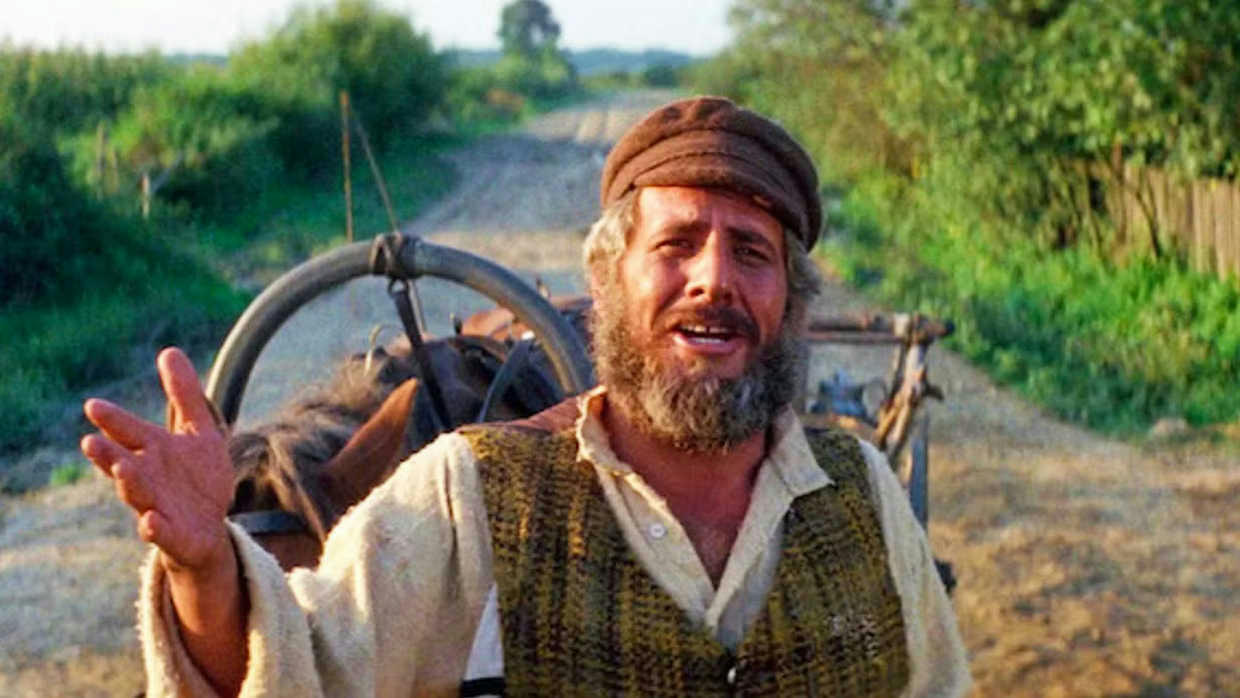
A lot of us grew up with Fiddler on the Roof.
Singing. Dancing. “Tradition!”
It felt like our story. A warm, nostalgic picture of the old country. The town matchmaker. A daughter dreaming of a simple life.
A wedding where the whole shtetl shows up. Familiar songs. Familiar struggles. A community trying to hold itself together.
For many, that image still feels beautiful. For others, it’s tinged with something harder.
What if the collapse—of family, of faith, of community—was already in motion long before the pogrom?
Because we know how it ends. The town is emptied. Families are scattered. And most people walk away thinking: That’s just what happened to our people. Tragic, yes—but inevitable.
But what if the unravelling didn’t begin with the pogrom?
What if the collapse—of family, of faith, of community—was already in motion from the start?
And what if it could’ve been stopped?
Tevye shouts “Tradition!” like it’s the answer to everything.
But when you really look at his life—what is he actually building?
He sings. He dances. He jokes with God. But it’s not joy. It’s habit. It’s survival.
He clings to melody like a man shielding himself from truth.
He says that if he were rich, he’d finally sit and study.
But there’s no learning. No clarity. No vision.
“If I were a rich man…” isn’t a goal. It’s an escape—from asking the hard questions.
When his horse goes lame, he straps himself in and pulls the wagon.
That’s resilience – at first.
But weeks later, he’s still dragging it. Still stuck. Surviving instead of solving.
Even when he’s warned about an upcoming pogrom—he does nothing.
That’s Tevye’s pattern. Don’t fix the system. Just absorb the pain. Don’t rethink the plan. Just keep moving and hope it works out.
But pain without direction doesn’t make us strong. It wears us down.
Tzeitel. Hodel. Chava.
One daughter wanted love—with a good man. Hardworking. Humble. Ambitious.
Tevye resists—not out of principle, but fear. An old widowed butcher offered security, so Tevye nearly gave up his daughter’s future for the illusion of safety.
It’s a classic mistake Jews have made for generations: Trying to fix the world without staying grounded in who we are.
One daughter followed a revolutionary. A boy full of passion. Fire. Big words about justice.
But where was it all headed? What was it rooted in?
It’s a classic mistake Jews have made for generations: Trying to fix the world without staying grounded in who we are.
He had spirit—but no roots. He knew what he wanted to tear down—but not what was worth preserving.
And one daughter went further. Marrying outside the faith. Under a cross.
At each step, Tevye bends. Not out of compassion—but out of confusion. He doesn’t know what’s worth holding onto—and what can change.
He mistakes fear for wisdom. Tradition for truth. And by the end, everything is gone.
Not just because of exile. Because nothing was holding them up anymore. Like a tree that still looks tall—but is rotting from within. It only takes one hard wind—and it all falls down.
There’s a deeper pattern here—one we still live.
First the spiritual foundation weakens.
Then the cultural bonds unravel.
Then the physical safety crumbles.
That’s not superstition. That’s history. Again and again.
When a people forget who they are, they don’t last long.
We sing the songs. Celebrate the holidays. Tell stories. But too often, we don’t ask what any of it really means.
We still do this. We sing the songs. Celebrate the holidays. Tell stories. But too often, we don’t ask what any of it really means.
It feels Jewish—but it doesn’t build anything. What starts as tradition becomes nostalgia.
And what we pass down gets lighter every time.
It’s not enough to feel Jewish. We have to live Jewish.
Freedom. Comfort. Opportunity. No pogroms. No exile. No one forcing us to hide who we are.
But if we don’t pass down something more—real Jewish meaning, structure and clarity—then we’re building on sand.
For many, Judaism has become cultural wallpaper. What some might call Seinfeld Judaism. Funny. Familiar. Even comforting.
But emptied of purpose.
If all our kids inherit is irony, bagels with lox, and a couple of holidays—should we really be surprised when it fades?
At some point, we have to ask: Is this what we want to give our children? A culture of memory—or a life of meaning?
Tevye failed because he trusted tradition to hold on without explanation.
Tevye didn’t fail because he didn’t love his kids. He failed because he didn’t educate them. He trusted the culture to carry it all. He trusted tradition to hold on without explanation.
He gave an unanchored revolutionary a platform to teach—and never asked what was taught. He let someone else shape his daughter’s mind—and never checked what she was learning.
That wasn’t just a small mistake. That was his whole job.
His wife was no different. She meant well—but her parenting came down to chores, marriage pressure, and yelling from the kitchen.
Plenty of activity. No guidance.
And their daughters? They learned plenty. Just not from them.
Our kids are always learning. From their friends, their schools, their screens. From a culture that constantly reshapes values. What are they learning, and from whom?
Jewish education isn’t just about information. It’s about formation.
It’s the foundation that helps a child know who they are—before the world tells them who to be.
Preschool. Elementary school. That’s when identity forms. That’s when everything sticks. That’s when they decide: Is Judaism something I am—or just something my parents were?
But wherever you are—it’s not too late to grow.
Because your kids aren’t just listening to what you say. They’re watching what you choose and prioritize. What you live.
They may not always listen to your words. But they become what you model.
If you want strong Jewish children—build a strong Jewish life. And let them grow up inside it.












There is so much I disagree with in this essay. I’m not even sure what you mean by “Jewish eduction.” To me it sounds like Jewish “Indoctrination.” I have a different take on the Tevye story.
Read thru the comments; I was impressed by the diversity of the responses. The comments even more so than the article made me think. Bottom line: The author was looking at the past with today's perspective. Life was very difficult then. The opportunities were few for all living in the shtetls When my husband(obm) and I moved to Tallahassee in 1971 for my graduate studies, there was no Orthodox Jewish life. To get Kosher meat we had to travel to Jacksonville. We couldn't just up & move. We did our best. Finally moved to Gainesville - wonderful community, then Atlanta. Had Kosher meat but the women and I had no connection. I worked. Most of them were able to stay home. Had food for my body, but not my soul. Now, at 75, I'm reaching out online and gathering the threads of my Judaism.
Now that I’m reading these comments here I am more appreciating what a tragic figure Tevye is. He IS doing his best - and that IS, likely, the most that could’ve been done at that moment in history. How very sad. The point is that he was doing the right thing but it was a LOST CAUSE. And that’s why Hashem brought us out of there. The ironic twist for us
Right on! Great piece
I wrote a comment that was taken off about daughters did not have a Jewish religious education only boys did in Europe, until Sarah Schneider came up with schools called Bais Yacov to teach Judaism to the daughters too, which was very important for the Jewish society before that the mothers taught the daughters and also the Torah portions were in a book language of Yiddish called the Sanarana that was all the education for Jewish women until a seamstress call3d Sarah Schneider went to Rabbis to approve a school for women, she succeeded and now there are a lot of Bais Yacovs and other Orthodox schools for Jewish women, Tevye did his best under the circumstances of the time, but in reality the daughters needed to learn their heritage in Orthodox Judaism themselves
Interesting reading,what the author lacks is more nowledge of Jews living in easter Europe, lands where oppression by the Tsar was clockwork Jews had nowhere to go except when America opened the doors & land to allow folks like Tevie to leave .Travels vere not organised ,money not either everybody took various maters in their own hand win or loose .New Yorks 2 Ave, is full of Tevie like stories, America was a difficult proposition with few choices so Tevie's life was full of chances ?either be murdered by a friendly progrom or take a chance in a new country America was the best proposition....
Your comment is so true, and in the movie I think there was a reference to the Holocaust
I am not Jewish, but I have Jewish friends and love them all dearly. This movie was my favorite musical since I was a kid (now 62). I must have seen it a dozen times.
The music alone is absolutely brilliant and so catchy. In 1993, at Detroit's Fox Theater, I took my wife, mother, and father to see the play with Topel, the actor from the movie.
They don't make music like this anymore!
Miracle of Miracles Lyrics
Wonder of wonders, miracle of miracles-
God took Daniel once again,
Stood by his side and- miracle of miracles-
Walked him through the lion's den!
Wonder of wonders, miracle of miracles-
I was afraid that God would frown,
But like he did so long ago, at Jericho,
God just made a wall fall!
When Moses softened Pharaoh's heart, that was.... good stuff 🙂
Be careful about imposing 21st century realities (threats as well as opportunities!) on an earlier time period. The point about the importance of day school, however, is spot on.
Excellent analysis and it fits today’s global situation, but the most learned Jews didn’t fair any better during any pothole nor the Holocaust. What does Jewish survival really entail?
Jewish survival is not simply about physical survival, as everyone eventually passes on. Jewish survival means the passing down of deep-rooted ideas and values: mesorah, ensuring that next link in the chain (that stretches back to G-d at Mt. Sinai, passed down from generation to generation), remains strong. This mesorah, passing down of Judaism, is what Jewish survival entails. The most learned Jews who perished - what remains of them is the legacy they gave over to those who survived, who passe that down, because their contributions remain, strengthening the links of the mesorah. Jewish survival is the continuation of us as Hashem's nation, living our lives according to His will. I think this is what the author was getting at - it is not our hope to pass on "tradition," but rather mesorah
You are right 100%
To me, the best example of Tevye's lack of education was when he said that we "always wear a little prayer shawl. ... You may ask, how did this tradition get started? I’ll tell you. I don’t know. But it’s a tradition." He didn't even realize that this "tradition" got started in the Shema, which he himself recited daily. It was a tradition to wear them, and that was enough for him. So sad.
Tevye's community were post-Takh Wetat (tach vtat), which largely severed Torah learning for the masses, so how could he know?
Tevye was more holy than one might think. He lives in the presence of G-d. He talks to him throughout the day, about the profane and also the mundane matters of his life. That's a very high level.
His daughters were provided with a very healthy environment.
And, of course, the rabbis that Aish admires were AGAINST education for girls at that time.
And, off course too -- it's a Broadway play. Written by people who were making fun of the shtetel.
But even in doing so, they portray a man of great faith.
That his daughters were moving on. That was the times. The winds of Socialism and Enlightment were stronger than we might think.
You insinuate that it would have been BETTER for girls in 1905 to have education. Actually, in 1917, Beith Ya'aqov was launched, with backing of Gur & the Chafetz Chayim & this was done to strengthen them against socialism, secularism & assimilation, otherwise it would not have been done. Today, it's continuation is facilitates livelihood as well as better informs students of Judaism!!! The Jewish woman of today is far more literate Jewishly. The STIFLING poverty of Eastern Europe was a factor, so that wealthy Jewish women were more Jewishly educated. Sarah Schenirer's launching of Beith Ya'aqov gave POORER Jewish woman access to greater Jewish education.
It's so good that you are here on Aish.com, Elena! Your soul is still seeking the joyful nourishment you know is there.
OUTSTANDING!
Nothing new. Let's look at our Jewish History. As we read G-D's Written Torah - we see that - G-D caused the FLOOD because men began believing & practicing all manner of humanistic beliefs. Jewishness devolved - from the time our forefathers - came to Egypt & were seduced by the the cultural environment - they became used to seeing from the Egyptians. It continued after the Exodus & the 40 years disobeying in the desert. It recounts throughout the Neviim - the Jewish devolution - until & with the beginning of the belief in Xtianity 2500 years ago - then Muslim beliefs - and others.
We need to ask G-D - to use His Power - HIS LEADERSHIP - to teach us His Written Torah - as He told us to teach our children - & help us do this in EACH GENERATION forever.
He cut off Hodyl. He only wished her well in end because that was the last time he would see her
This is a great article - right on the mark. I am a baal teshuva (getting close to sixty years) and B"H I voted way back then to discover my Jewish roots and pass them on to my family. B"H we have children, many grandchildren, and great grandchildren who are Torah observant and making the world richer through their purposeful attachment to their faith. And my aunts, uncles, cousins, etc. from where I came from? Mostly a spiritual wasteland, culturally informed but spiritually ignorant, loving 'Fiddler on the Roof' but just as lost as he and his family. It's never too late to make wise and consequential decisions. As R' Noach Weinberg was wont to say: "You're not living if you don't know what you're willing to die for."
Sadly by the time this article was written we are reliving this question in the diasporah.
Do we hide our jewishness from those who hate us and want to destroy us ?
Thank God, today there is a solution to the ominous problems of living in the Diaspora.
Reside in your homeland, where you are welcome and can experience miracles daily!
Instead of trying to deal with antisemites, keep any arguments within the family.
Yes, there are unfortunately enemies within the Jewish community, but they are by far the minority and will eventually disappear (since traditional and, especially, religious communities keep growing, b"H, while they're a vanishing breed).
We do NOT all hide our Jewishness. I wore my Kippah in Communist Hungary when I lived there till I was 14, and I wear it everywhere in the world, wherever I go.
Actually from what we now know from the science of trauma, sometimes people can't live past what's in front of them without help. In this story, at least Tevye had his community. But he was so stuck in the trauma of surviving the now, he couldn't see ahead.
And nowadays, many rich Jews snub the poorer ones especially single mothers. I put my kids through Jewish day school since preK and by the time they were in high school they were so turned off by the snobbery and elitism that they became atheists. And neither one has a Jewish partner. The Jewish community is still not addressing these issues. Education is great and I thought it would revive the continuity. But instead it likely ended it. And we were the last practicing Jews in the entire family.
There’s a lot of truth here. I became disabled, and my salary was too source of kids’ tuition. After I lost my full salary, we had to discontinue their day school educations.
It sounds like there were so many traumas for your family to live through. How terrible that your community did not step in to assist you and your children! I am so sorry that you were let down in these ways.
There should be scholarships in cases like this, that rich people should help people that can't pay for their child's Jewish education
How sad! But b"H, this is not the norm—quite the contrary!
I hope your children can somehow manage to find their way back under the mentorship of mentchlich Jews.
I guess they didn't learn how to be a Jew on one foot, to put yourself in another's shoes so to speak, instead of snubbing single mothers they should have helped them, and also help them pay for tuition, in Judaism there is tzedka to help the less fortunate, I guess these people failed the test of being rich, you are rich to help the less fortunate if Jewish people acted like that, it is not the Jewish way it sounds like a foreign culture to me, when my mom( obm) was very poor she( obm) gave tzedka and the collectors saw she ( obm) was poor so they gave her( obm) money, it is so sad that happened to your children not everyone is like that, there are good people that help others not just snobby snubbers
This seems to ignore the actual times. He didn't educate his daughters? Who educated their daughters then. He wasn't particularly educated, though he certainly wasn't ignorant, as was true of most of the people who had to work long backbreaking work just to keep a roof over their heads. He wanted to marry his daughter to a fine, but older, man who would treat her well and give her security? In a world where women needed men for security, that was common. The musical isn't set in NYC in the 1960s where the criticisms might have been correct. It's a story of its time – exaggerated because it's a series of humorous short stories and a musical and not a documentary or history book – but its tells much truth about devotion to God, family, home, and tradition under trying circumstances.
I agree in that I think this was written with a very 21st century perspective. Daughters were not educated, they were trained to be mothers and wives. There was no alternative for women. Tevye straps himself to a plow because there is truly no other option for him. He fantasizes about being a wealthy man because there is absolutely no possibility he will ever be wealthy. Everyone who had a life as hard as that would probably have a fantasy of an easier life. The closest he could possibly come is having a daughter who is married to a butcher. Evolving of tradition can be excruciatingly painful, but it's also inevitable.
Of course Tevye wasn’t sending his daughters to day school—but education never only comes from school. It comes from life. From what we model, what we explain, what we prioritize. And when we don’t, someone else always does.
That’s the real loss in Fiddler. His daughters didn’t rebel—they simply weren’t rooted. Judaism came through as pressure, not purpose. So when life pulled them in other directions, there wasn’t enough there to hold them.
The guidance of our own generation’s leaders has been clear: in a world like ours, we need real schools, strong communities, and parents who live what they want their kids to carry. That’s not a critique of the past. It’s a responsibility to the future.
The original Broadway LP record of Fidler was what I sometimes describe as "the soundtrack of my childhood". It was seemingly playing all the time and as I got older I began to appreciate the humor of Sheldon Harnicks lyrics and I often say something like "in the words of the great Jewish philosopher Sheldon Harnick 'when you're rich they think you really know'. Ha.
As I got even older, I began to see the tragedy of Tevya. His "I don't know but it's a tradition" is not just a cute lyric, it is at the heart of the assimilation so rampant among Harnick's generation. The show opened in 1964 and Harnick and Bock weren't historians, they were two very typical products of their generation speaking to their generation.
If only all the Tevya's had "known" more about his traditions. Sigh.
Great article. The historian Rabbi Beryl Wein once said that the Judaism of that time and place was a mile wide and an inch deep. No surprise so many chucked it on their way to the New World or shortly after their arrival.
But what's also sad is how Fiddler on the Roof played to the hearts of "bagel and lox" Jews with a warm spot for Jewish tradition living in the 1960s, but can no longer do so. Jews back then wouldn't have been happy if their daughter married a poor man or a revolutionary, but they could deal. But a non-Jew? That was too much. Today it no longer is.
Very perceptive analysis. Really hits the nail on the head!
Story of my life. I married Jewish but we divorced. Then I married outside the faith but still went to temple. Then the temple lost its support and we have no place to celebrate Judaism.
Try a shul, with a rabbi who does outreach in a warm, Torah-true community.
Try Aish or Chabad
You could have moved, if you missed the Temple. Our parents left Hungary and came to a new country where they started over with NOTHING, not even knowing the language, but they did it to stay Jewish. It is all a matter of choice and committment.
Does it really?
As someone commented above: you cannot use today's standards to judge the past
The daughters learnt from their parents and osmotically accepted the traditions and carried them forward. They were females who did not do book learning and were not Yentels.
We are looking backwards as a sheltered life of simplicity and not a sophisticated world of the internet, social media and advanced technology
That was life for hundreds of years that handed down traditions and the blue print of existence. It did not fail the people. The anti Jewish world failed them.
Well now we are in the same place, after all these years with back to square one