




 The Hidden Pattern of Jewish History

7 min read
6 min read
7 min read



8 min read


A haunting portrait of NYC’s poster war, Torn reveals how grief, denial, and dialogue collided on city streets after October 7—turning walls into battlegrounds of empathy and division.
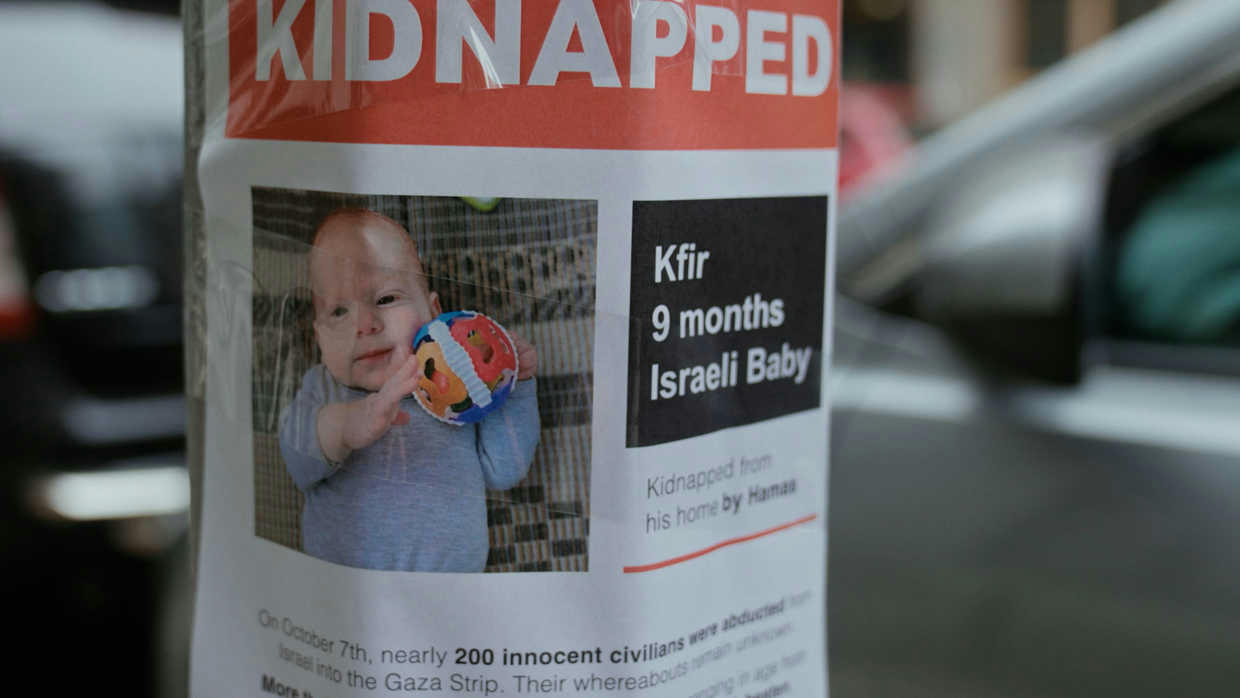
Torn, a documentary directed and produced by Nim Shapira, is a gripping portrait of what unfolded on the streets of New York City in the first three months of the war following October 7. The film does not take place in Israel or Gaza, but in NYC—where grief, anger, and division played out in public space and online. The period it covers ends around Thanksgiving 2023, when the first hostage deal was reached and the poster war on New York’s walls had already left its mark.

Nim Shapira was in Israel on October 7 when Hamas attacked. When he returned to New York, where he had lived for 13 years, he was unsettled by the city’s reactions. It was remarkable how quickly the “Kidnapped” posters went up. But just as remarkable was the backlash: they were almost immediately torn down, burned, and defaced. The documentary captures this heated atmosphere, documenting the hostility and debate that emerged in New York after October 7.
For Shapira, the loss was personal. Friends of his had family members who were kidnapped or murdered. The grief weighed on him, especially as people he’d long known—New Yorkers he had shared coffee or drinks with—began suggesting that the hostages were actors or AI, or that the victims somehow “deserved what they got.”
“Living in New York,” he recalls, “I felt both the distance and the closeness: the news was happening thousands of miles away, but grief—and denial—appeared in my social feeds and conversations every day.”
As a filmmaker, he felt compelled to capture this fragile moment—not to provide simple answers, but to document how a distant war fractured daily life in NYC, and to give voice to the conflicting perspectives of New Yorkers caught in the crossfire.

“In many ways, the film is my way of inviting ‘the other side’ into a conversation. I believe dialogue—even when uncomfortable—is the only way forward.”
The film follows the voices of artists, activists, and families of the hostages, showing how they handled the backlash on the streets of NYC.
It begins with Alana and Liam Zeitchik, siblings whose relatives were kidnapped and taken to Gaza. On October 7, as Alana and Liam watched the horrifying news, they paced in front of the television, waiting for their family members in Israel to answer the phone.
“I kept telling myself and my brother, they aren’t answering because there isn’t service in the Maamad (bomb shelter).”
They could never have prepared themselves for what was to come. Then came the dreaded voice note from their cousin Danielle. Their hearts stopped as they heard her voice, laced with panic:
“The house is on fire!
We are on fire!
If we stay inside we will burn alive. If we flee outside they’ll shoot us…
Smoke is filling the room.
It’s over.
I hear gunshots outside… We are doomed either way.
This is the end for us.”
While scrolling TikTok, Alana found a video of abducted Israelis being driven away by Hamas terrorists. Her jaw dropped when she saw her cousin Sharon, who had just visited her in New York, in the footage. Sharon had been kidnapped along with her husband David, their twin three-year-old daughters, her sister Danielle, and Danielle’s four-year-old daughter. David remains in captivity to this day, together with his younger brother Ariel.
“Seven of my family members were taken hostage by Hamas,” Alana says. “It’s hard to put into words what I was feeling.”
When she saw others creating posters of the hostages, it meant the world to her. Seeing that strangers cared gave her hope.
The documentary also interviews the two artists behind the posters: Israeli street artists Nitzan Mintz and “Dede Bandaid.” They had arrived in New York in September 2023, and after October 7, began brainstorming what they could do from afar.

“We decided to create posters inspired by the ‘missing children’ on milk cartons,” they explain. “In a city flooded with images, we needed something bold.” Instead of “missing,” they chose the word “kidnapped,” added names and ages, and printed 2,000 copies. Initially, few New Yorkers took interest.
They tried handing out posters to strangers, but no one was interested. One person even said: “Why bother? Everyone was murdered.”
That night, they published pleas across social media asking for help to post the flyers. When they awoke, their phones were blowing up with notifications. Jews of all stripes had started putting them up all over the world—Berlin, Paris, London, Australia, New Zealand. ABC and FOX News picked up the story. The posters were making an impact.
The posters became more than just notices—they were stand-ins for absence, grief, and the fight over visibility in one of the world’s most diverse cities.
Liam took time off work to post flyers daily. “It became my mission,” he says.
While many embraced the project, the backlash was fierce. The film shows Liam confronted by a man who told him, “If you cared about children, you would be putting up posters of Palestinian children.” Liam replied, “This is my cousin’s daughter. She’s four years old and being held captive.” The man’s response: “She looks like a white colonizer.”
Other scenes depict posters being ripped down, defaced, or mocked. “What struck me most,” Shapira reflects, “was how quickly the walls of New York City became a symbolic battlefield over grief, empathy, and visibility.”
When asked why they were tearing posters down, some refused to answer. Others mocked or defaced the images: one drew a Hitler mustache on a hostage’s face; another spat on a poster; another gave the middle finger and said, “F Israel. F you.”
 Nim Shapira
The conflict wasn’t only visible on lampposts and storefronts. It also unfolded across social media, where harassment, unfollows, and doxxing intensified divisions. Friendships fractured as people blocked or attacked each other online. Viral videos of torn posters triggered real-world consequences: one clip drew thousands of views and led to a doctor being fired, an NYU student suspended and expelled, and donors pulling funding from the university.
“A lot of the fighting happened online,” Julia Simon, a student at Parsons and a friend of Omer Neutra, who also appears in the film, explains. “And then you have to show up in class and sit next to them and talk about your homework assignment.”
The escalation spilled back into the physical world, with stickers placed over ripped posters reading: “The person who ripped this sign supports rape, murder, and mutilation of Jewish people.”
The film also examines the role of social media in shaping moral binaries. “Jonathan Haidt, my colleague at NYU, speaks about how the increased use of social media among the young has reinforced moral binary thinking,” notes Rabbi Yehuda Sarna, another interviewee. “On social media, you either see views that reinforce your own perspective or the most extreme version of the other side. There’s no gray. Seeing these faces challenges that binary view.”
Other voices include Chen Levy, a jewelry designer in midtown, who displayed both a Star of David and the hostage posters. “Since Oct. 7, every day people come and tear the poster. This is private property. Many pro-Palestinian rallies down the street started to target my store daily and send threatening messages. I didn’t feel safe.”
Her store was repeatedly targeted, and police advised her to remove the star. “The day I have to remove the Star of David is the day I move from this country,” she says.
By the end of the film, the artists acknowledge that while the poster campaign drew attention and created conversation, it did not solve the larger problem—the hostages remain in captivity. The film closes after the Thanksgiving 2023 hostage release deal, marking the end of a chapter but not the end of the crisis.
Shapira ends with a plea for dialogue, which has become even more urgent in the wake of Charlie Kirk’s assassination:
“Restricting speech risks silencing dialogue. We are thousands of miles away from the war—no rockets or missiles are falling on us. The least we can do is hear each other out. We don’t have to agree with one another’s narrative, but we do have to listen. And there are enough lampposts and walls in New York for everyone’s grief and pain.”
In doing so, the film highlights not only a conflict overseas, but also the fractures—and fragile possibilities of dialogue—within New York itself.
The film opened, Friday, September 12, in Los Angeles for a one-week Oscar-qualifying theatrical run at the Laemmle Town Center 5, through September 19. Torn can also be streamed directly at torn-film.com, where audiences can either watch at home or host a community screening.









This is the result both of the 1965 Immigration Reform Act and the demographic transformation of NYC plus the ongoing radicalization of America starting in, oh, about 1880 by certain immigrant groups plus the quakers sponsorship of the Frankfurt School. Mamdani will be mayor and he’s a result of the same. Don’t expect any improvement anytime soon. BTW, when you compile and then publish granular demographic data and caterwaul publicly about its dismal data set, you invite—invite—attacks from people who do not like you and want to fill the political vacuum you’ve shown to the world.
Torn posters and hatred of Israel? Pressure on Jewish students? Look forward to about 75 years of the same and worse.
some people need to learn to keep their big mouths shut a appreciate this country.
Heartbreaking! What does G-d think of the inhuman humans He created?
In the bible it says Ishmael is a wild man, also once before when humans acted inhuman G _ d brought a flood, now something else would come to destroy the evil that these inhuman things they do, before that there was a Holocaust which was also inhuman to humans, whoever starts up with the Jews and Israel will not exist, all empires that started up with the chosen people don't exist anymore, in the end evil will be erased and vanish like smoke, and these terrorists claim to be religious, they are full of bologna