 Bestselling Author Freida McFadden Reveals Her True Identity





12 min read


A quarter million Jews were murdered at Sobibor. But on one October afternoon in 1943, nearly 300 prisoners fought back and ran for their lives.
On Yom HaShoah (Holocaust Remembrance Day), as we remember the six million, Sobibor demands we remember something else: the moment when Jews marked for certain death rose up and demonstrated that even inside a killing factory, courage and defiance were still possible.
They armed themselves with whatever the Nazis overlooked: axes smuggled from the camp's own carpentry shop, hammers lifted from the metalworks, knives quietly forged from scrap metal. Day after day, under their captors' gaze, Sobibor's prisoners built the tools that would one day turn the camp against its masters. When their hidden arsenal was finally ready, they struck with precision, killing eleven SS officers, including the deputy commandant, and blasting open a path that allowed nearly 300 prisoners to seize their freedom.
Sobibor began operating as a Nazi death camp in April and May 1942. Unlike most Nazi camps, where prisoners were worked to death or cycled through labor details, Sobibor had a single purpose. Alongside Belzec and Treblinka, it operated under Operation Reinhard, a plan to systematically murder the Jews of German-occupied Poland.
It was a killing center. Hidden in a forest near the village of Sobibor, eight kilometers south of Wlodawa, a small town's name became synonymous with industrialized murder.
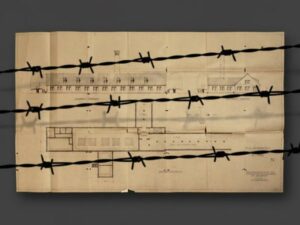
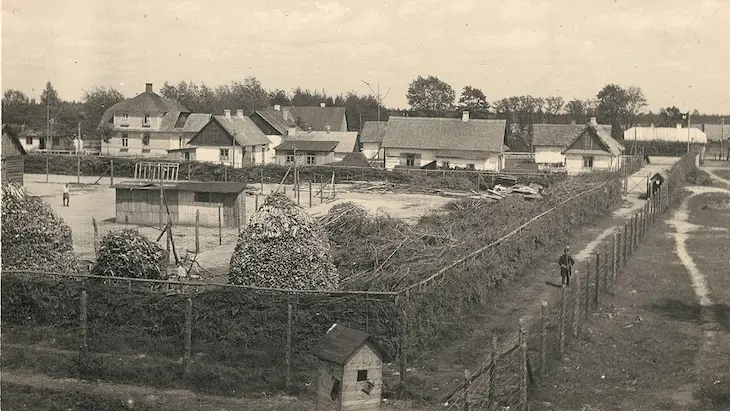 Sobibor camp, 1943
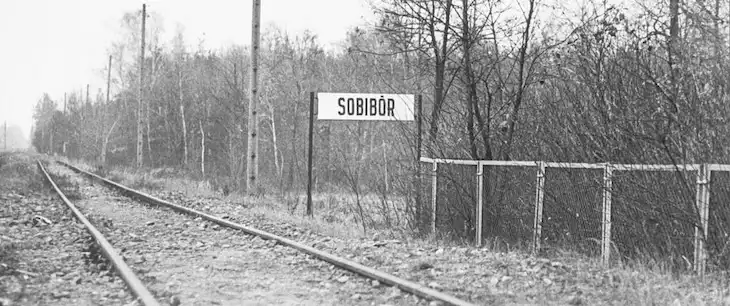
Trains arrived from ghettos across Europe along a rail line beside the camp. Most victims were taken directly from the cattle cars and killed in the gas chambers within hours. The elderly, the sick, and the infirm were often shot at open pits instead.
Sobibor was divided into zones. The Vorlager (Fore Camp) was the administrative hub, containing the main gate, a railway spur, and housing for the black-uniformed SS and Ukrainian guards. Camp I held workshops for blacksmiths, cobblers, cabinetmakers, and tailors, workshops that would later play a decisive role in the uprising.
In Camp II, Jewish deportees, many still unaware of what awaited them, were ordered to undress, surrender their money and belongings, have their hair cut, and walk toward a fenced pathway known as the "tube," which led directly to the gas chambers. Ukrainian guards, with German authorization, took many of the sick, elderly, and young children to nearby ditches and shot them.
Beyond Camp II lay Camp III, where SS men and Ukrainian guards drove victims into the gas chambers with whips and dogs. The mass graves were here, as were the barracks for the small group of Jewish prisoners forced to move the bodies. It was the heart of Sobibor's machinery of murder.
Holocaust historian Raul Hilberg cites the testimony of an SS man temporarily assigned to Sobibor, who described a 200-horsepower, eight-cylinder engine, taken from a captured Soviet tank, pumping lethal carbon monoxide into chambers that could each hold more than 200 people at once.1
Sobibor had no crematoria. Corpses were burned in open pits. People living near the camp recalled the night sky glowing from the fires and an overwhelming stench that drifted for miles.2
In its short existence, Sobibor claimed roughly a quarter million Jewish men, women, and children from Poland, the Netherlands, the occupied Soviet territories, and Western Europe.
Prisoners kept alive for labor were forced to clear the gas chambers, burn the bodies, and crush remaining bone fragments to powder, part of the camp's effort to erase all evidence of mass murder. They lived under watchtowers, electrified fences, minefields, and armed guards, surrounded by constant reminders that no one was meant to leave Sobibor alive. It was not a prison. It was a factory built for one ruthless purpose: to kill with maximum efficiency.
Leon Feldhendler (1910-1945) was born in Turobin, Poland, son of Rabbi Symcha and Gitla Feldhendler. His family was well known and relatively comfortable in their community. Before the war, records are sparse, but he appears to have worked as a miller with no deep involvement in political organizations.
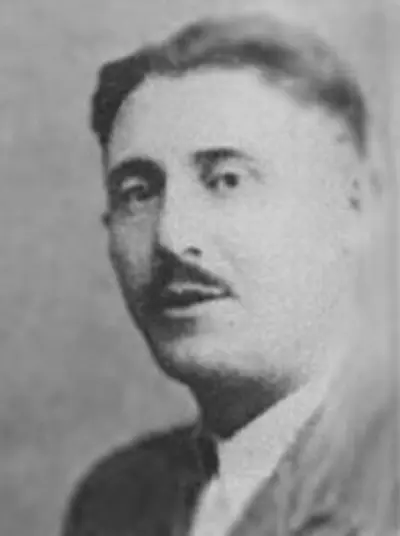 Leon Feldhendler
During the German occupation, he became head of the Judenrat (Jewish Council) in Zolkiewka and led the local Jewish Self Help Society, working to secure food and aid under brutal conditions.
In October 1942, the Jews of Zolkiewka, including Feldhendler's family, were deported to the Izbica Ghetto, where his parents and sister were murdered shortly after arrival. Feldhendler hid for several weeks before being discovered and sent to Sobibor on November 2, 1942.
Young and able-bodied, he was kept alive for forced labor, sorting the clothing and belongings confiscated from incoming prisoners. Over the following months, he quietly formed a secret committee and began building an underground network. They studied the camp's layout, operations, and daily routines, sketching plans for a mass escape. But without anyone with military training, the group stalled. Real resistance remained more hope than plan.
Alexander Pechersky was born in 1909 in Kremenchuk, Ukraine, son of a Jewish lawyer. He was a brilliant man with a university degree in music and literature, who later worked as an accountant and managed a small school for amateur musicians. Everything changed when he was conscripted into the Red Army.
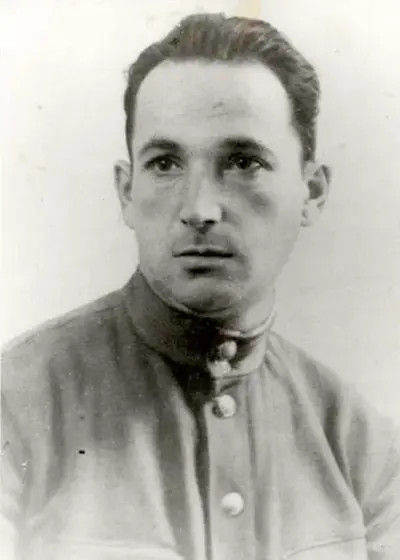 Captured during the Battle of Moscow in 1941, he managed to conceal his Jewish identity for nearly a year, until a medical exam after a failed escape revealed it. "I was locked up with other Jews in a place nicknamed the Jewish cellar," he later recalled. "Ten days in total darkness."3
In September 1943, Pechersky arrived at Sobibor on a transport of Jewish Red Army prisoners of war from a labor camp in Minsk, Belarus. Of the roughly 2,000 people on that train, almost all were sent straight to the gas chambers. He survived only because he was strong enough to be pulled into the labor force.
Within days, he crossed paths with Leon Feldhendler. One spoke only Russian; the other only Polish and Yiddish. A prisoner from Warsaw stepped in to translate. Three weeks later, the quiet newcomer with military training had become the driving force behind a bold, fully formed plan for revolt.
Together, the two men conceived one of the most daring plans of the Second World War.
Feldhendler and Pechersky's plan unfolded in three phases. First, underground members with access to knives, axes, and hammers delivered weapons to the men assigned to kill specific officers. Then, the assassins lured their targets to preset locations and eliminated them as quietly as possible. "They had to be taken out one by one, without the slightest sound, and within no more than one hour."4
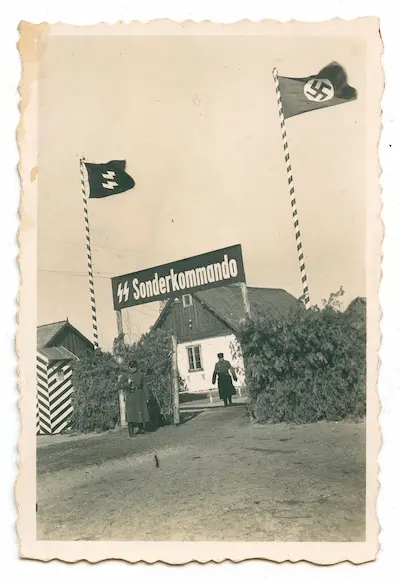 The fence at the entrance of Sobibor was covered with tree branches to camouflage the mass-murder operation. (U.S. Holocaust Memorial Museum)
Other conspirators disabled the camp's vehicles and cut the telephone and telegraph cables. Finally, a kapo (a prisoner appointed to a supervisory role by the Nazis) would blow the whistle for an early roll call, giving inmates an excuse to gather near the main gate without alerting the watchtower guards. From there, the underground hoped the rest of the prisoners would seize the moment and escape en masse.
In Camp One, just before 3:30 p.m., a messenger arrived with a simple request: the tailors needed Johann Niemann, the highest-ranking SS officer in Sobibor, to try on a new leather coat. He walked toward the workshop without hesitation, even handing his horse's reins to a passing prisoner. Inside, he set his belt, revolver and all, on the table and slipped on the coat.
As he turned to admire the fit, a prisoner brought an ax down on his skull. Niemann dropped to the floor, the first SS officer to fall. His body was hidden beneath a table; sawdust covered the bloodstained floor.
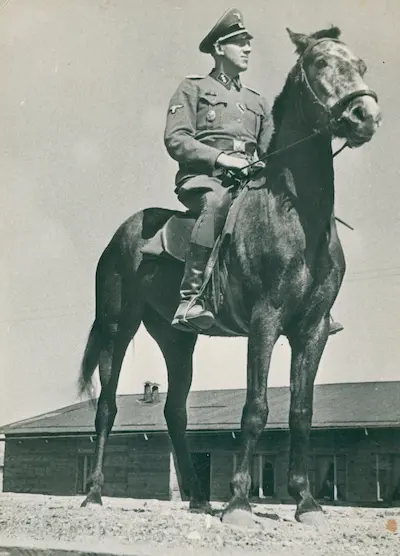 Johann Niemann poses on horseback at the arrival ramp. (U.S. Holocaust Memorial Museum)
In Camp II, prisoners lured SS NCO Josef Wulf into a warehouse of victims' belongings under the pretense of trying on an expensive coat. Once inside, surrounded by the stolen remnants of the dead, they struck before Wulf understood he had been led to his execution. Two Soviet prisoners dragged him behind a pile of clothes to hide him.
In a nearby barrack, SS man Siegfried Graetschus was next. Sobibor prisoner Chaskiel Menche, a Polish hatmakers' foreman, took out a pair of scissors and repeatedly stabbed the corpse, shouting: "This one is for my mother, and this one for my wife, and this one for my child, and this one for all the people of Israel."5
Over the next hour, small groups of prisoners invited individual SS officers into workshops one by one, under ordinary pretexts: to try on boots, a leather jacket, or to check on alterations. Across Sobibor, eight more SS men fell to axes, knives, and hammers.
Then Pechersky signaled the kapo to blow the roll call whistle. Prisoners poured into the yard, most unaware that the camp's command structure had just been destroyed. Chaos erupted almost instantly: one conspirator killed a guard, while elsewhere an SS officer stumbled upon a corpse and opened fire wildly. Pechersky leapt onto a table and shouted over the gunfire, telling the stunned crowd that their captors were dead and the moment had come. "Forward, comrades, forward! Death to the fascists!" With that, the camp surged toward the fences.
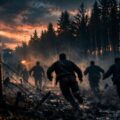
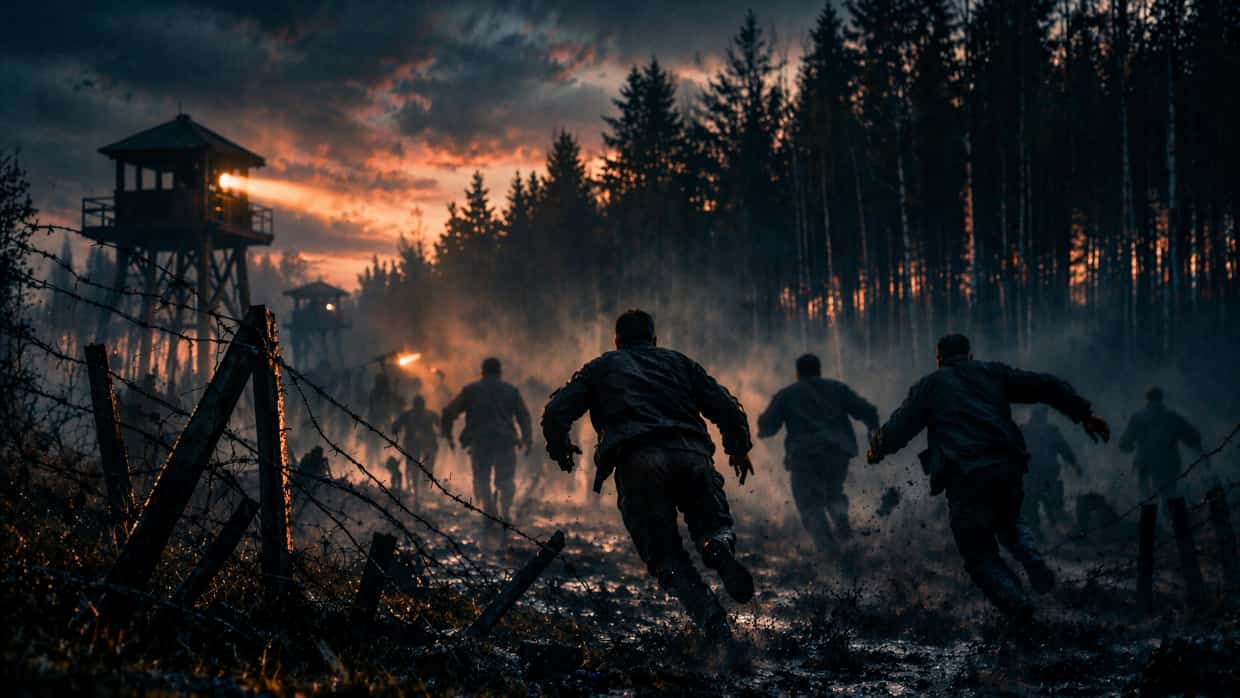
Machine gun fire erupted from the watchtowers as prisoners threw themselves toward the perimeter. The barbed wire buckled and collapsed under the weight of bodies pressing against it. Hundreds sprinted through smoke and shrapnel into the open fields beyond Sobibor. Mines detonated beneath their feet. Many fell, shot from the towers or torn apart in the minefield, but the surge did not stop.
By the time the camp's defenses fully responded, more than 300 prisoners had broken free. In the forest, survivors regrouped only long enough to scatter again, breaking into small bands with a better chance of slipping through the tightening dragnet. The next day, the Nazis executed every prisoner left inside Sobibor.
Hundreds of German soldiers, Ukrainian guards, SS men, and police fanned out across the region. More than a hundred escapees were captured within nine days. Another fifty or more were murdered by civilians, some of whom pretended to offer help before shooting the fugitives and stealing their belongings. Those who survived did so by vanishing into the forests, joining partisans, or finding the rare sympathetic Pole willing to hide them.
About 300 prisoners escaped during the revolt. Only around 60 survived the war to testify to Sobibor's existence.
In the immediate aftermath, SS chief Heinrich Himmler ordered the camp erased. Within days, Sobibor was shut down. A group of Jewish prisoners from Treblinka was brought in to dismantle the remaining structures. The grounds were plowed over and thousands of trees planted to conceal the murder of at least 250,000 Jews. When the work was finished in late November 1943, those prisoners were murdered as well. Sobibor never killed again.
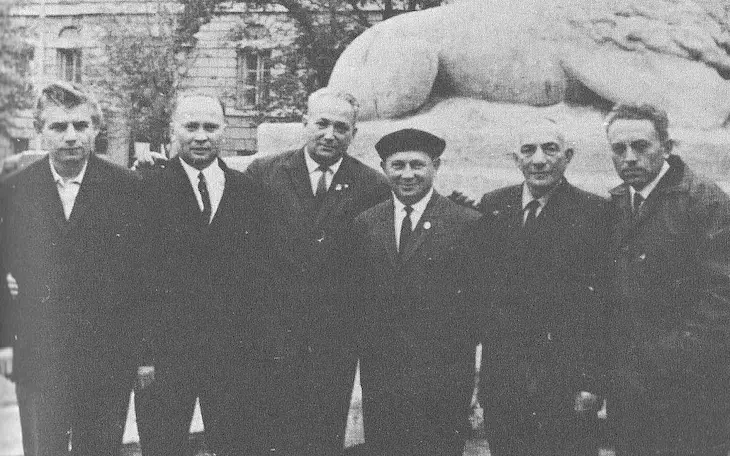 Alexander Pechersky (third from left) and other former Sobibor prisoners circa 1970. (Public domain)
The destruction was part of a broader effort to eliminate evidence of Operation Reinhard. In response to the uprisings at both Treblinka in August 1943 and Sobibor in October 1943, the Nazis launched Operation Harvest Festival, the mass execution of approximately 42,000 Polish Jews, including 18,400 murdered at Majdanek in a single day.
After the war, the fates of the uprising's leaders were tragically different.
Leon Feldhendler, who had quietly organized resistance inside Sobibor for nearly a year before the revolt, survived the escape only to be shot through his apartment door in Lublin by antisemitic Polish attackers shortly before the war ended.
Alexander Pechersky escaped into the forest and rejoined Soviet partisans. He survived the war, but in 1948 the Soviet government arrested him, accusing him of collaboration. He was barred from leaving the USSR and prevented from testifying at international trials, including the Eichmann proceedings. Pechersky died in 1990, never having been allowed to tell his full story on the world stage.
The Sobibor uprising has been depicted in both dramatizations and documentaries. Films like Escape from Sobibor (1987) and Sobibor (2018) focus on the planning and execution of the revolt, while works such as Claude Lanzmann's Sobibor, October 14, 1943, 4 p.m. (2001) and the archaeological documentary Deadly Deception at Sobibor draw on survivor testimony and the physical evidence the Nazis tried to erase. Together, these films preserve the story of the most successful revolt in any Nazi death camp and the survivors who ensured it would not be forgotten.
A modern memorial and museum now stand on the grounds of the former extermination camp at Sobibor. Its mission centers on survivor testimony and the legacy of uprising co-leader Alexander Pechersky, whose charge, "Those of you who survive should bear witness," serves as the museum's guiding principle.
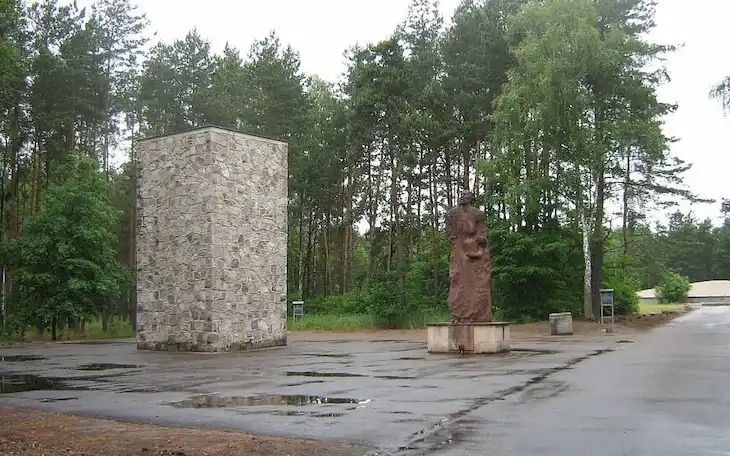 A memorial at the site of the Sobibor extermination camp in Poland. (Public domain)
The complex features a permanent exhibition on the camp's operation from 1942 to 1943, a memorial mound containing victims' ashes, a Mother and Child monument, and archaeological paths tracing the camp's layout, including the "Road to Heaven," the route to the gas chambers. A visitor center and educational facilities complete the site.
One of the museum's most powerful installations is an 82-foot glass showcase holding more than 700 belongings of the murdered: jewelry, keys, glasses, scraps of clothing, writing tools. Seen together, these everyday objects carry an almost physical weight.
Extensive excavations in the 2010s and 2020s uncovered gas chamber foundations, personal belongings, and other camp structures, reshaping historians' understanding of the site.
In 2024, the museum received a special commendation at the European Museum of the Year competition.