






 The Red Cross’s Jewish Problem

11 min read





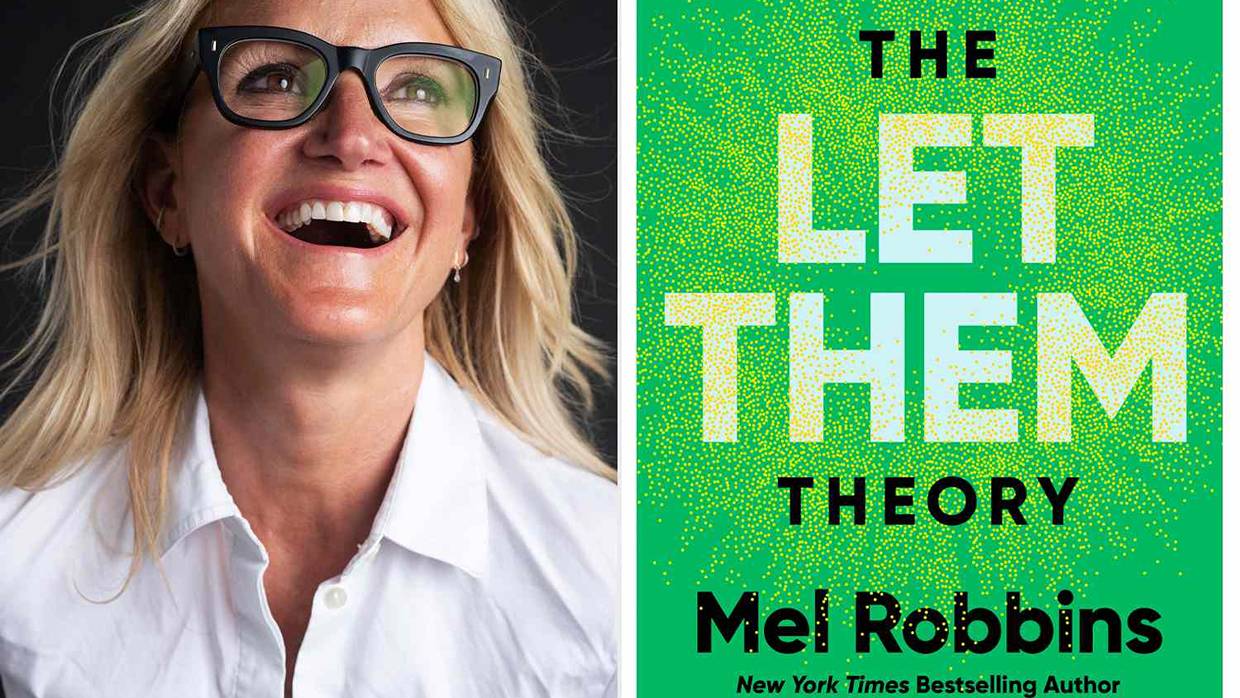
Mel Robbins Let Them Theory helps you stop trying to control people and let them – and yourself – be.
Author Mel Robbins initially shared the Let Them Theory in an Instagram post in May 2023 that now has more than 15 million likes and over 15,000 comments. She now explains her theory in detail in her latest book The Let Them Theory, a guide to reducing the impact of other people’s judgments, dramas and opinions on your life. Mel believes the theory can set you free from the exhausting cycle of trying to manage everything and everyone around you.
Robbins writes that so much time and energy is wasted forcing other people to match your expectations. Let them be themselves because they are revealing who they are to you. Just let them. And then you get to choose what you do next: “Immediately what happens when you adopt the Let Them Theory is that you are able to catch yourself when you're controlling people and you don't need to be.”
Here are three ways that you can apply the Let Them Theory to your life.
You may be standing on a slow line at the grocery store and wondering why there is only one cashier working. You get yourself worked up. If you were running this supermarket, you would have at least three more lines open. You convince yourself that you know how to run a grocery store better than the useless manager. And where is the manager anyway?
Ask yourself if this is really your business. Let them run their own store. Just let them. And then you can decide what to do about the situation without the emotional reactivity. You can leave. You can call your grandmother. You can listen to a meditation or a podcast.
Or you’re stuck in traffic because they decided to paint one of the lanes during the busiest part of the day. Why did they decide to do that? It doesn’t matter. Ask yourself if this is your business. As Robbins writes, “Use the Let Them Theory to detach yourself from the emotional or mental struggle that you get yourself into. When you're thinking about either what other people are doing or how things should be going.”
You may have somebody that you are close to in your life that you really want to help. You think that if they would only go on that diet, stop that habit, apply themselves more or let you take over the situation, it would solve all their problems. And so you hide all the snacks, give them that look when they pour a drink, tell them over and over again to work harder. You can figure it out for them if they would just listen to you.
Take a step back and ask yourself if you are really helping. How many times have you done this and the person you love has not changed?
This is one of the hardest ways to apply the Let Them Theory, but you have to let people around you fail. You have to give them room to grow and take responsibility for their own lives. Every time you try and rescue someone, you rob them of the opportunity to grow. “Every time you step in and you make the problem go away, you make the person a little weaker and more dependent on you. So if you truly want somebody to tap into the strength inside themselves, let them.”
So your teenager is late again for class? Let them. Your spouse breaks that healthy diet? Let them. You don’t help others by taking away their opportunities to solve their own problems.
Perhaps you are dating someone and you wish they were just a little thinner or more ambitious. Or you’re married and still waiting for your spouse to love having guests or to suddenly become the life of the party. Or you have a child who you wish would follow in your footsteps or at least share your beliefs.
In these situations, you need to ask yourself: Am I seeing others as they really are or as I wish them to be?
You may spend an inordinate amount of time and energy trying to change someone instead of having a relationship with the person who is actually in front of you. As Mel Robbins writes, “Let them be themselves. When you let somebody just be who they actually are and you stop trying to make them something else, you realize in so many friendships and so many relationships, you actually are in love with their potential. You're not in a relationship with who the person really is.”
If your children have different interests than you, let them. If your spouse is an introvert and prefers to skip the get together, let them. Let people have their feelings too. It’s okay for people close to you to be angry, frustrated or sad without you immediately having to try to fix it. It is a gift to the people around you to see them as they really are instead of who you prefer them to be. And once you let them be themselves, you can decide who you truly want to be in the relationship and what choices you want to make.
Robbins writes, “You trick yourself into thinking that you're going to be in control if you can control other people. It doesn't work that way because you can't control other people. You can manipulate them, you can guilt them, you can shame them, you can compliment them, you can love them, but you can't control them. The person that you can control is yourself. And every time you use the Let Them Theory, you immediately reverse the focus of that control on everybody else, and you turn it back on yourself.”
So the most important part of this life-changing tool is actually what happens after you say “let them.” That’s when you tell yourself: Let me. Let me decide what kind of person I want to be. Let me decide if I want to stay in this office, this relationship or this situation. Let me decide what I want to focus on. Use this life-changing tool to let others be themselves and to give yourself back the energy and time to become who you want to be.












This sounds like - it's straight out of the Chr-stian belief playbook - of "turn the other cheek" - forgive them for everything - there is no such thing - as offenses,
While this is good advice for the given situations (and something I discovered years ago.) However, it doesn’t take account of things specific to us as Jews. I am thinking specifically of dealing with a spouse and adult children who are not observant despite my best efforts through the years.
Just a quick note: Let Them appears to be a work that is plagiarized from a much smaller creator. I just read an article with evidence from the original author of the method behind the system (along with screenshots detailing her process and Mel finding it and following it after the fact).
I just mention that because smaller creators are often erased by larger authors/artists who can easily pay to silence them.
I heard you should just give them love unconditional love and stop making them from for me. That’s that’s very hard. That’s why I’m reading this, but this is what you should do.
Excellent advice. My mom always spoke to me about these ways of thinking and approaching relationships- it is indeed a lifelong endeavor😊
When someone shows us who they are, let them.
Mel my 28 year old son has cut me out of his life because I didn’t vote how he thought I should. My heart is broken and I don’t know what to do. He won’t answer my phone calls or messages. Help.
People are selling drugs to other people and addicting them and killing them? Not your problem. Let them.
Your husband regularly drinks too much and drives drunk? Let him.
Your teenager is chronically late for class? Let him. Don't try to teach him the importance of being on time.
Your wife is ruining her health by being morbidly obese? Not your business. Let her.
The "public servants" at the DMV treat people rudely and needlessly keep customers waiting unconscionable lengths of time? Don't get worked up about it and try to improve the service there. Let them.
Your trash collector dumps your garbage all over your lawn? So what? Let them.
Go ahead. "Let them." And one day you will wake up and find out you are living in 1984.
"Let them"? I don't think so.
It’s a judgment call. Letting the teenager get into trouble with the teacher may become a life-changing lesson in consequences, before a more serious incident occurs - perhaps even preventing that incident. On the other hand, a stern complaint to the customer service of the DMV is certainly in order and might have some effect. As the saying goes: choose your battles. But I think the theory is valid when applied to close relationships and idiosyncratic quirks.
There is a spectrum of responses and this advice has to be used with common sense- as you have pointed out, universally applying “ let them” is not wise. I think it must be tempered with those situations and individuals that can be changed and those that cannot😊
Brilliant
"The LET THEM Theory" book is holding at #3 on Amazon, after a month, so there must be something to the idea. But, I fear LET THEM is one-sided. Of course we all need advice and some pushing, at times. Perhaps, Mel Brooks is saying that we may not realize that we are overdoing nagging, doing more harm, than good.
Eruvin 54B, in the Talmud, tells the story of a Rabbi Preida, who gave a student, 400 repetitions of each lesson, in order to teach him. So, at times, we all need pushing. The question is, when and how much?
Before, you rush to buy the LET THEM book, you can watch Mel Robbins on YouTube, first. THANKS so much for this inspiring Aish.com advice.
Let them.
Let me.
Let G-d.
I really enjoyed reading and immersing myself into this beautiful commentary that you have created out of your observation of people and your own experiences .
It’s so obvious yet I learned a lot and will practice your commentary, thoughts and philosophy in my life in the future, it is life-changing attitude for me, particularly with my own son!
Thank you and I pray many people will read your book and practice it. The world will become a better place.. Tikun Olam
a very useful article. we tell ourselves and other people, YOU CANT CONTROL OTHER PEOPLE, YOU CAN ONLY CONTROL YOURSELF. WORRY ABOUT YOURSELF!!!!! but its always good to hear it again. as obvious as it is, we clearly are forgetting about this each time we allow ourselves to get upset about one thing or another