




 Unity: The Driving Force Behind the Jewish People


>20 min read




A doctor told Ahava’s mother to end the pregnancy. Decades later, Ahava gave her mother a kidney, and surgeons found something inside that nobody expected.
When she was 12, Ahava Doria’s mother, Shirley, was diagnosed with lupus, an autoimmune disease in which the body attacks itself. At 24, a severe flare-up put her in a coma. She weighed 86 pounds, and at one point her heart stopped.
“She lost a whole year of her life in the hospital, but that hardship helped define her,” Ahava recalled.
During that illness, Shirley discovered her Jewish roots and grew closer to Judaism. As she put it, “Sometimes you have to hit rock bottom to know God is your rock.”
After becoming religiously observant, she met Ahava’s father, and they married.
Shirley never expected to have children. With lupus, she assumed she could never carry a pregnancy to term. Then, shortly after the honeymoon, she found out she was pregnant.
One doctor told her to end the pregnancy because of the risks. Terrified, she got a second opinion, and that doctor was comfortable with her continuing.
Shirley went home and asked her husband, “What if I die?”
He felt deep down that everything would be okay and told her not to be afraid.
The pregnancy went beautifully; her symptoms actually disappeared. Nine months later she gave birth to a healthy baby girl and named her Ahava, which means love.
She had no idea how much that little girl would one day give back.
Years later they were blessed with a second daughter.
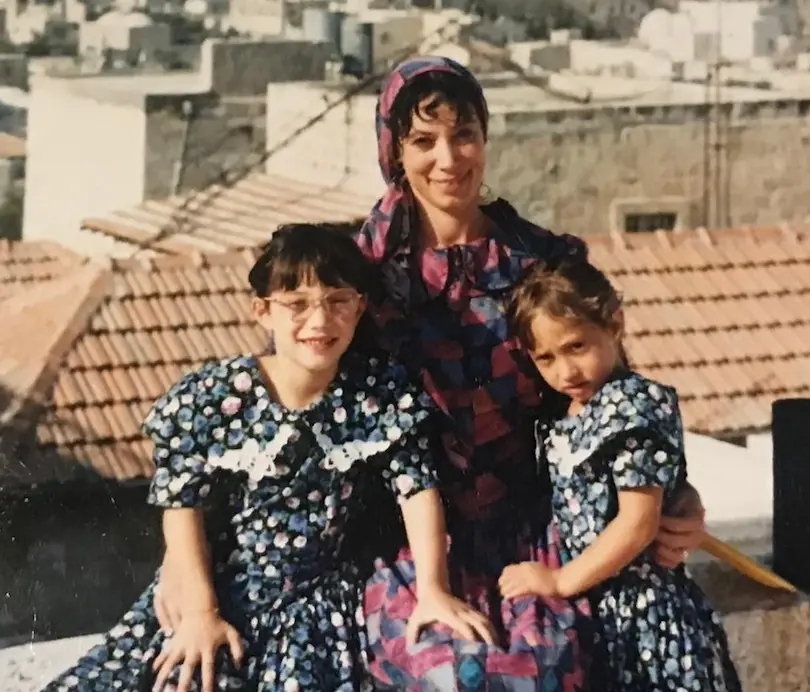 Shirley with her two daughters
When Ahava was eight, another lupus flare-up hit her mother, this time attacking her kidneys. Doctors treated her with chemotherapy.
Her health kept declining and she fought to protect her kidneys with careful eating and a healthy lifestyle.
“Growing up, there was no salt in our house,” Ahava said. “Her kidneys lasted another 20 years.”
At 19, Ahava learned her mother had been put on the waiting list for a kidney transplant. Finding a deceased donor can take years, so doctors wanted her on the list early.
Ahava immediately offered one of her kidneys.
Her parents firmly said no. She was young, and her mother didn’t need a transplant yet. They didn’t want her giving up an organ before it was necessary.
Ahava accepted their answer and let it go.
Years later, her mother’s kidney function had fallen to about 15%. She wasn’t on dialysis yet, but everyone knew a transplant was coming.
By then Ahava was married with children and living in Israel. One potential donor came forward as a match, but it fell through.
Then something unexpected happened.
Chatting with her neighbor, Sarah, Ahava learned that Sarah had been tested as a kidney donor through an Israeli organization.
Ahava was stunned. “You’re willing to donate a kidney at this stage of life?”
Sarah urged her to look into donating, even though Ahava still planned to have more children. “Women can go on to have healthy pregnancies and healthy babies after donating a kidney,” she explained.
Ahava decided to take it one step at a time. She pulled out her file of medical records and checked her blood type.
B positive.
“We both like to be positive,” she quipped.
Her husband backed her completely and she started testing to see if she was a match for her mother.
That Passover, Ahava’s family flew to America to spend the holiday with her parents and sister. As they prepared for the holiday, they noticed her mother was unusually exhausted, needing a nap every two hours.
During a family outing, they recognized the signs of kidney failure. Shirley needed dialysis right away, and Ahava’s sister helped get her to the hospital.
The family went into survival mode. Ahava took over the cooking, childcare, and housework. Shirley started dialysis twice a week. It was grueling. The dialysis room was packed with machines, people, and the constant noise of suction. Each session left her drained for two days, and then it was time to go back.
Meanwhile, Ahava sped up her testing, got approved, and the surgery was scheduled for just one month later.
Ahava’s 27-year-old sister got engaged, and Ahava and her mother planned the engagement and the wedding from the dialysis room.
Two days later, Ahava went in for surgery.
When doctors examined her kidney, they found something remarkable: a rare anatomical variation, a split vein wrapping around the kidney in the shape of a heart.
“They say parents have a touch of prophecy when they name a baby,” Ahava said. “My kidney was wrapped in a little heart. And my name, Ahava, means love. Everyone told my mother, ‘You’ll never be alone. You’ll always have Ahava in you.’”
The transplant worked. Today her kidney function is healthy.
The surgery was a success but neither recovery was easy.
Shirley developed a blood clot and at first couldn’t walk. One of her biggest fears was missing the chance to walk her daughter down the aisle. In the end, she healed and walked her down the aisle.
Ahava was in serious pain, especially from gas after the surgery. For the first week or two, even getting out of bed was a struggle. Many laparoscopic patients go home the same day. Ahava couldn’t walk on day one.
She also developed a rare complication called a lymphocele, a buildup of lymphatic fluid. Her abdomen filled up and doctors had to drain the excess fluid.
It was especially frightening because she’d been told this rarely happens.
“When you’re going through something like that, you don’t necessarily feel inspired,” Ahava said. “You want to be inspiring, but the reality is you’re in pain. You’re struggling. You’re just trying to get through the day. You don’t have to feel strong every moment to show strength. Sometimes the inspiration is simply that you kept going.”
As she recovered, Ahava would hear her mother’s voice on the phone and remind herself that everything she was going through was keeping her mother alive.
Today Ahava’s life is full and busy. She has five boys and two girls, with another baby on the way, and has had several healthy pregnancies since the donation.
When she was pregnant with her youngest, the ultrasound technician finished the scan and came back with the doctor.
“Your baby has a unique anatomy,” the doctor said.
His renal arteries were split in a way that formed the shape of a heart. The doctors assured her it was harmless.
Ahava already knew all about it. It was one more heart-shaped reminder of love.
This past summer, Ahava went back to Los Angeles for her father’s 80th birthday. It was also the 10th anniversary of the surgery and her parents’ 40th wedding anniversary.
During the visit, her brother-in-law, Yaakov, took the family to a restaurant to meet the man who received his kidney.
He told Ahava that she had inspired him with her kidney donation.
Yaakov had donated bone marrow before he even met his wife, but he said, “I didn’t even know kidney donation was a thing until you did it!”
He gave his kidney to a 32-year-old man with special needs. They had never met or spoken before the donation.
When they finally met, the young man could barely contain himself. He was clapping, practically dancing, completely beside himself.
There was something beautiful about his gratitude. He held nothing back.
So while the family celebrated ten years since Ahava gave her mother a kidney, they were also celebrating another life saved by the ripple effect of her choice.
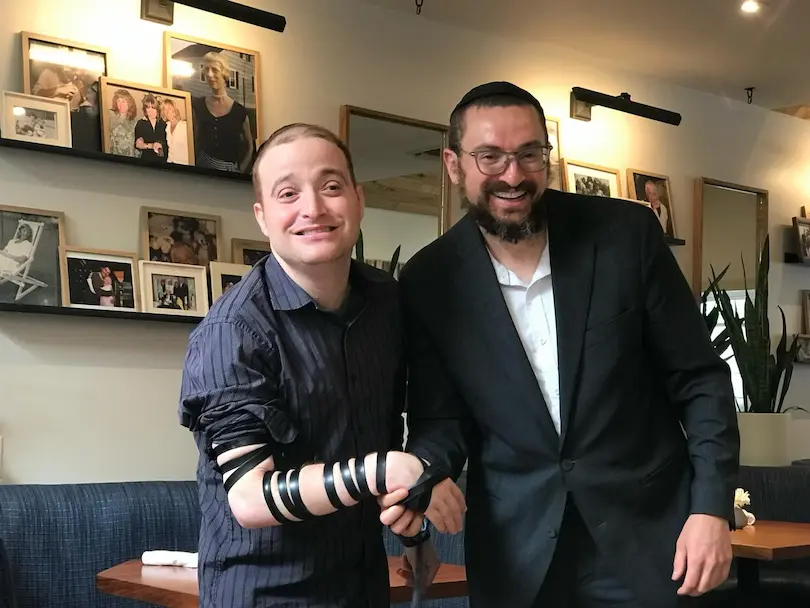 Yaakov meeting the person who received his kidney donation
One of the greatest gifts of the whole experience was the chance for Ahava to thank her mother and, in some small way, give back. Her mother gave her life. Now Ahava had literally given her an organ.
A few months after the surgery, Ahava’s parents came to visit, and the family held a festive meal to thank God. Afterward, Ahava read her parents a letter.
She knew no words could ever capture everything her mother had done for her. But she wanted to try.
She wrote:
Dear Dad and Mom,
If I were to properly elaborate on everything I’ve written below, and everything I’ll inevitably forget to write, it would fill volumes. Even if I had a thousand years, or a million years, it would never be enough time to thank you for everything you’ve done for me.
God gave me parents as a reference point for how grateful I need to be to Him. I want to open a thank-you account and keep making deposits. The more I think about everything you’ve done for me, the more grateful I feel.
I can start before I was even born. Thank you for all the work you put into becoming such outstanding people and wonderful parents. Thank you for carrying me for nine months, for the pain of labor, and for every investment you’ve made in me.
Thank you for the thousands of meals you shopped for, cooked, stirred, fried, and cleaned up after. Thank you for all the restaurants you’ve taken me to.
I am humbled that I was able to give you one organ after all you’ve given me. It could never begin to repay everything you’ve done for me over the years.
There is something so remarkable about giving life to someone who not only gave me life but risked her own life to bring me into this world.
With love,
Ahava