







 Seven Reasons for Hope on October 8







As a teen in Vienna during WWII, Georg Rauch suddenly discovered his mother was a Jew. Then he got called up into the German army.
Born in Austria in 1924, Georg Rauch grew up in Vienna viewing himself no different than his schoolmates.
But all that changed in 1938, shortly after the Anschluss – the German annexation of Austria.
One day, at age 14, Georg came home from school and told his mother1, “Tomorrow I have to take birth certificates and baptismal records of my four grandparents to school… [It’s] something they have to check before accepting us into the Hitler Youth. They are going to give us all uniforms and special knives, and we’re going to go camping in the woods on the weekends.”
Georg describes his mother’s reaction in his memoir, “Unlikely Warrior: A Jewish Soldier in Hitler’s Army”2:
My mother stood there looking at me for a few moments. Then she went into the other room and returned holding a photo album…
She opened the album and pointed to a small photo of an oil portrait. “This man was Baron Moses von Honigsberg. His father was knighted by Kaiser Josef II in 1789. This is Moses’s daughter, Luise Tauber, born Baroness von Honigsberg. She was your great-grandmother.”
After showing her son more pictures of distinguished-looking people, Georg’s mother concluded3, “All these I have shown you were your ancestors, and they were Jews. You have every right to be proud of them, and I hope you never forget that.”
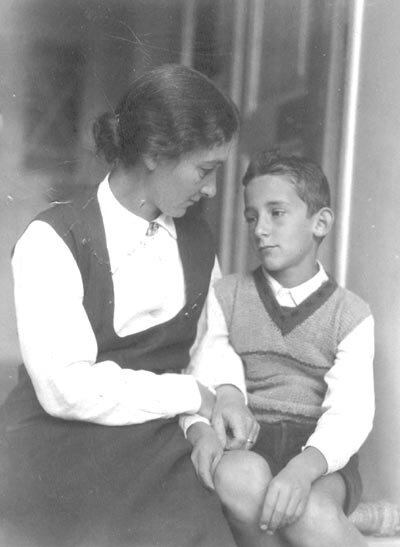 Georg and his mother
Georg’s mother explained to him that according to Jewish tradition, he was Jewish because his maternal grandmother was Jewish. According to Hitler, he was one-quarter Jewish, enough to prevent him from joining the Hitler Youth.
His mother’s revelation brought mixed feelings. Georg recalls4:
During the following months it wasn’t all that easy for me to come to terms with my new status, or lack of one. I noticed that a number of my schoolmates began turning their backs on me, and even two or three of my teachers effectively ignored me. More and more of the boys my age were wearing the black corduroy shorts and brown shirts of the Hitler Youth and filling their free time with marching and practicing premilitary exercises…
I had two friends who shared my non-Aryan status, and we often took bicycle trips to the woods and mountains. I also began spending more time alone, tinkering or painting little watercolors. I passed many hours simply dreaming about the fantastic projects I would someday complete.
Georg’s mother and his non-Jewish father made their opposition to Hitler and his regime very clear to their children.
Georg’s father, though “Aryan,” found himself with a strange status. He had served honorably as a captain in World War I and was called up in the beginning of World War II. Because he was married to a Jew, the German army didn’t want him as a captain, but they couldn’t demote him either. Thus, he was sent home two days later and spent the war years in Vienna, working as an engineer in a tool factory.
Perhaps because of his father’s status, Georg’s family remained safely in their home as more and more of their Jewish relatives and friends began disappearing from the streets of Vienna.
One January night in 1940, Georg’s mother’s best friend, who was Jewish, knocked on their door at 2 AM and asked if she could hide in their attic. Georg recalls5, “She had just managed to slip out of the Gestapo’s grasp by climbing over a neighbor’s balcony and sliding down a shed roof. She arrived with only the clothes on her back.”
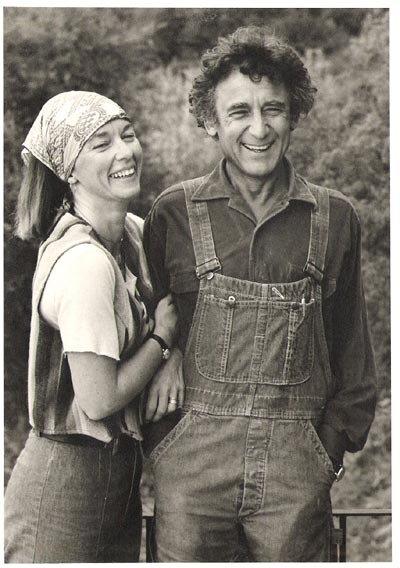 Georg and Phyllis Roach
Georg’s parents could have refused and continued living in relative safely, under the radar of the Nazis. But that night, they made a decision that ultimately led to saving many Jewish lives. Living on the top floor of an elegant building originally built to house individual families of the nobility, they agreed to hide their friend in their spacious attic.
Georg helped his father repair a broken attic window, cover it with black paper, construct a makeshift bed, and install a light fixture.
More Jews arrived in the following weeks and months. “I remember the carpenter the most vividly, because it was he who built the complicated false walls into the attic behind which our guests could disappear whenever it was necessary,” recalls Georg.
His mother fed the hidden Jews, providing them with their needs, while Georg illegally purchased food coupons on the black market. Though this task was dangerous, Georg didn’t even consider refusing. “I had come to understand that although I was a citizen with limited rights, for the full Jews it was a much harder time,” he wrote6.
Georg lost track of how many Jewish visitors passed through his home.
Later, Georg discovered that his mother “sometimes slipped out of the house after midnight with one or another of our visitors to rendezvous with unsavory characters who promised, for high prices, to smuggle the Jews through Hungary to Yugoslavia or Bulgaria. From there they hoped to make it into neutral Turkey and then to London or the United States7.”
Georg helped his mother prepare travel kits for the refugees. He also built complicated alarm systems throughout the apartment to alert everyone in case of unexpected visitors. He taught himself electrical engineering and put together a radio, which the family and the hidden guests could use to listen to news from London, which gave hope to the Jewish guests.
Georg lost track of how many Jewish visitors passed through his home. Some stayed only for a few days and others stayed longer. The family did all they could to help them.
As Georg matured from a teenager into a young man, he began to dread what he knew was inevitable – the day when he would be called up into the German army. He recalls8:
How utterly hopeless I had felt the day that a draft notice finally appeared in our mailbox! Though I was used to enjoying the deep, dreamless sleep of the young, that night I lay awake for long hours thinking of where I could hide myself so I would not have to become a German soldier.
I knew it was hopeless. Hadn’t I already gnawed at the problem for a whole year while pedaling my bicycle hundreds of kilometers through the Austrian Alps? That perfect place where I could be taken in, fed, and kept warm and safe while all of Europe tried to annihilate itself did not, unfortunately, exist.
Georg had no choice but to report for duty. He was trained as a telegraphist. He wrote:
My transition from playful adolescent to disciplined soldier was far from simple… The offspring of doctors and architects, I had grown up with the assurance that my opinion would always be heard and at least considered. I found it particularly difficult, therefore, to follow orders that often seemed illogical, serving only to produce a completely submissive subject who could be depended upon to obey without the slightest objection. One of our training officer’s favorite sayings was “Leave the thinking to the horses. They have larger heads.”
Several times, Georg was locked up for minor offenses, but the army didn’t manage to crush his independent thinking. When he was sent to a course for communication officers and slated to be promoted to an officer – “supposedly capable of ordering hundreds of men to attack and of screaming with conviction those commands that would send them to their deaths9,” Georg was determined that he would not “use my brain for receiving and passing on orders intended to win a war that, in my opinion, should be lost as soon as possible10.”
Georg made an appointment with his division commander. Georg recalls11:
At 9:00 a.m. on November 10, 1943, I stood in front of [the officer’s] desk, facing both him and the large portrait of Adolf Hitler that hung on the wall at his back. My boot heels clicked smartly together, my right hand snapped a lightning salute to the edge of my cap, and, in the overloud voice decreed by the German army, I yelled…, “Funker Rauch reporting, sir!”
When asked what he had on his mind, Georg12
bellowed the sentence that I had been framing in my mind for weeks. “Funker Rauch wishes to be permitted to report that he cannot be an officer in the German Wehrmacht.”
With an astonished, almost idiotic expression on his face, the lieutenant colonel sputtered, “Are you crazy? Did I hear you correctly?”
Turning crimson, the officer accused Georg of treason and demanded an explanation. Georg recalls13,
Again I clicked my heels together. As though charged by an electric shock, I pressed my hands flat against my thighs and shouted once again, “I don’t feel able to become an officer in the German army because I have Jewish blood.
The officer wondered how Georg got there in the first place and dismissed him. Georg returned to his barracks, not knowing what to expect.
The next day, he found out that he was dropped from the officers’ course and ordered to frontline duty as an infantry telegraphist.
Thus, on November 11th, 1943, Georg found himself on an east-bound train, headed towards the Russian front.
In the Soviet Union, Georg experienced air raids, freezing Russian winters, hunger, and sickness. He participated in battles with the Soviet army, somehow miraculously surviving against all odds. Once, a tank rolled over a trench, where he’d hidden.
In battles, when under attack, he fought back. He told himself14:
I might have a chance… First, shoot fast and well. And if they are too many, throw hand grenades, and whoever yet comes closer can still be stabbed with our bayonets. Or, as that officer so poetically expressed it the day I took my oath, we can split the Russians’ skulls with our spades. Jewish blood in my veins or not, that’s exactly what I’ll do, because I want to live. I’m only twenty years old.
Towards the end of the war, with the German army on the retreat, Georg was taken prisoner by the Soviet army. Being a prisoner turned out even more life-threatening than being a soldier. The prisoners were forced to march long distances with barely any food or drink. Most of them didn’t make it. Georg caught dysentery and almost died.
What saved him was a Russian officer’s unexpected interest in him. The officer, who spoke fluent German, was married to a Viennese Jewish woman. Since Georg spoke openly about his Jewish background, the officer engaged him in conversation and found that they had shared interests.
Once he recovered, Georg found out that there was more to the Russian officer’s interest in him. He was offered to serve as a spy for the Soviet Union. Thinking of the hidden Jews in his parents’ attic and of his own desire for the Nazis’ defeat, Georg agreed.
Soon, Georg was faced with a moral dilemma: Should he turn in a Nazi who had known his family and had helped Georg personally?
The Allies won the war before Georg had to make this decision. Georg describes the “wild racket of shooting and yelling15” at the news that Germany had capitulated. He recalls16:
I rolled from my mattress onto the ground and buried my face in the juicy spring grass. I filled my lungs with the wonderful smell of damp earth and young plants, stretched my arms and legs out wide, and gave myself up to a deep feeling of thankfulness. If everyone at home had managed to survive the bombs and the Gestapo, perhaps we could be together again in peace after all.
It took many more months until Georg was finally reunited with his family, which survived the war.
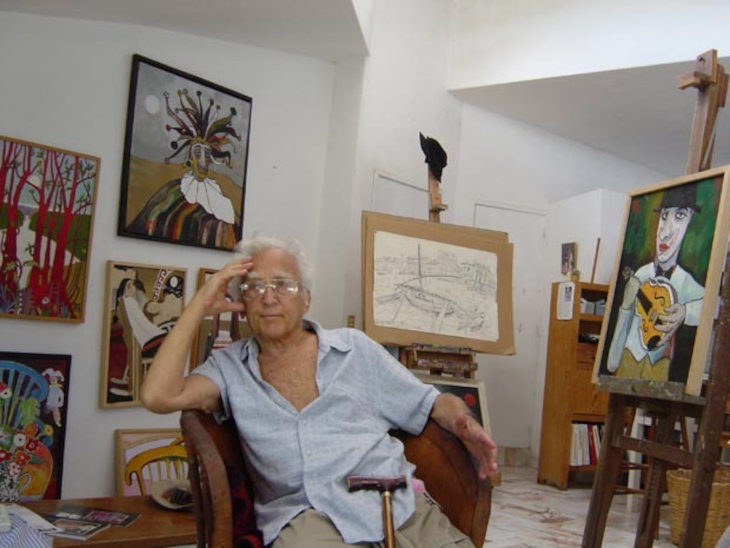 Georg in his studio in Mexico
Forty years after the war, now living in Mexico and working as an artist, Georg compiled his war experiences into a memoir. The book includes the translation of letters Georg had sent home from the front, as well as his original drawings.
After the war, Georg never found out what happened to all the Jews who’d hidden in their attic. Whenever he tried asking his mother, she would cry and refuse to talk about it. He surmised that his mother’s best friend did not survive. However, there were others that did survive and sent notes and gifts from England and America.








A fascinating and amazing story! 👌💯🙏✡️
I was honored to read your life story during the war, like my father who was in the army during WWII he survieved and escaped to Siberia, USSR, thereafter returned back to Poland, he became a known Artist - Chaim Goldberg, in my eyes those men were the real heros...
Everyone should see the movie Europa Europa. It is incredible
Thank you for this amazing story.
Very touching story.
Interesting story. Thanks for sharing it.
We should have used nuclear weapons on Germany.
Study ur history boy, Germany surrendered on May8, 1945. The 1st nuclear bomb was not tested in the U.S. until July 16, 1945.
I don't know if this story is true or not, but I heard another story about a Jewish man, that dressed like a Nazi(may their name be erased) to save Jewish lives, I am not sure if he was Hungrian or from another country to save is fellow Jews
Fascinating thank you!!
I Suppose You Had Genius Gutsy & Very Lucky To Survive.!!!
How wonderful to learn this.
History of Jewish people is fascinating and never fails to fill me with wonder.Like....how are we still here!!!!
My Mum, תח"י, from Franconia, Germany, had an Uncle (full Jew) by marriage, who served in the Weimar "heer" and subsequently served under Hitler and went AWOL after he saw the horrors of the early German occupation of Poland in 1939. His brother-in-law who owned drapery stores in Bamberg and saw Hitler'sthugsdispossessing Jewish merchants left Germany in 1934 under the Havara agreement. Whilst his his brother-in-law experienced little or no Antisemitism in the Whermacht until he saw what his beloved Whermacht was doing under the occupation.
Thank You...
So many heartbreaking stories, never ending. At age 68, have severe PTSD from hearing about the horrific events. God bless all. Have Mercy on us all.
Or you could se the wonder at the fact that the Jewish people are growing as a people,still alive and kicking with in fact chareidim the largest growing Jewish group.Its unbelievable.Like a phoenix from the ashes!
Great story . I imagine it’s true because George is a real person whose art is known . It’s pisfibke some of the story is fabricated because the author is known for historical fiction . How do we find the true story ?
This article is based on Georg Rauch's memoir, which I stumbled across in my local library and found fascinating. The book includes photos and drawings, so as far as I can tell, the story is true. Here's the memoir: Unlikely Warrior: A Jewish Soldier in Hitler's Army.
Moreover, Georg Rauch wasn't the only Jewish soldier in Hitler's army. Apparently, there were thousands of soldiers of Jewish descent. Here's another fascinating book: Hitler's Jewish Soldiers: The Untold Story of Nazi Racial Laws and Men of Jewish Descent in the German Military.
It seems the Nazis, with Hitler's personal permission, kept "useful" Jews in the army. Fortunately, we will never find out what their plans for those Jews were after the war.
Sorry, Jewish ancestry, much or faint, alone doesn't make one Jewish. A person must, at the very least, identify with the Jewish nation. If not, in my view, he/she isn't Jewish.
Rigg's book, "Hitler's Jewish Soldiers", is full of these nominal Jewish types. What self-respecting Jew would have anything to do with the Nazi regime, much less wear it's uniform? I read the book twenty years ago. With the possible exception of German soldier Paul Hirschfeld, none of the individuals highlighted in the book were Jews.
Sorry, but only HALAKHA defines Jewishness which is matriarchal or through a valid orthodox conversion. That's why, like it or not, Kissinger & such were Jews, despite their identity issues.
Kissinger had no identity issues. He was a proud Jew and never denied his religion or heritage.
Great story, if true.
I think more research is needed. I wouldn't rely on the stories of this person, alone. I noticed in art sources it is reported that he was born in 1927 and passed away in 2006. That itself raises questions.Georg RAUCH ist ein Künstler, der 1927 in Österreich geboren wurde und 2006 gestorben ist.
I would also add- that Georg who virtually had hardly any Jewish background, intermarried-- and this is how his wife, Phyllis, describes the wedding: 'Mother’s next idea was to ask our long time minister, Pastor Philip Sinner (yes, that was his name) to perform the service in German. He had grown up speaking German, and though he hadn’t had much practice in recent years, he agreed to her request. I suspect she wanted to be certain that her daughter’s unexpected choice, an older man, a foreigner, an artist with curly black locks speaking very little English, really knew what he was promising to do'....'..... Pastor Sinner did his best, but it was clear to the two of us, standing in front of him.... > in short.. a church wedding.
Oyyyy.
What an unusual story. I truly hope there is a God and he/she punishes the evil doers.