








 Those Shameful Thoughts and What They Really Say about You
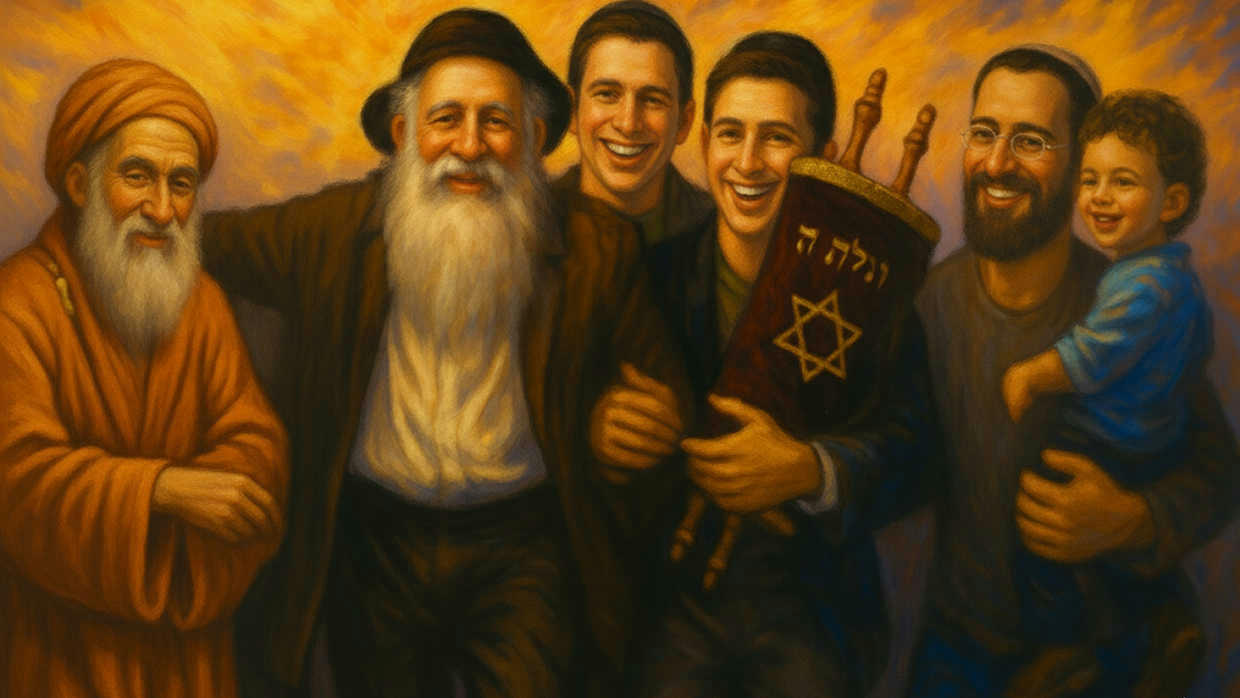





The deeper meaning behind dancing with the Torah.
What other nation dances with their books?
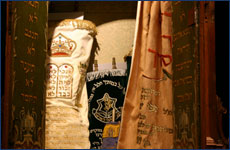
As the festival of Sukkot draws to a close, Jewish communities worldwide remove their sacred Torah scrolls from the ark and dance with them for hours on end. This celebration, known as Simchat Torah (Joy of Torah), appears to defy logic. If our goal is to revel in Torah's Divine wisdom, shouldn't we spend the day studying its profound teachings rather than dancing like banshees with closed scrolls?
The answer lies in Judaism's unique approach to human nature: the recognition that we are neither purely physical beings nor purely spiritual ones, but rather a divine fusion of both. Simchat Torah embodies this principle through three distinct yet interconnected expressions:
You know that feeling when joy fills you up so completely that words simply cannot express the feeling of your heart? On Simchat Torah, we finish the entire yearly cycle of reading the Torah. The holiday celebrates the culmination of a whole year's worth of Torah learning.
Dancing and singing become the body's way of participating in the soul's celebration of the gift of Torah.
Torah is at once our compass for living, our channel to the Divine1, and our pathway to self-actualization. The proper response to finishing such a text? Jumping for joy and dancing with glee!
At the Torah's grand finale, our joy naturally overflows into physical expression - dancing and singing become the body's way of participating in the soul's celebration of the gift of Torah.
Judaism teaches that our bodies and souls aren't meant to be enemies, but partners. This principle became real to me through an unexpected lesson about celebration. During my second year in yeshiva, I finished a tractate of Talmud for the second time; a significant accomplishment for a newcomer to learning Talmud.
I told one of my Rabbis, Rabbi Lawrence Kelemen, about this accomplishment while on a run together. Suddenly, he grew very serious and asked, "What did you do for the celebration?" I described the beautiful party - the delicious food and the friends and mentors in attendance. He breathed a sigh of relief, "Good." Confused at his response, I inquired, "Why are you so concerned about how I celebrated?" He responded, "When you learn Torah, your soul is very happy with your accomplishment, but your body bears none of the fruit. By celebrating your spiritual achievement with delicious food and good company, you let your body partake in the celebration. Doing so trains your body to love the process of learning just like your soul."
Rabbi Kelemen's wisdom reflects the fundamental Jewish understanding of human nature, embodied in the very word for 'human being' - אדם (Adam). The word "Adam" contains two distinct parts:
1. א – The Hebrew letter Aleph is the letter of spirituality. As the first letter in the Hebrew alphabet, it signifies primacy and unity. Also, it's the only letter with no physical sound. Without delving too deeply into Kabbalah, we can already see that Aleph represents the Godly Soul within man.
2. דם - The root word "Dam" translates as ‘blood’ in Hebrew. This represents the physical aspect of the human being - the Human Body.
If we don't enlist our body in our spiritual mission, it will attempt to stop us at every turn and limit our ability to grow.
The word “Adam” therefore holds the truth that each of us is comprised of body and soul. The body’s natural tendencies almost always directly conflict with the desires of the soul. In order to achieve our fullest potential, our bodies must unite with our souls in the pursuit of wisdom and spiritual growth. If we don't enlist our body in our spiritual mission, it will attempt to stop us at every turn and limit our ability to grow. That’s why we need to train our bodies to love what our soul desires by giving physical rewards whenever we make a significant spiritual accomplishment.
This Jewish principle of integration—enlisting our bodies in our spiritual mission rather than fighting against them—finds its ultimate expression on Simchat Torah. After a whole year of learning and growing spiritually with the Torah, we dedicate a full day of physical and emotional celebration, dancing, singing, jumping, and laughing with the Torah, then going home to delicious meals. All of this physical joy literally revolves around our Torah, allowing it to permeate and penetrate into our very physicality.
On Simchat Torah, we celebrate completing the entire Torah by immediately beginning it again—a cycle that repeats annually in Jewish communities worldwide. As most of us have experienced, starting anything significant requires tremendous energy. How can we generate the motivation necessary to propel us forward into another year of Torah learning and spiritual growth?
Modern psychology has proven that the way we move and express our physical bodies can change our feelings about ourselves and our world. When we act confident, we feel confident. Physiology creates psychology; motion creates emotion.
As we restart the Torah reading cycle, we dance, sing, leap, and laugh to build into our psyche a powerful association between Torah and joy. This wisdom of creating positive associations with learning is woven throughout Jewish tradition. When a child first begins to read Hebrew, their teacher takes the letter Aleph written on paper and smears it with honey. The child then licks the honey off the letter, creating their first sweet association with Torah learning.
Like this time-tested tradition, Simchat Torah leaves a honey-flavored taste of joy in our hearts as we begin yet another year of learning. The ecstatic dancing and singing echo in our minds throughout the year, infusing us with enthusiasm each time we open our books to learn.
Authentic religious experience requires the harmonious union of body and soul.
These three expressions - elation, integration, and motivation - are really three facets of one fundamental truth: authentic religious experience requires the harmonious union of body and soul. Simchat Torah, with its unique custom of dancing with sacred scrolls, becomes the perfect embodiment of this principle. The seeming paradox of celebrating wisdom through dance resolves itself: we dance instead of studying Torah on this one night to train every part of ourselves to love Torah, ensuring our learning continues with joy all year long.
Chag Sameach!
Avraham








Absolutely love the connection between body and soul. For me, music - specifically singing - has always been both a physical and spiritual joy. In college, when singing in the choir, I found an almost physical "high" just from singing properly. During breaks between classes, I would go to the school library, put on headphones, and listen to music. Never needed "drugs" - music was my high - then and now!