







 I Will Not Apologize for Living
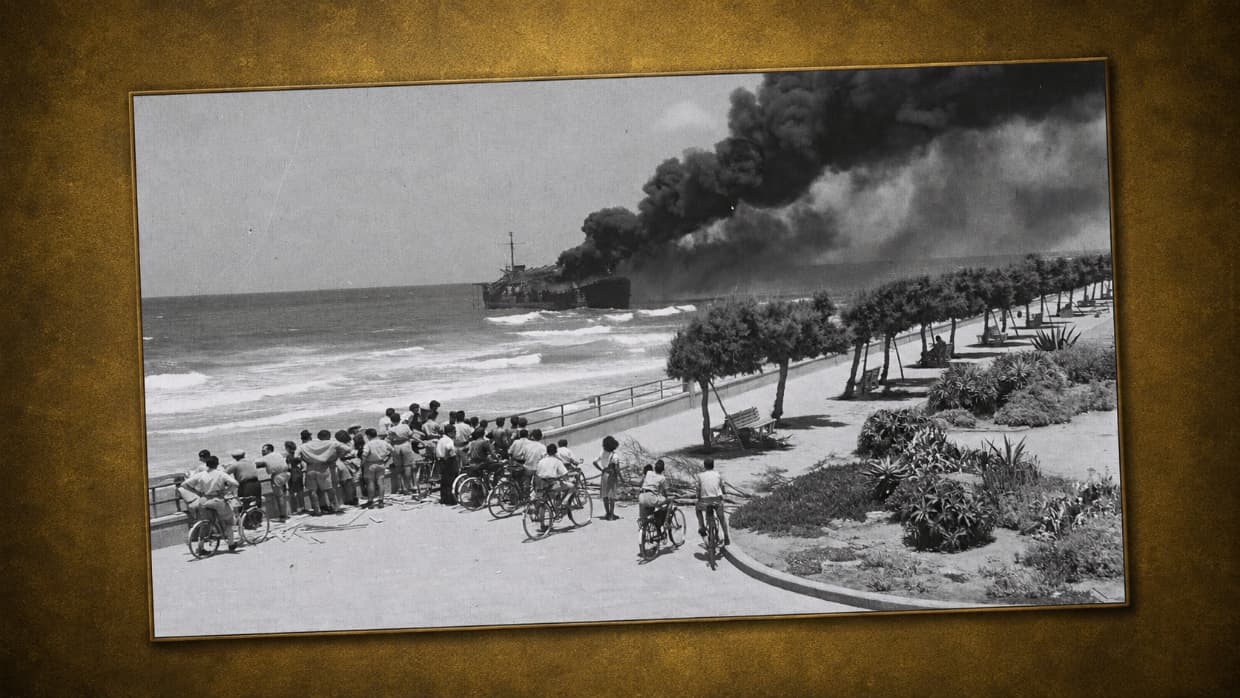






Israel’s Heritage Ministry’s recent announcement of the discovery of the sunk ship Altalena is bringing to light one of the darkest moments in Israel’s early history.
Shortly after Israel declared independence in May 1948, it came dangerously close to a civil war.
The conflict culminated in the Altalena affair in June 1948, when the Israeli army, under the orders of Israel’s provisional government, attacked a military ship sent by a rival Zionist organization1. Nineteen people were killed in what the eyewitnesses described as “Jews shooting Jews.”
This tragic story had its roots in the early disagreement among Zionists on how to achieve security for Jews in the Land of Israel. After World War I, the British took control of the Land of Israel under the mandate of facilitating the creation of “a national home for the Jewish people,” as per the Balfour Declaration of 1917. However, the British did not anticipate the violent reaction of the Arab world to the idea of Jewish independence. Fueled by religious incitement, Arab mobs perpetrated massacres on the centuries-old Jewish communities in the Land of Israel. The British did nothing to protect the Jews.
Frustrated by British inaction, early Zionist leaders formed Jewish defense groups. Soon, a disagreement emerged. The first such group, Haganah, advocated restraint. Though ready to defend the Jewish community, they generally cooperated with the British authorities and did not go on the offensive.
Some felt that the policy of restraint was not enough. Among them was Ze’ev Jabotinsky, who formulated a “revisionist” version of Zionism, revising the original Zionist principles to include the use of force when necessary.
The Revisionist Zionists formed the Irgun, also known by its Hebrew acronym Etzel, a paramilitary organization willing to go on the offensive and retaliate for Arab attacks in the hopes of preventing future attacks.
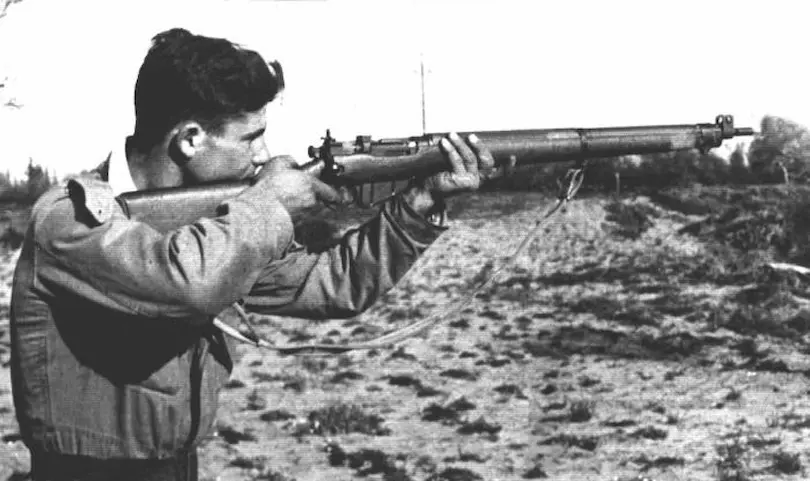 Haganah member in training. Picture taken between 1944 and 1946. ארכיון גן-שמואל, CC BY 2.5 <https://creativecommons.org/licenses/by/2.5>, via Wikimedia Commons
Unable to control the violence in Mandatory Palestine, the British appointed a commission of inquiry, headed by Lord Robert Peel, to investigate the situation. In 1937, the Peel committee presented its recommendations: to partition the land into two states, Jewish and Arab, and to limit Jewish immigration.
In 1939, the British government issued the infamous White Paper, setting a limit on Jewish immigration to 75,000 people over the course of five years. This limit frustrated both the original and the Revisionist Zionists, who understood that with Hitler setting out to conquer the world, Jews remaining in Europe were in great danger. While the Haganah, now under the leadership of David Ben Gurion, still held out hope for diplomacy, the Irgun redirected its military efforts from the Arabs to the British. Irgun members began bombing British military bases and killing British army officers.
In 1942, Menachem Begin, the only survivor from his immediate family in Poland, arrived in Mandatory Palestine. With his previous experience in Jabotinsky’s organization, Begin was appointed head of the Irgun in 1943.
Having witnessed the destruction of European Jewry, Begin was determined to do everything in his power to help the remaining European Jews escape the Nazis and reach the Land of Israel. The main obstacle, in his eyes, was the British government that, fully aware of the Holocaust, still insisted on enforcing the ridiculously insufficient immigration quotas.
Both the Haganah and the Irgun were involved in Aliyah Bet, the illegal smuggling of Jews into the Land of Israel. However, only a fraction of Jewish refugees made it safely to shore. Some drowned during the smuggling attempt, and others were caught by the British and sent either to detention camps or, worse, right back into the Nazis’ hands.
In February 1944, Begin issued a Declaration of Revolt, openly calling for the overthrow of British rule. The posters plastered all over the Land of Israel stated2:
[W]e face an historic decision on our future destiny… the British administration of Eretz Israel… is betraying our brethren to Hitler. Our nation will fight this regime …
And this is our demand:
Rule over Eretz Israel must immediately be handed over to a provisional Hebrew government… [which will:]
a. establish a national Hebrew army.
b. conduct negotiations with all authorized bodies on the organization of the mass evacuation of European Jewry to Eretz Israel.[T]his is the sole way of rescuing our people…
The posters came to the attention of the British authorities, who immediately declared Begin the most wanted man. Begin went undercover, directing the Irgun from his hiding places. The revolt began with attacks on the British immigration offices and moved on to the intelligence and police headquarters.
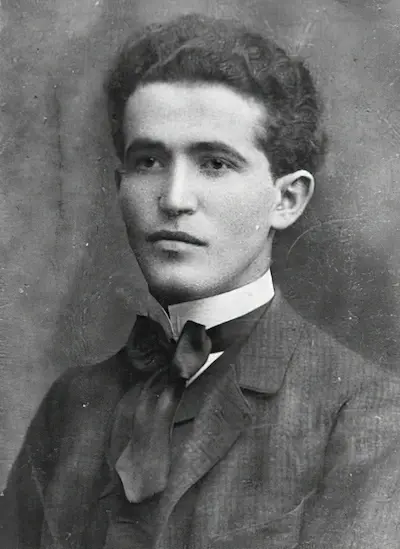 Young David Ben-Gurion. Author unknown. CC0, via Wikimedia Commons
Ben-Gurion and other leaders of the Jewish Agency, the main body representing the Jews of the Land of Israel in the diplomatic arena, condemned the revolt.
American historian Jerold S. Auerbach writes3:
Ben-Gurion remained steadfastly convinced that cooperation with the British government would be more effective and cost fewer Jewish lives. It would also build international support that would be necessary for Jewish statehood once the war in Europe ended. He wanted to persuade the British – and other Western governments – that Palestinian Jews, unlike their Arab neighbors, were “a civilized community and a reliable ally.”
Ben-Gurion attempted to negotiate with Begin. In October, Moshe Sneh, a Haganah commander and member of the Jewish Agency, spent five hours trying to convince Begin of the importance of international support for Zionism and the dangers of alienating the British government. Unconvinced, Begin insisted on waging a war against the British. At their next meeting, Jewish Agency representatives threatened to end Irgun operations “at all costs4.”
Concerned about the explicit threat, some Irgun members urged Begin to take action against the Jewish Agency. Begin responded, “I will never lend a hand to a war of brothers5.” Milchemet achim, literally “war of brothers,” the Hebrew term for civil war, remained out of the question for Begin for the rest of his life, even when it came to the difficult test of Altalena.
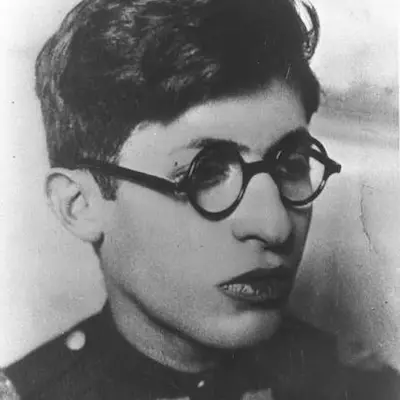 Menachem Begin
The nadir in the relations between the Jewish Agency and the Irgun was the assassination of Cairo-based Lord Moyne, who was responsible for implementing the White Paper quotas and, consequently, for deporting the hapless immigrants. Ironically, the Irgun was not involved in his assassination, which was perpetrated by Lechi, a more militant Jewish faction.
The assassination outraged the British far beyond Mandatory Palestine. Even Churchill himself issued a warning against “a new set of gangsters worthy of Nazi Germany6.”
The Jewish Agency immediately condemned the assassination. Their official statement proclaimed7, “The perpetrators of terror [the Irgun and Lechi] are traitors! … The Jewish Agency proposes herewith that all persons who are acquainted with any of the terrorists, should immediately inform the police…”
The decision was far from unanimous. Two members of the Jewish Agency resigned.
Thus began the Saison, or the hunting season, when the Haganah captured Irgun members, at times tortured them, and turned them over to the British authorities. Between November 1944 and March 1945, the names of close to a thousand Irgun members were passed on to the British. They were arrested, placed in detention camps, and some deported to Africa.
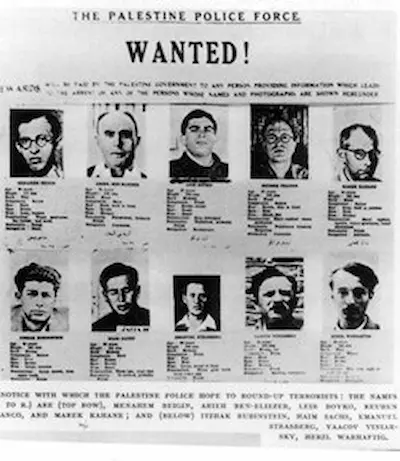 Palestine Police Force wanted poster of Irgun and Lehi members. Begin appears at the top left.
From his hideout, Begin condemned the Jewish Agency’s collaboration with the British. Yet, insisting, “There shall not be a war of brothers8,” he instructed the Irgun members not to take any action against the Jewish Agency or the Haganah.
The conflict only grew after the Holocaust, as Jewish refugees stranded in DP camps attempted to reach the Land of Israel and as the frustrated Irgun perpetrated more attacks on the British authorities.
Eventually, the Irgun won. Historians believe that it was due to their armed resistance that, in February 1947, the British announced the end of the Mandate and their withdrawal from Palestine9. The British Mandate officially terminated on May 14th, 1948, and Ben-Gurion proclaimed Israel’s independence, celebrated by the Jews and greatly opposed by the Arabs. Attacked by the neighboring Arab nations, the newborn State of Israel was plunged into the War of Independence.
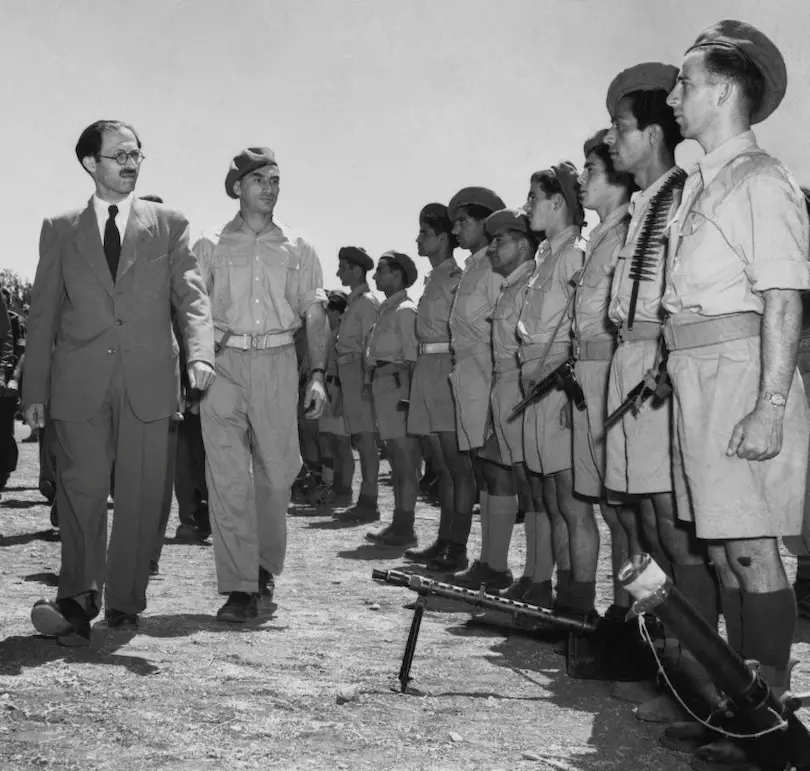 Menachem Begin inspecting Irgun members in 1948. Public domain
The story of the Altalena began long before the British withdrawal. An American Revisionist Zionist organization that had attempted to rescue European Jewry throughout the Holocaust turned its attention to the plight of survivors. In 1947, they purchased a military ship that had participated in the D-Day invasion. The organization renamed the ship Altalena, after Jabotinsky’s pen name, and hired a mostly Jewish crew to operate it. The ship was intended to transport Jewish refugees, as well as weapons to assist the Irgun in its armed struggle against the British.
To accomplish such a feat under the nose of the British, the organizers collaborated with the French government, which was only too happy to help the Jews get rid of the British in the Middle East, thus increasing their own influence in the region. The French even provided the Jewish representatives with arms, in return for a promise of “significant freedom of action” in the Middle East10.
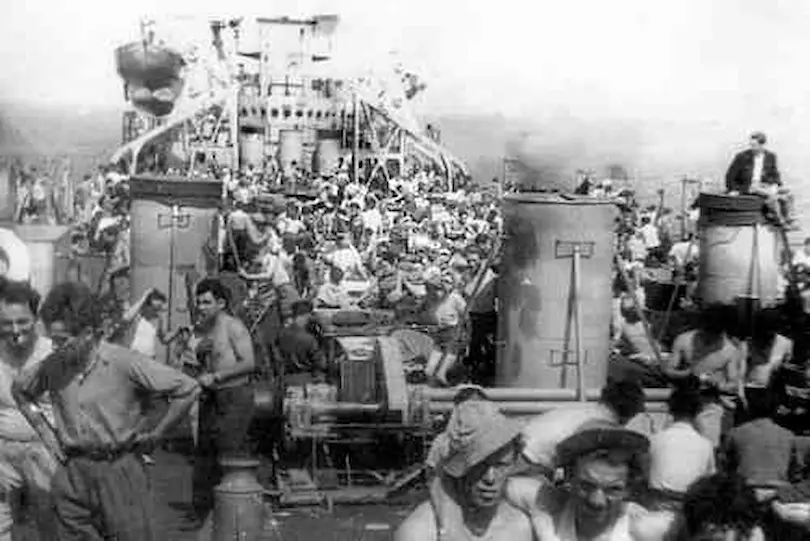 The Altalena on its way to Israel. Photo: Israel State Archives
At the same time, the Irgun coordinated the operation with the Jewish Agency. Though still suspicious of each other, the organizations agreed to work together on this common cause.
However, the negotiations and preparations took time. The Altalena finally sailed from France on June 11, 1948, weeks after the Declaration of Independence. On board were close to a thousand Jewish refugees, as well as a significant amount of guns, grenades, and ammunition.
Though there was no longer a need to smuggle the refugees clandestinely, the State of Israel, under attack by five Arab countries, remained in great need of weapons. Thus, when Begin informed Ben-Gurion about the Altalena, Ben-Gurion welcomed the news.
But there was a complication. Soon after the ship’s departure, the United Nations declared a two-week ceasefire between Israel and the Arab nations. It was an open secret that the Arabs were using the ceasefire to obtain more weapons. Thus, the provisional Israeli government did not object to the Altalena’s arrival in principle but instructed Begin to act carefully, out of the view of the U.N. observers. Under the circumstances, Begin decided to postpone the ship’s arrival.
However, communication with Altalena could not be established, and Begin’s instructions to wait were not received. Meanwhile, certain leaders of the Haganah became suspicious of the arms being brought into the country by the Irgun. Officially, the Israeli government authorized Altalena’s landing at Kfar Vitkin, near Netanya.
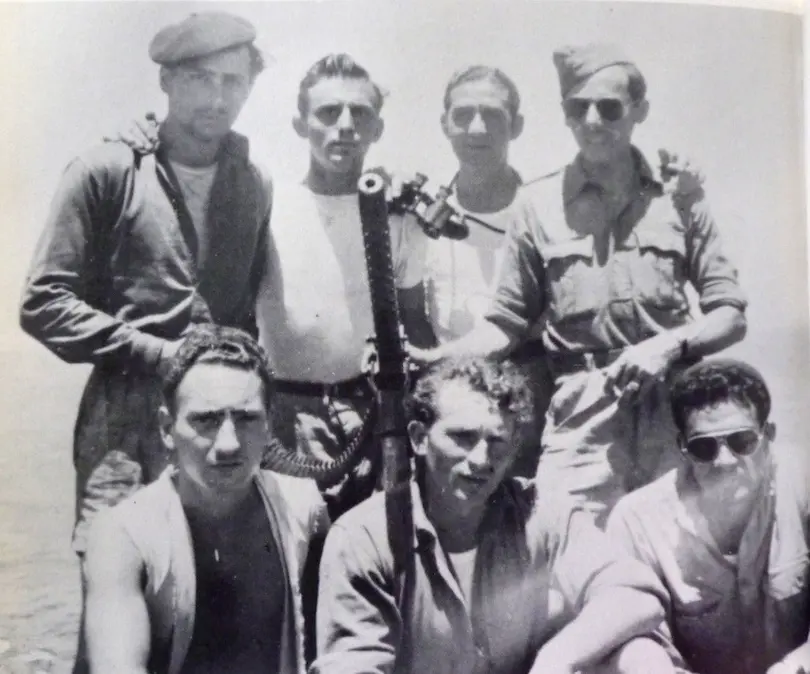 Crew members of the Altalena. Jabotinsky Archives, Tel Aviv, Public domain, via Wikimedia Commons
Even after the Declaration of Independence, the relations between the Haganah and the Irgun remained tense. The Haganah was now transformed into the Israel Defense Forces (IDF), the official army of the State of Israel. Ben-Gurion insisted that all the independent Jewish militias, such as the Irgun and Lechi, be incorporated into the army.
Begin, now out of hiding, held negotiations with Ben-Gurion. The Irgun members resented the idea of serving under Haganah commanders. As Begin acknowledged11, “It was not an easy matter to send our comrades to an army whose officers had hated the underground, persecuted it, besmirched it, kidnapped its members and handed over its officers… The men who were about to take command of our members had been systematically trained to hate them.”
Begin proposed a compromise. The Irgun members would form distinct units within the IDF, maintaining internal control over their own weapons. Ben-Gurion refused, insisting that the state could have only one army, with a unifying command structure.
In the beginning of June, Begin and Ben-Gurion finally signed an agreement stipulating the disbandment of the Irgun and its absorption into the IDF. However, the agreement would be in force “within the State of Israel12.” At the time, Jerusalem was excluded from the officially recognized State of Israel. Ben-Gurion and his colleagues had given up on it. To the Irgun, however, Jerusalem was an inseparable part of the Land of Israel. Some Irgun fighters remained in Jerusalem, still hoping to liberate it from the Jordanian invaders. They were running dangerously low on ammunition.
To Begin and his Irgun colleagues, it was implicit in the agreement that they would continue to fight for Jerusalem. Therefore, he requested that 20% of the ammunition arriving on Altalena be transferred to the Irgun members. To Begin, the request was perfectly reasonable, as it was the Irgun supporters who purchased the weapons, and he was willing to pass along 80% of them to the IDF. Ben-Gurion, however, insisted that all of the arriving weapons be under IDF’s jurisdiction.
It is unclear what exactly took place in the days before Altalena’s arrival. The key players have given contradictory testimonies in the ensuing decades about the conversations between the Israeli government and the Irgun leaders. Clearly, there was much miscommunication, fueled by years of distrust and hostility.
When Altalena approached Kfar Vitkin, its passengers and crew expected a warm welcome.
Ben-Gurion, however, remained extremely suspicious. When Israel Galili, the deputy minister of defense who had met with Begin, reported to Ben-Gurion that “a new and dangerous situation has arisen: a demand for a kind of private army, with private weapons13,” Ben-Gurion responded that this was unacceptable.
Shortly before Altalena’s landing at Kfar Vitkin, Ben-Gurion called an emergency session of the Cabinet. The Cabinet members expressed panic. Foreign Minister Moshe Shertok said, “We may now be facing a blatant, public violation of the truce by Jews14.” Ben-Gurion stated, “There are not going to be two armies. And Mr. Begin will not do whatever he feels like… If he does not give in, we shall open fire15.”
At 9 p.m. on June 20th, the Altalena stopped near the Kfar Vitkin beach. Begin came by motorboat to greet the new arrivals, amid much celebration. Within two hours, the passengers disembarked, and the unloading of the weapons began. Several dozen Irgun members gathered to help.
When IDF soldiers began surrounding the landing area, Begin remained unconcerned, convinced that an agreement with the government would be reached momentarily.
In the morning, the Government Press office issued an announcement16:
The Government regards this attempt by an independent group to bring in arms, particularly during the truce period, as a grave violation of Israel’s laws and of her international obligations, as well as an infringement on the clear agreement reached recently by the heads of [the Irgun, who] were to accept the authority of the state.
Begin was presented with an ultimatum demanding to relinquish all the weapons aboard Altalena within 10 minutes. Those on board were taken by surprise. Begin refused to believe that Ben-Gurion would follow through on his threats.
Meanwhile, the Israeli government began giving orders. When military pilots on a nearby base were ordered to bomb the Altalena, they refused. Boris Senior, a World War II veteran, said, “I will never be capable of bombing my Jewish brothers17.” Ben-Gurion had no choice but to abort the mission. Instead, he ordered the soldiers already at the beach to open fire. Though some IDF soldiers refused to shoot, others obeyed orders.
Despite the bullets flying around them, Begin and his second-in-command, Yaacov Meridor, ordered their men not to return fire. An Irgun fighter recalled18, “I couldn’t shoot. My brother was on the other side.” Another Irgun member recalled19, “We were confused and ashamed at the same time. Instead of welcoming us, they were killing and wounding many of our men whose only purpose was to help.”
Six Irgun men and two IDF soldiers were killed at Kfar Vitkin that day.
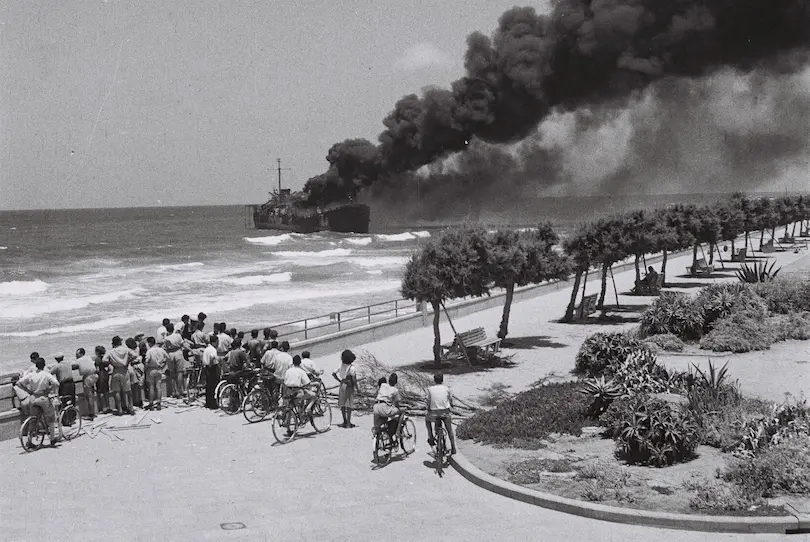 Altalena burning off the coast of Tel Aviv. Hans Pinn, Public domain, via Wikimedia Commons
Begin and other Irgun commanders boarded the Altalena and instructed the captain to head to Tel Aviv. Still hoping to resolve the tragic misunderstanding, Begin thought that proximity to Tel Aviv would gain them direct access to the government, as well as public support.
Shortly after midnight on June 21st, the Altalena ran aground 150 meters from the Tel Aviv beach. Several activists, including local mayors, tried to intervene and negotiate between the government and the Irgun, but Ben-Gurion insisted that the future of the State of Israel was at stake.
The Cabinet members later recalled Ben-Gurion, pacing nervously, stating that the only way to prevent a civil war was to destroy the munitions on the Altalena. In a 7-2 vote, the Cabinet decided to demand the ship’s unconditional surrender to the state.
When IDF officer Yitzchak Rabin arrived at the headquarters in the morning, he was informed that an insurrection was underway. Rabin recalled20, “Rumor follows rumor. [The Irgun] wants to take over all of Tel Aviv… no, even that is not enough… it intends to forcibly take control of the new state.”
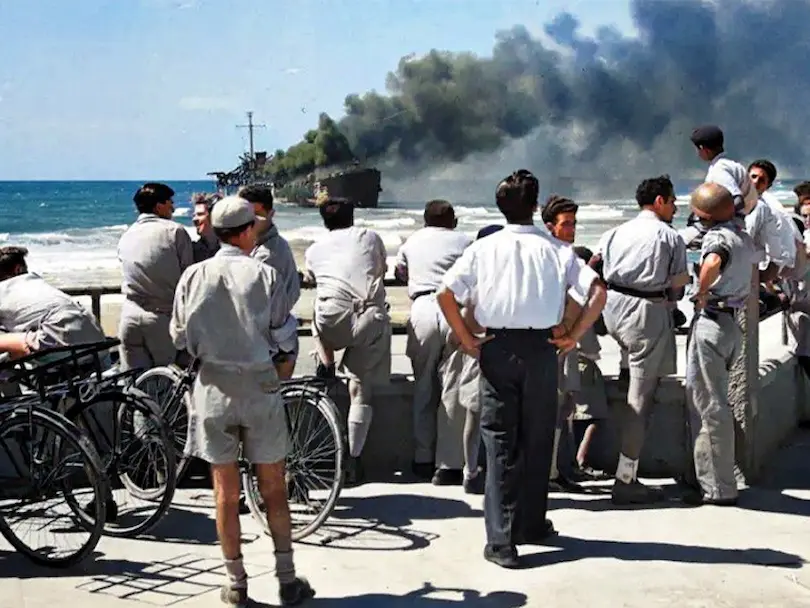 Soldiers and civilians looking on as the Altalena burns off the coast of Tel Aviv. Photo: GPO
Rabin himself threw grenades at the Irgun members. Though many IDF soldiers refused to follow their orders, others complied and fired. Two Altalena crew members were killed and others wounded. Still, Irgun members did not return fire. Over the loudspeaker, they announced, “We want to negotiate… We don’t want to have war with our brothers.” But Ben-Gurion insisted on unconditional surrender.
At 4 p.m., Ben-Gurion ordered the artillery to fire at Altalena. The first three shots missed, but the fourth cannon shell hit Altalena’s hold and ignited a fire. The captain ordered everyone on board to abandon ship.
Eyewitnesses recall that even after the white flag was raised on the Altalena, the soldiers continued to shoot at the people evacuating the ship. The Irgun members suspected that Begin was the target. Begin himself was one of the last people to leave the ship. Throughout the ordeal, he urged his people not to return fire.
That day, ten men from the Altalena and one IDF soldier lost their lives.
After the Altalena incident, Ben-Gurion remained convinced that he had done the right thing. Begin, on the other hand, was heartbroken. The next day, he delivered a tearful radio address. After refuting the rumors of armed rebellion, Begin reminded his listeners21, “Do not raise a hand against a brother, not even today!”
Later in life, Begin wrote that he wanted to be remembered, “above all, as someone who prevented civil war.22” Even after serving as the sixth prime minister of the State of Israel, he considered his refusal to open fire during the Altalena affair his greatest accomplishment.
A year after the affair, Ben-Gurion ordered the burned-out hull of the Altalena towed out and sunk into the sea. For decades, its exact location remained unknown.
On August 24th, 2026, the Israeli Heritage Ministry in conjunction with National Security Minister announced that the Altalena has been located about 20 kilometers off the coast of Israel, at a depth of 503 meters. After years of searching, the discovery was made using advanced sensors and other technology.
Prime Minister Benjamin Netanyahu congratulated everyone involved. In an official statement, he said23:
[T]his is an emotional, foundational moment. Off the coast of Tel Aviv, the Altalena went up in flames; … brothers fell by the hands of brothers. But precisely out of the infernal fire, burst forth the immortal cry of the commander of the Etzel, Menachem Begin of blessed memory, to stop the firing that was taking place… because we will not go to a civil war. This is the great lesson of the Altalena. It is as true today as it was true then. Because division is weakness, and unity is strength.











When this happened my mother( obm) was on the shore line in Israel, and the ship going up in flames , and before the ship caught fire threw threw down Menechem Begin( obm) and he swam to shore, most of the people on that ship were Holocaust Survivors and there was weapons on the ship too, my mother ( obm) was a Holocaust Survivor ( obm) got smuggled into Israel when the British was in control of Israel, and the British did not side with the Jews but with the Arabs
Unfortunately, today's Israel has too many Ben Gurions (extreme leftists, the Low Court of INjustice, Jewish or supposedly Jewish antisemites, etc.) and too few true heroes like Menachem Begin, z"l, a traditional and proud Jew.
But all is not lost, b"H, because repentance is available to everyone, except for hard-core HELLinizers, who will undoubtedly receive their just desert, as has occurred throughout Jewish history.
Another point. The "turning over" of Jews to the British almost assuredly violated the halachos of Mesirah. There is a reasonable possibility that "technically", those turning over Jews to the British would be considered "Mosrim" AND would HALACHICALLY be deserving of being killed to block the turn-over of Jews to the British. It says a great deal about Begin that he refused to exercise this Halachic "license" and -- instead -- refused to act against those Jews. Conclusion: Begin Loved Jews. Ben Gurion loved politics.
Begin( obm) did not want to start a civil war, he( obm) was a traditional ( or religious) and a mensch too
I -- for one -- am neither surprised by ben Gurion nor by Begin. Regardless of his actual religiosity, Begin was "sensitive" to true Jewish values. HE greatly respected Rabbis. It is no surprise to me that he would refuse to fire on fellow Jews. Ben Gurion -- on the other hand -- was a secularist. The left-wing parties of Israel (of which Ben Gurion was a member) did not really care about "being Jewish". They cared about the politics. So, since it was politically not acceptable to Ben Gurion, he ordered the firing upon (and killing) of Jews. AND.. people who "mourn" Rabin should recall that he ACTIVELY committed murder as recorded in the article above.
This is sadly not entirely surprising. Jacob de Haan was killed by fellow Jews because he too did not follow the "party line".
There statement that “revisionism” was intended to revise Zionism to include the use of force is incorrect. “Revisionism” as Jabtotinsky formulated it was a return to basic Herzlian principles, namely, political action seeking the establishment of a Jewish state in the land of Israel with a Jewish majority. The official Zionist movement at the time was unwilling to pronounce these goals for fear of offending the British, and it was willing to accede to limits on Jewish immigration and was unwilling to confront efforts by the British mandatory government to undermine the eats of a Jewish state.
Small correction: there was no willingness to accede to limitations on immigration. The difference was that the official movement looked to diplomatic means for pushing back rather than military action.
If you remove all the titling inherited from history, about this period; one thing remains: Defending the safety of Jews, and Jewish communities, and the Jewish Nation, should have been, and continues to be, something, that should have been, and should be non-negotiable to ALL Jews.
We are One Nation.
It turns out, that this one nation, consists of a lot of individuals with diverging political opinions from each other. But, protecting the safety and life of the individual Jew, and the Jewish community, and the Jewish Nation should be an agreed upon as a non-negotiable consensus.
Retaliation is a separate issue.