






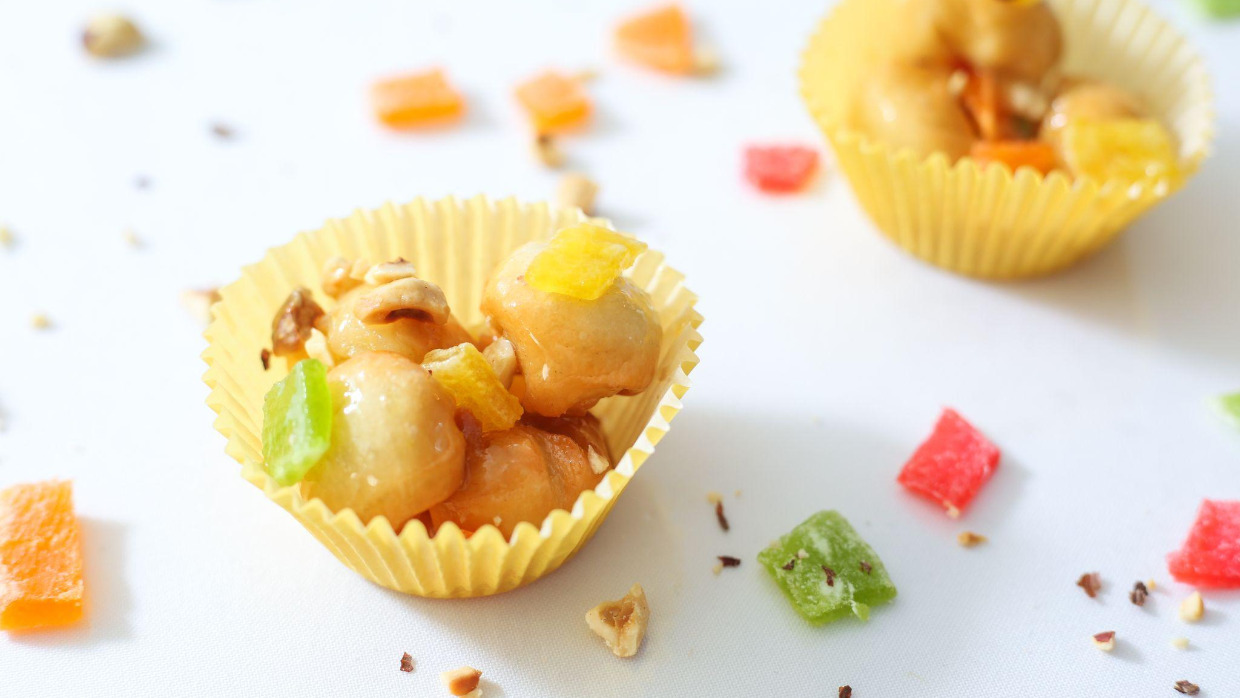
What better dessert for Rosh Hashanah is there than teiglach? Teiglach, Yiddish for “little dough,” are small, honey-boiled dough balls that are as sweet as the new year. I also think that their shape makes them perfect for this holiday. After all, life is cyclical and the festivals come round every year. And if the challah is already round for Rosh Hashanah, why not the dessert, too?
While teiglach have been a traditional Ashkenazi food for many generations, the exact origins are unclear. In Gil Marks’ “The World of Jewish Cooking,” there is an entry dedicated to Teiglach that sees them originating from an ancient Roman treat called vermiculos. Marks states that vermiculos were “strips of fried dough in honey,” and that “Italian Jews adopted” them into their cuisine. Ashkenazim eventually also knew them as “chremslach.” He goes further to say that several offshoots supposedly emerged from this among Sephardim and Ashkenazim, and as teiglach having “gained the widest appeal” in Eastern European communities.
In my research, I found very similar fritters across the mediterranean. The most notable examples are Italian struffoli, and Sephardi ceciarchiata and bimuelos . The latter is interestingly more associated with Hanukkah and Purim. The main difference to teiglach seems to me that sometimes dried fruits and nuts are added to the teiglach. Since there may be a relation to pinonate, Sephardi honey fried nuts, this makes sense. As Marks says in the aforementioned, “The obvious similarity in texture and taste of teiglach to pinyonati and ceciarchiata suggests an Italian or Sephardic origin.”
On Rosh Hashanah, some have the custom to skip nuts as the numerical value for the word “nut” is the same as for the letters chet and tet, which sound like the word “sin.” I think they are delicious either way. For the lovers of savory foods, I also included an alternate cooking method.
Ingredients
- 3 eggs
- 2 tablespoons neutral oil
- 1 1/2 cups all purpose flour plus 2 tablespoons
- ½ teaspoon salt
- ½ teaspoon baking powder
- ¼ tablespoon ground ginger
For the syrup
- ¾ cup honey
- ¾ cup sugar
- ⅔ cup water
- 1 tablespoon fresh ginger or ¼ tsp ground ginger
- Dried fruit optional
- Nuts of choice optional
Nutritional Facts
Instructions
- In a bowl, combine the eggs with oil, salt, baking powder and ground ginger.
- Gradually add 1 ½ cups of flour to the bowl until a dense, lightly sticky dough forms.
- With the remaining 2 tablespoons flour, dust a clean countertop, or large board.
- Roll out the dough on the floured surface until it is about ¼ inch thick. Using a non-serrated knife, cut the dough into 1 inch squares. Fold up the sides to form small balls, the size of marbles.
- Alternatively, roll the dough into a long rope, the size of a nickel. Cut the rope into small, ¼ inch pillows, using a non-serrated knife. Roll the pillows into small marbles.
- Transfer the balls into a tray large enough so they won't touch and cover it with plastic wrap. Put the tray in the fridge so the dough can rest.
- In a deep, 5 quart pot, add honey, sugar, water and ginger. Turn the stove top to its highest setting. Stir the ingredients together as the mixture is cooking. Once the syrup is boiling, after approximately 7 minutes, decrease the heat to half. The syrup should start to turn the color of caramel.
- Remove the tray from the fridge and drop the teiglach into the cooking syrup. Stir to allow the teiglach to soak up the sweetness and continue cooking for about 12 minutes. Add dried fruit and nuts to taste.
- Turn off the heat and move the teiglach to a parchment paper covered dish. Traditionally, teiglach are served in one large heap, although cupcake liners look good too. Once they cool down, they can be put onto skewers as well. Enjoy!








I’m anxious and excited to try this but I have a question before I begin. What is the best way to store them?
you don't...you eat it right away for Rosh Hashanah!