




 What Mamdani Gets Wrong



7 min read



5 min read


SpaceX just filed the biggest IPO in history while losing billions. Jewish wisdom explains why this disparity isn’t irrational.
SpaceX just filed the largest initial public offering (IPO) in history while losing billions of dollars. Judaism has understood this paradox for centuries.
A company that lost $2.6 billion last year just filed to go public at a valuation of $1.77 trillion.
By every conventional financial metric, that makes no sense. SpaceX's proposed IPO, targeting up to $75 billion in proceeds, would shatter the previous record held by Saudi Aramco, which raised $29.4 billion in 2019. Elon Musk could become the world's first trillionaire. The numbers are staggering, almost cartoonish.
And yet the market believes.
Why?
Part of the answer is Starlink, SpaceX's satellite internet business, which is profitable and growing fast, with more than 10 million subscribers across more than 160 countries. Space X also merged with xAI, and plans to offer AI servers from space. But Starlink and xAI alone does not explain a $1.77 trillion valuation. The rest of SpaceX - rockets, Starship development, the Mars program are burning cash at an eye-watering pace.
Investors are paying $1.77 trillion for a vision.
Investors are not paying $1.77 trillion for what SpaceX is today. They are paying for what it might become: humanity's transportation system to the stars.
In other words, they are paying for a vision.
This is where things get interesting from a Jewish perspective.
Judaism has been in the business of investing in vision for 3,300 years.
When the Jewish people stood at Mount Sinai, they had nothing. No land, no army, no treasury. They were a collection of former slaves with a recently received legal code and an enormous promise about a future they could not see. A rational outside investor in 1300 BCE would have passed on the deal immediately.
And yet they bet everything on what they might become.
The Torah was given not to a nation at its peak, but to a nation at its starting point. The covenant at Sinai was, in financial terms, an investment in projected future value, not in current earnings. The balance sheet was empty. The vision was everything.
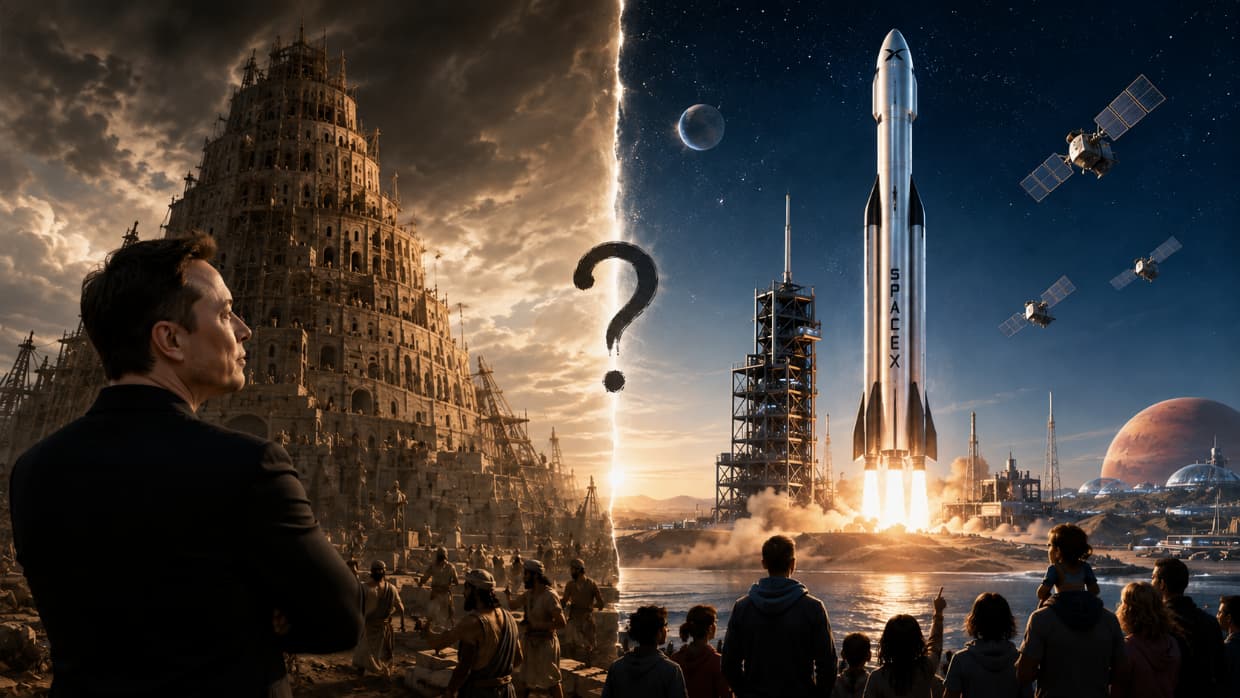
Vision, though, is not automatically virtuous. The Torah's most vivid story of visionary ambition gone wrong is the Tower of Babel. A unified humanity, pooling remarkable technological capability, set out to build something that would "reach the heavens" and "make a name for themselves" (Genesis 11:4). God dispersed them before they could finish.
According to Rabbinic tradition, the problem was not the ambition; it was the purpose behind it, namely self-glorification, the desire to achieve permanence through ego rather than through contribution.
Musk is not a man without ego. He wants control. His retention of 82.4% of voting power after the offering makes that structurally explicit. The question the Torah forces us to ask is not whether SpaceX's ambition is large, but whether its mission is genuinely oriented toward something beyond the founder's own aggrandizement.
"Making humanity multi-planetary" to ensure civilization survives could be one of the greatest acts of kindness in human history. If the mission is genuine, it is worth something no spreadsheet can capture. If it is merely a monument to one man's legacy, a "Tower of Elon," then history has seen that story before, and it did not end well.
Strip away the scale and what SpaceX is doing is not unusual. It is just unusually visible. Musk is asking the market to assign $1.77 trillion of present value to a company whose most consequential products do not yet exist. Rockets that will reach Mars. Servers in space that will support AI. Missions that are, at best, a decade away. The investors are not being irrational. They are making a disciplined judgment that these future returns, properly valued, are worth more today than almost any operating business on earth.
The Talmud tells a story about Honi, who once saw an old man planting a carob tree. Honi asked how long until the tree would bear fruit. Seventy years, the man replied. Honi pressed: do you expect to live another seventy years to eat from it? The man answered without hesitation. "I found carob trees in this world because my grandfather planted them for me. I plant these for my grandchildren."
The value of what he planted was real and present, even though the yield lay entirely in the future.
The man was not being sentimental. He was applying a precise logic. The value of what he planted was real and present, even though the yield lay entirely in the future.
This is what l'dor v'dor, from generation to generation, actually means. It is a valuation method. Judaism has always held that actions whose returns arrive decades or generations later carry full present weight. A parent who pours years into a child's education before seeing any result. A community that builds an institution it will never fully benefit from. A person whose act of kindness ripples forward in ways they will never witness. These are long positions, held with conviction.
SpaceX is losing billions because it is planting carob trees. The market is reading that correctly.
So the real question the SpaceX IPO should prompt is not whether you would buy the stock. It is whether you are living like the man who plants for the long-term payoff. What are you building today whose full value will not arrive in your lifetime? What are you planting that your grandchildren will eat from?
That investment will never appear on any prospectus. But it may be the highest-returning investment you ever make.






Is there kosher food at SpaceX's locations?
you are missing a lot of the financials such as Starllink which will be extraordinarily profitable in the near future. there is way more to spacex than space travel but you have to make the effort and read why people who are investors believe it will be worth far more
Great!
I’m afraid what Musk is proposing is “pie in the sky”
Have you forgotten the words of Isaiah: “For behold, I will create new heavens and a new earth. The former things will not be remembered, nor will they come to mind”