








 What Two Hebrew Words Reveal About Israeli Democracy


7 min read
7 min read
10 min read





The creator of The Twilight Zone used his trailblazing series to wrestle with the moral issues of his time.
In addition to co-writing the screenplay for the original 1968 Planet of the Apes movie that launched the third longest running movie franchise in the world, Rod Serling’s greatest achievement was his TV series The Twilight Zone, which he used as a platform to fight against fascism, racial injustice, and prejudice, while promoting social equity. Serling was one of the first to use TV to explore moral and political questions of his time, addressing controversial subjects through the prism of science fiction and horror.
Rod Serling was born into a Jewish family in Syracuse, NY on December 25, 1924. His family belonged to the Binghamton Jewish Community Center. In late June 1943, he graduated high school and joined the Army the day after graduation. He wanted to go to Germany and kill Hitler. As a member of the 511th Parachute Infantry Regiment, he saw vicious combat in the Philippines that gave him lifelong nightmares. He was a decorated war hero and earned a Bronze Star and Purple Heart.
But he was disappointed he wasn’t sent to Europe to fight the Nazis. In a few years, he’d get a chance to do exactly that in an unexpected way.
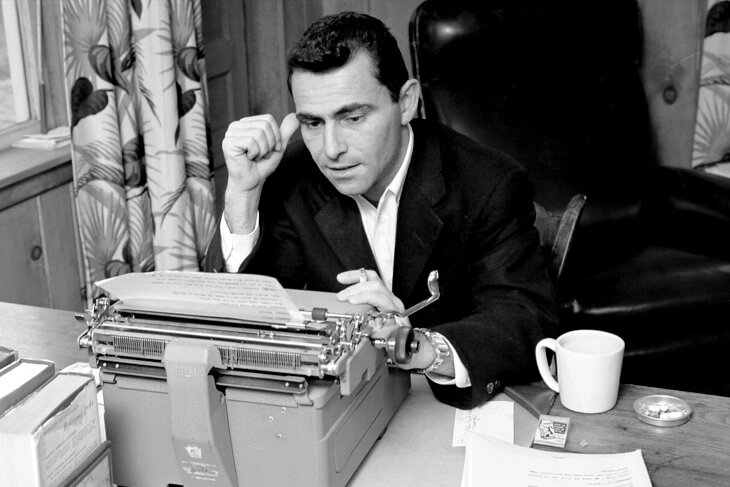
He went to college on the G.I. Bill, became active in the college radio station with writing, acting, and directing roles. In 1954, he jumped into the evolving world of early television, wrote scripts for live television dramas, and garnered praise for his boxing drama with 1956’s Requiem for a Heavyweight.
Serling’s Twilight Zone television anthology premiered in 1959 and produced 156 episodes over five years. Serling won six Emmy Awards for writing, a Golden Globe, a Peabody Award, and became entrenched into American pop culture. Reruns are still shown today and appear in many all-day marathon broadcasts. It’s been broadcast in nearly 100 foreign markets and has spawned full length movies and television reboots.

In honor of his lasting impact on American culture, Serling and the Twilight Zone appeared on a 2009 US postage stamp.
The Twilight Zone used allegories through a mix of horror, science fiction, history, and fantasy to explore the darkest corners of mankind. Many episodes packed an unexpected twist ending. Fighting evil, prejudice and fascism were common themes for Sterling.
Let’s look at a few Twilight Zone episodes for examples.
This episode was broadcast during Nazi Adolph Eichmann’s war crimes trial where he was charged with planning and implementing the Holocaust as an SS officer. Eichmann had been hiding out in Argentina but was tracked down and brought to trial by Israeli Mossad agents.
Serling created the character of a remorseless and sadistic SS Officer named Lutze who returns to the Dachau concentration camp only to be haunted and put on trial by the spirits of his murdered victims. The ghostly trial judge was a prisoner Lutze killed. Wearing concentration camp striped pajamas, he charges the defendant with these crimes, “Captain Lutze, ten million human beings were tortured to death in camps like this. Men, women, children, infants, tired old men — you burned them in furnaces. You shoveled them into the earth. You tore up their bodies in rage”.
Serling’s powerfully narrates the epilogue with these words:
“All the Dachaus must remain standing. The Dachaus, the Belsens, the Buchenwalds, the Auschwitzes – all of them. They must remain standing because they are a monument to a moment in time when some men decided to turn the Earth into a graveyard. Into it they shoveled all of their reason, their logic, their knowledge, but worst of all, their conscience. And the moment we forget this, the moment we cease to be haunted by its remembrance, then we become the gravediggers. Something to dwell on and to remember, not only in the Twilight Zone but wherever men walk God’s Earth.”
The rage and fury of Serling’s script may be one of his finest.
In this episode, the ghost of Adolph Hitler visits the leader of a rag-tag group of American Nazis. Hitler’s ghost teaches him how to whip a crowd into a frenzy and exhorts and manipulates him into committing increasingly violent acts and a murder. Hitler eventually turns against his student, and Serling delivers another searing epilogue:
“Where will he go next, this phantom from another time, this resurrected ghost of a previous nightmare – Chicago? Los Angeles? Miami, Florida? Vincennes, Indiana? Syracuse, New York? Anyplace, everyplace, where there's hate, where there's prejudice, where there's bigotry. He's alive. He's alive so long as these evils exist. Remember that when he comes to your town. Remember it when you hear his voice speaking out through others. Remember it when you hear a name called, a minority attacked, any blind, unreasoning assault on a people or any human being. He's alive because through these things we keep him alive.”
In this episode, a gloomy fog of darkness descends across certain cities around the world. In one small town, it delays the execution of a man sentenced to be executed in the morning. His guilt is questionable. The darkness appears over North Vietnam, Berlin, Germany, Dallas, TX, and elsewhere. I read that this episode was written as Serling’s response to President Kennedy’s assassination, and the darkness was a metaphor representing hatred and racism.
Serling’s eloquent narration closes the episode with:
"A sickness known as hate. Not a virus, not a microbe, not a germ—but a sickness nonetheless, highly contagious, deadly in its effects. Don't look for it in the Twilight Zone—look for it in a mirror. Look for it before the light goes out altogether."

Here, a fascist government puts a simple librarian on trial for being “obsolete”. The government and its Chancellor have banned religion and books and legislated belief in God and book ownership into offenses punishable by death. The episode’s hero is given 48 hours to choose his method of execution. He devises a choice that also kills the Chancellor.
Serling wrote another blistering epilogue:
“The Chancellor, the late Chancellor, was only partly correct. He was obsolete. But so is the State, the entity he worshipped. Any state, entity, or ideology becomes obsolete when it stockpiles the wrong weapons: when it captures territories, but not minds; when it enslaves millions, but convinces nobody. When it is naked, yet puts on armor and calls it faith, while in the Eyes of God it has no faith at all. Any state, any entity, any ideology that fails to recognize the worth, the dignity, the rights of Man... that state is obsolete. A case to be filed under "M" for "Mankind" - in The Twilight Zone.”
TIME magazine named this as one of the ten best Twilight Zone episodes ever made. A small town hears a whistling sound and sees a flash of light in the sky. Was it a meteor? Soon the town’s electricity is affected and appliances, lawnmowers, even automobiles are not working. Suspicions grow as to which citizen is responsible for the chaos, and a man is murdered.
Maple Street residents become convinced that space aliens are living on their street, disguised as “normal” people. Echoing the Red Scare of 1950’s McCarthyism, Serling weaves in themes of mob mentality, paranoia, “outsiders”, scapegoats, prejudice, stereotypes, and disinformation.
Serling’s epilogue summarizes what happened on Maple Street in this way:
“The tools of conquest do not necessarily come with bombs and explosions and fallout. There are weapons that are simply thoughts, attitudes, prejudices ... to be found only in the minds of men. For the record, prejudices can kill ... and suspicion can destroy ... and a thoughtless, frightened search for a scapegoat has a fallout all of its own—for the children and the children yet unborn. And the pity of it is ... that these things cannot be confined to ... The Twilight Zone!”
Serling was a chain smoker and had three heart attacks in 1975 before dying in surgery. He was six months short of his 50th birthday.
Television was in its infancy when The Twilight Zone premiered in 1959. Sterling is credited with bringing a sense of morality, social consciousness, provocative drama, and ethics to the medium, as opposed to the lighthearted comedy, variety and game shows that were popular at this time.
Biographer Nicholas Parisi wrote, “When Serling died in 1975, at the age of fifty, he was the most honored, most outspoken, most recognizable, and likely the most prolific writer in television history.”
Public Television’s 1995 episode of American Masters summarized his societal impact this way: “Fed up with the difficulties of writing about serious issues on the conservative networks, Serling turned to science fiction and fantasy. Through an ingenious mixture of morality fable and fantasy writing, he was able to circumvent the timidity and conservatism of the television networks and sponsors.”
SOURCES











Great article on his life and work, one omission is that he wrote the original "Planet of the Apes" - what a take a humanity and the arms race and the nuclear age.
Serling's 1968 movie screenplay was an adaptation of the 1963 original novel by Frenchman Pierre Boulle, "Planet des Singes".
Rod Serling was an exceptional writer and NEVER forgot his Judaism. "Being a Light onto the Nations" is not an easy task for us. His clever mixture using various themes and social commentary during the 60's period within his Zone episodes is highly commendable. It made one realize their false prejudices was wrong and enhances more hate against those that should be respected. His recorded dreams created most of the "Twilight Zone" episodes and we are better as a species for that. R.I.P.
Benjilini
The American Masters 1995 episode on Serling was entitled "Submitted for Your Approval", same title as an anthology released by his daughter. The narrator sounds like Serling so he talks in the first person. It is funny to hear him explaining how the sponsors controlled so much of the content in the 1950s, while advertising such mundane goods as toilet paper. It was released on DVD in 2015, now no longer available. You may find a used copy on eBay.
it is a shame he died so young. imagine what he could have done!!! i was very young and watched his shows and of course only at face value. now i want to watch these episodes again
wIn reading comments from other posters, Mathayu W. used the "darashic." I've never heard that word before. Can you please tell me what it means?
From the word darash
https://www.biblestudytools.com/lexicons/hebrew/nas/darash.html
It's not an English word. The word "darasha" derives from Hebrew and means a homily or moral sermon, typically given by a Rabbi in a synagogue. So adding the suffix "ic" turns it into an adjective. It took me a couple readings to get it.
My Uncle Al Zacher was Rod Serling's roommate at Antioch College in 1946.My Dad met him and coincidentally my dad was part of the 20th armored division that helped to liberate Dachau in April 1945.
I long supposed that Serling’s stories were darashic, and I wondered —without researching— if he had a connection to Judaism. This article pleads a strong case for the former and confirms the latter! Thank you!
He was our frequent guest professor at SI Newhouse at Syracuse Univ in 1972. He'd show clips from the Twilight Zone and then give a deep and meaningful lecture based on the clip
He was a good man, who gave many black listed writers a job. The sensors who would not allow certain subject matters on television, seemed oblivious to it when it was framed by science fiction.
I understand that he walked away form Judaism religiously, but more than a "Yiddish cup" I think he had a Jewish Neshama. He lived in a world that we might not understand today but he did not write empty stories. His stories made people think. There is so little thoughtfulness today.
It is sad this person intermarried, even though he talked about important subject matter on his show
He had a Jewish ‘kop’ (head).
Right, I used to watch his sgow