





 Passover and the Crisis of Jewish Identity




8 min read
6 min read
7 min read


6 min read


In this interview, writer-director Josh Safdie explores how Marty Supreme weaves post-Holocaust Jewish pride, resilience, and ambition into a bold coming-of-age story.
One of the most refreshing films that celebrates Jewish heritage is the hit “Marty Supreme.” Judaism is deftly sewn into the ambitious world of Marty Mauser, a fast-talking, confident dreamer played by Timothée Chalamet (who previously starred as Jewish musician Bob Dylan in “A Complete Unknown”).
Already nominated for numerous Hollywood awards, the movie is loosely inspired by the feisty life of Jewish ping-pong legend Marty Reisman, who won many table tennis titles throughout his career and features several Jewish actors.
Jewish writer-director Josh Safdie (“Uncut Gems”) co-wrote the original feature with his longtime collaborator Ronald Bronstein. The duo were drawn to the idea of using the resilient Mauser as a way to explore post-Holocaust pride; how winning World War II ignited the idea of the American dream.
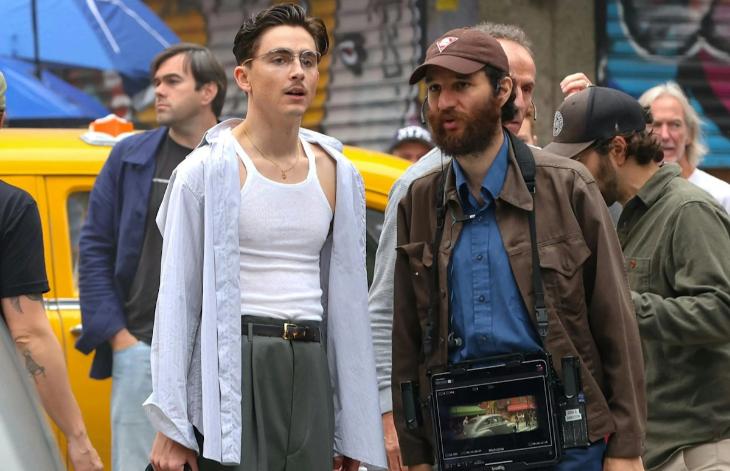 Timothée Chalamet, wearing a Star of David, and Josh Safdie on set.
“He comes from a very provincial place, the Lower East Side in the mid-20th century, which was a melting pot but a high concentration of Jewish immigrants,” Safdie said during a recent interview with National Public Radio (NPR).
“And after the war, the concept of Jewish pride kind of blossoms. And the survival of the Holocaust was something to kind of be proud of.”
One of the many scenes which illustrate Marty’s cockiness and mental toughness includes Marty telling a group of journalists that he’s Hitler's worst nightmare. "Just look at me. I’m here. I’m on top. I’m the ultimate product of Hitler's defeat."
In an interview with Aish.com, Safdie commented, “I think that World War Two and the Holocaust in particular, was like gasoline on the fire of Jewish pride–you can't kill us, and we survived. So I think that's where real Jewish pride really came to exist in the world.”
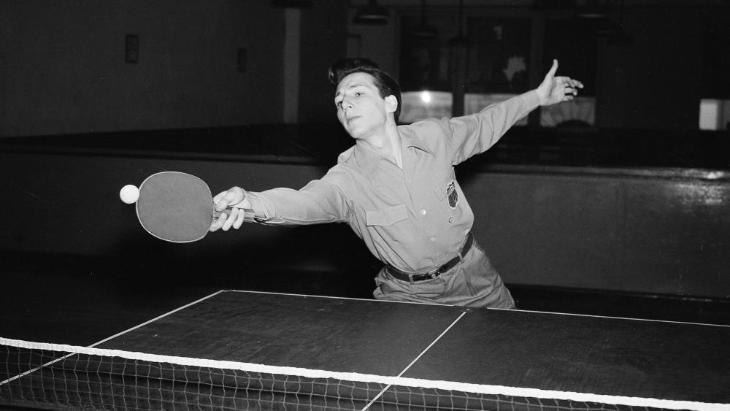 Marty Reisman
A riveting Holocaust flashback scene in the film is based on a true story. Marty’s friend, ping pong player, Béla (“Son of Saul’s” Géza Röhrig) tells him that while he was disarming bombs in the forest, he found a honeycomb. Seeking to give sustenance to his fellow inmates, he rubbed the honey all over his body and later, secretly let them lick it all off.
“That's a very special sequence for both Ronnie and I,” Safdie told Aish. “I find it to be more evocative and more telling than some Holocaust films that I've seen in their entirety. Sometimes we can understand the bigger picture through a smaller story. And that is exactly what happened when I stumbled upon it in my research of the mid-20th century table tennis international scene.”
The real-life occurrence happened with Hungarian player, Alojzy Ehrlich.
“He was a champion in the late ‘30s and early ‘40s, and he was Jewish and was taken into a camp. It was Dachau and he was on his way to the showers and an officer who is a fan of table tennis recognized him, which spoke to its popularity in Europe. He had been at the 1939 championship, which had this record-breaking point in its length, and told him that he was going to come and work for them, as some Jews who had special treatment would end up working directly for some of the Nazi officers.”
Like many table tennis players, Ehrlich was very intelligent, said Safdie.
“They had high IQs but did very bad at school. And they had him, they used his brains and his body to basically defuse and dismantle US bombs or US mines that they had found. They sent him into the forest in the middle of nowhere. And so that if the bomb did detonate, he would be the only one spared and he would be able to defuse it in 5, 10 minutes. It was easy work for him.”
Ehrlich would tell the SS officers that it was going to take him a few hours and then he would just spend his time moving around the forest.
“And that was when he saw the honeybee,” said Safdie. “So Ronnie and I expanded upon the story slightly. He didn't find a honeybee, he found an abandoned honeycomb. But he did in fact spread the honey across his body and share it with, for nutrients, his fellow inmates. It was such a beautiful story for us because I think that it spoke to the camaraderie and the tight knit community. And how the Jews, particularly in the Holocaust, banded together to survive.”
Bronstein and Safdie describe “Marty Supreme” as “a Jewish experience” story. That is not to say that Marty is an embodiment of Jewish values; he decidedly isn't. This not a family film.
 “That attracted us to this world and this story and this time period, this moment of the silent generation, in particular, the Jewish Americans who were far from the conflict,” acknowledged Safdie. “My grandma, who when she was 10 years old in New York City, saw Hitler invading Paris and her first question was to her mom, ‘Is he coming here next?’ There was a certain sort of distance but complete connectivity to the nomadic people throughout the world, Jewish people.”
That fear manifested a certain sort of “pervasive anxiety” that exists to this day within her.
“Which is understanding that the entire world can turn a blind eye to a collective experience of the Holocaust or the collective ignore the collective naivete of what is. What was happening to a very specific type of people. That goes back to a much more subtle context, to the Middle Ages.”
That level of anxiety is a bedrock inside Marty’s life, said Safdie.
“But the perseverance, the survival of the Holocaust for a Jew, post war, which, when Ronnie and I write from the perspective of a character in their current setting, all we can do is as much research and apply ourselves from an emotional standpoint and see the world through that character. Understanding what it's like to be a young man who was too young to fight in the war, but who saw his people survive, creates.”
He added: “It was the first moment in assimilated Jewish culture where you saw the concept of what Jewish pride could even be, because there was a sense of, ‘Oh, wow, we survived.’ Therefore, there's a sense of being, preening a little bit. Not preening, but prideful.”
The film’s trailer has already garnered positive buzz from Jewish audiences; Chalamet has a number of scenes where he’s wearing a Star of David necklace.
Said activist/influencer Naz Hashem on her Instagram: “It’s a nod to Reisman’s Jewish identity, and it resonates even more knowing Chalamet’s mother is Jewish herself. A subtle but powerful reminder of the pride woven into this story of grit, talent, and heritage.”












It’s disappointing to see Aish promoting a film that reinforces the very tropes we fight against every day. Why is an Orthodox Jewish site celebrating a story that lacks basic Jewish morality and makes us look like the antisemitic caricatures the world wants to see? Representation matters, but not at the expense of our values. We should expect more from a platform representing 'Jewish Pride.' This is a huge miss.
I would not recommend that anyone take children to the film. First, kudos to Chalamet, a brilliant actor who fully realizes his character.
However: the character is utterly immoral. His Jewishness rests on some of the worst stereotypes about us: that we don’t care about anyone else, that we will cheat to get ahead, etc.
This is one of the most irritating films I have seen in a long time.
The only possible way to explain the ending is that Marty’s extended adolescence is ending and he finally realizes that winning a game is not everything.
Great movie.
Can’t tell you how many times over the years, I’ve told people “I’m a miracle!” Born in 1951 to (Alumni) from Auschwitz & Bergen Belsen!
I barely understood this poorly constructed and confusing article and still have no idea what the movie is about. "The film’s trailer has already garnered positive buzz" the article states. The trailer? What about reaction to the actual film? "Uncut Gems" from this same director was yet another film showing Jews in a negative light--and from the comments section it appears this film does the same.
With Jews like this you don't need enemies, news flash if they were in the south or north of Israel on October 7, 2023, they would have had the same outcome like the others endure, I can't actors and musicians, and a lot of entertainers have a iq of fruits and vegetables and not of normal thinking people, plus these ignorant useful idiots should read up about terrorists, not only dangerous for Jews and Israel, but for non Muslims and western values that are Judeo and Christian, also they should learn Arabic what the terrorists are really saying, I won't to school with people that talked Arabic in there home, so they know what the enemy is saying
They are not, there was a Jewish gangster named Meir Lansky, also a embarrassment, for the Jewish people
Jewish pride? Jewish embarrassment.
I also saw the movie and not only did I not feel any Jewish pride I thought he was a disgraceful and despicable character who was the exact opposite of what Jewish values truly are - he was greedy, self-centered and absorbed, cut-throat, sexually immoral, and completely driven and obsessed with money and fame, and burned everyone along the way in his efforts to obtain them. His character only reinforces the typical Jewish stereotype of the money-hungry Jew. Total chillul Hashem in my eyes.
I took my family to see this movie. In the first 20 minutes my son got up and walked out. This movie is unmoral. I stayed and watched the movie. Yes he had skills in ping pong but his life was chaos and a perfect example of the kind of life no one would hope to live. I am ashamed I did not get up and walk out with my son.
I had the same feeling and the same impulse watching this film
Having lived in New York
1970- 2001 and visited every borough as afocisl worker - this movie was a caricature of NY poorer classes
if the actor's mother is Jewish, so is he (halachically, anyway)!
You never know if the actor mother is actually Jewish, most people in that industry intermarry, so you never know if that statement is true or not, and some Jews are Jews in name only, and know nothing about their heritage