




 Canada Is No Longer Safe for Jews


4 min read
5 min read


5 min read


Eli Sharabi survived 491 days in Hamas tunnels. Rick Rescorla ran back into the South Tower to save others. Together, they redefine what heroism actually looks like.
On a recent trip to New York, I encountered two heroes, one living, and one who lives on in memory.
Honoring the first of the two, Eli Sharabi, was the reason of my trip.
Sharabi, an Israeli kibbutznik, had his world destroyed on October 7th. On that day, he lost his wife and two daughters and was kidnapped to Gaza. There he survived 491 days in captivity, much of it in the grim tunnels beneath the city.
He endured beatings, starvation, psychological torture, and squalor. Despite the conditions he did not crack. Eventually he was released and wrote a riveting memoir of his ordeal, titled Hostage.
Hostage, which won The Jewish Book Council’s book of the year, is a short work of prose. Its language is straightforward and unadorned. Nevertheless, in one respect it resembles the epic poems of Homer, Virgil, and Dante. Sharabi, like Odysseus, Aeneas, and Dante, descends into an underworld, a place so hostile to life that only the greatest heroes can make the journey and return intact.
Notably, Dante merely observes the tortures inflicted on the damned. Not so for Sharabi, who was at the mercy of the merciless.
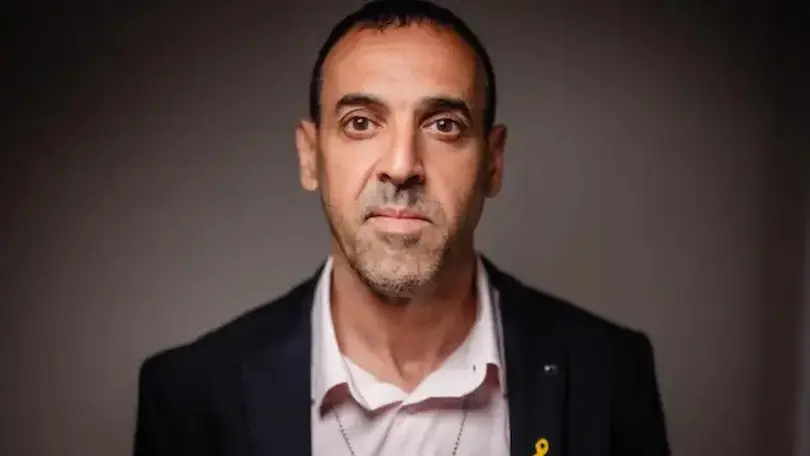 Eli Sharabi
And while each of the literary heroes has a guide or has been coached on how to return, Sharabi has only himself. Like his spiritual predecessor, Viktor Frankl, Sharabi finds a reason to live and clings to it with superhuman strength. Is this not the strength that has allowed the Jewish people to overcome a history heavy with persecution, subjugation, and genocide?
The great difference between Hostage and the epics is that the former is nonfiction. Therefore, it is impossible to read Hostage and not ask: how could he have endured? Could I have endured?
The other hero, Rick Rescorla, died in the South Tower on 9-11.
On the afternoon of the day I was scheduled to see Eli Sharabi honored I visited the 9-11 museum in downtown Manhattan. One room has a picture of each of the nearly 3.000 victims. By pure serendipity, I came upon Rick’s picture, and remembered reading of his courageous deeds.
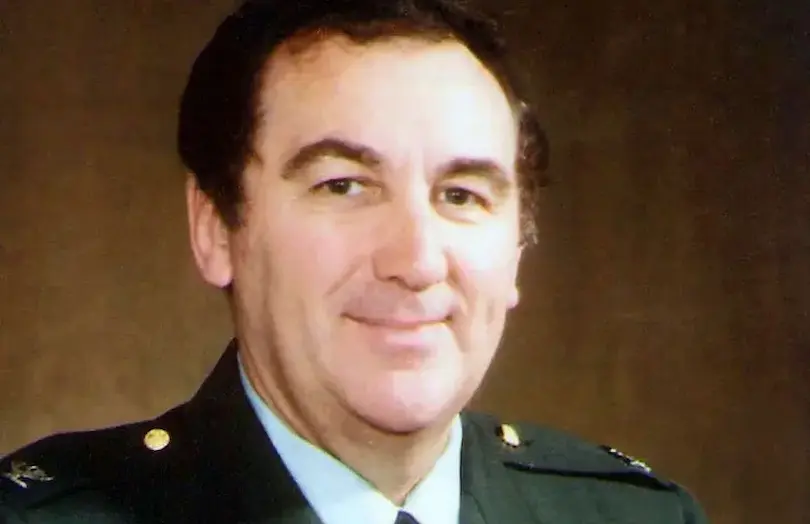 Rick Rescorla
He had been warning about a terrorist attack on the Twin Towers after a deadly car bombing of the North Tower’s parking lot in 1993. Port Authority officials ignored him, but he set about preparing his Trade Center-based employer for a deadlier attack.
The attack came.
Rescorla got out of the South Tower in time to save himself, but returned to help stragglers.
Rick’s drilling paid off. He is credited with saving 2,700 lives on that terrible day. Using his bullhorn, he exhorted his colleagues to exit calmly. Showing his own sangfroid, he serenaded them with songs from his native Cornwall. And, in the midst of the catastrophe he said that it was a day to be “proud to be an American.”
He was right.
Rescorla got out of the South Tower in time to save himself, but returned to help stragglers. Ever the good shepherd, he was searching for them when the Tower collapsed.
Can a hero have a more lasting legacy than the 2,700 lives Rick Rescorla saved? Neither marble nor bronze, nor even the sleek black granite of the Vietnam Memorial could pay greater tribute to his deeds than the multitude who live because of him.
We couldn’t live without heroes, and that is literally true for 2,700. Yet, all of us can draw inspiration from such selfless valor. Even though only a tiny few could match Rick’s devotion or Eli’s endurance, with their examples in mind anyone can stretch beyond their familiar limits and do more than they thought possible.
But what of those who perpetrated 9-11 and October 7? Do the examples set by Eli Sharabi and Rick Rescorla contain a lesson for them?
Periodically the worst kinds of leaders misread a free people as weak and decadent. This misperception sometimes metastasizes into a sneak attack, as it did on those two terrible days. But in each case, free people, often ordinary people, find within themselves the capacity to do extraordinary things. As deadly as the two terror attacks were, the actions of many heroes, some celebrated and many unknown, combine to make the attacks less costly for the victims and more costly for the terrorists than the plotters calculated. And once a wronged democracy gathers itself and retaliates in righteous anger, it strikes back with unimaginable power.
If religious fanatics can learn the lessons of history, from Herodotus right down until today, they would not attack the democracies that arouse such feelings of inadequacy, envy, and hatred in them.
They would choose peace, not from goodness but from fear and prudence. And that would be a blessing, because peace for the wrong reason is better than war for the right one.









My heart goes out to Mr Al Harabi for the horrors of what he went through as a hostage and also for the loss of his beloved family in the horrendous attack on Oct 7th. It's hard to even imagine surviving such horror for over 400 days. I wish him strength love and healing.
I also commend in the highest way the Mr Rescorla, who saved so many lives and then went back to save more and died himself. It's hard to imagine such courage.
Along with you I honor them and want to stop all terror and war and killing.
I do not believe that the people of the Middle East have hate for America because of our freedom and democracy. The United States has long supported tyrants throughout the Muslim world