



 Tucker Carlson's Lies About Jews and Israel




5 min read


Once the lifeblood of Jewish Europe, Yiddish now speaks from the margins—a wounded language that refuses erasure.
Before the Holocaust, Yiddish was the lifeblood of Ashkenazi Jewish culture. Spoken by over 11 million Jews across Eastern and Central Europe, it was more than a language—it was a vessel of memory, humor, resistance, and identity. In the shtetls of Poland, the tenements of Vilna, the cafés of Warsaw, and the concert halls of Vienna, Yiddish bound generations through its wit, warmth, and nuance.
The Holocaust destroyed not only a people but their linguistic soul. Today, Yiddish endures in pockets—kept alive by scholars, artists, and Hasidic communities, but its once-vibrant cultural ecosystem lies in fragments. What happens when a language so rich is torn from its native soil? What is lost when a language dies with its speakers?
Yiddish emerged over a millennium ago as a fusion of Germanic, Hebrew, Aramaic, and Slavic elements, written in Hebrew script. It was the lingua franca of European Jewry—not the language of prayer (which was Hebrew), but the language of dreams, arguments, lullabies, and jokes. As Isaac Bashevis Singer, the Nobel laureate who wrote exclusively in Yiddish, once remarked: "Yiddish is the wise and humble language of us all, the idiom of a frightened yet hopeful people."
Synagogues were burned, libraries destroyed, teachers and writers executed. Yiddish, as a marker of Jewish identity, was silenced in the ghettos and incinerated in the camps.
In the early 20th century, Yiddish experienced a renaissance. Newspapers, theater, poetry, philosophy, and political discourse all flourished in Yiddish. It was the language of both revolution and reflection. The Vilna Troupe redefined modern theater. Bundists organized for workers' rights. Poets like Celia Dropkin and Avrom Sutzkever expressed both radicalism and longing. Yiddish was not merely a vernacular—it was a cosmopolitan, diasporic culture, thick with history and saturated with emotion.
The Holocaust wiped out millions of Jewish lives, and systematically erased the very fabric of Jewish culture. Synagogues were burned, libraries destroyed, teachers and writers executed. Yiddish, as a marker of Jewish identity, was silenced in the ghettos and incinerated in the camps. Nazi propaganda ridiculed Yiddish as degenerate. With the murder of six million Jews, entire Yiddish-speaking communities vanished overnight.
The aftermath was equally devastating. Survivors often emigrated to countries where Yiddish was stigmatized as the language of the old world—the language of poverty, shame, and death. In Israel, the new state embraced Hebrew as a symbol of national rebirth, while relegating Yiddish to the shadows. As literary scholar Naomi Seidman has written, “Yiddish came to represent the exile that Zionism sought to overcome” (Seidman, 1997). In America, many immigrant families abandoned Yiddish in favor of English to protect their children from the discrimination they had fled.
In my own family, I witnessed how Yiddish both connected and divided. My mother-in-law, a Polish Holocaust survivor, often expressed herself in Yiddish-inflected English. The sharpness, her cadence, her choice of words—all bore the stamp of her native tongue. At times, I mischaracterized what she said. Her remarks could sound blunt, even insulting, and more than once, we clashed—me, feeling wounded; her, bewildered by my reaction.
Only later did I come to understand that what felt abrasive was just a directness shaped by language and trauma. Her expressions didn’t always translate—not into English, and not into the gentler emotional conventions I was used to. I began to see that Yiddish was the membrane through which her experience passed: earthy, unsentimental, deeply expressive, and steeped in the rhythms of survival.
Post-Holocaust, Yiddish became haunted. It was no longer just a language of the living—it was a language of ghosts. As author Cynthia Ozick writes, Yiddish became “a martyred language,” rich in pathos, spoken by the dead in dreams and by the living in elegy. The sound of Yiddish evokes a world that no longer exists—a vanished Europe of bagel-sellers and revolutionaries, mothers at soup pots, and sons with books under their arms.
Post-Holocaust, Yiddish became a language of ghosts.
Yet to mourn a language is also to acknowledge what it held. Embedded in Yiddish are centuries of Jewish humor, theological debate, immigrant yearning, and resistance. Its idioms reflect a worldview shaped by marginalization and creativity: ironic, skeptical, yet deeply humane. When this language falls silent, so too does an entire modality of understanding suffering and joy.
Today, there is a growing movement to revive and preserve Yiddish. Academic programs, Klezmer festivals, online courses, and theatrical productions have brought new life to the language. But even these efforts confront a moral dilemma: Can a language truly be revived if the world that produced it is gone?
The language may no longer fill the marketplaces of Warsaw or the classrooms of Vilna, but it endures as an act of moral defiance.
Yiddish is endangered, but it continues to pulse beneath the surface of Jewish memory and creativity. As Holocaust scholar Dovid Katz writes, “Yiddish is not dead—it is bruised, whispering, hidden in the walls.” It remains a language of resistance—not only against forgetting, but against erasure itself.
To engage with Yiddish today is to enter into dialogue with absence—to listen for the echoes of a silenced world and to answer them with care. The language may no longer fill the marketplaces of Warsaw or the classrooms of Vilna, but it endures as an act of moral defiance, a refusal to let erasure have the final word. In every revived song or whispered phrase, Yiddish reclaims a fragment of what the Holocaust sought to extinguish: the Jewish capacity for humor, irony, and resilience. To honor Yiddish is not merely to preserve a language—it is to affirm that memory itself can resist extinction, that culture can speak even from the ruins.










In Antwerpen, Belgium, yiddish is used by the Jewish population. And everyone gets away with it
Richtig saftig Yiddish wie in der alte zaten.
Also Sephardic people had a language called Landino, I wonder how this language is doing, besides the language of Yiddish being revived, I read about the music before the Holocaust that was klezmer music, the Gypsies that played with the Jews kept the music of the Jews alive, which is very interesting to me
Ladino in Ladino is "Spanyol," a somewhat Judaized Spanish of Exiled Spanish Jews, like Yiddish & most Jewish languages, it's written in Hebrew letters. An Israeli Greek Jew marry an Argentinian Ashkenaziya & she speaks with his parents in Spanyol. We don't hear Spanyol in Jerusalem anymore, but Argentinian Spanish is spoken because of the new immigrants from there. C.25% of English is from German, so many etymologies of English words can be seen in Yiddish, & therefore German, words. "Shrek," the character, is Yiddish for...SHRIEK!!! Geshmakt's root is smack (NOT to slap, but a taste of something), related to shmek (smell, like that ground root we sniff in schul) have one common Proto Indo European root of sensory perception (taste/smell). Kumtitz=picnic=come sit (& eat)
Yiddish and Ladino are not languages, they are jargons written in Hebrew characters. Native German & Spanish speakers can understand them, respectively. They are similar to the patois spoken in former colonial areas.
No Yiddish is Not a jargon it is areal language
It's been well over fifty years since I last encountered a native Yiddish speaker who speaks Yiddish exclusively. All the speakers I met since use it only as an adjunct to another language (mainly English). And the Yiddish spoken by some American orthodox is heavily Hebraic.
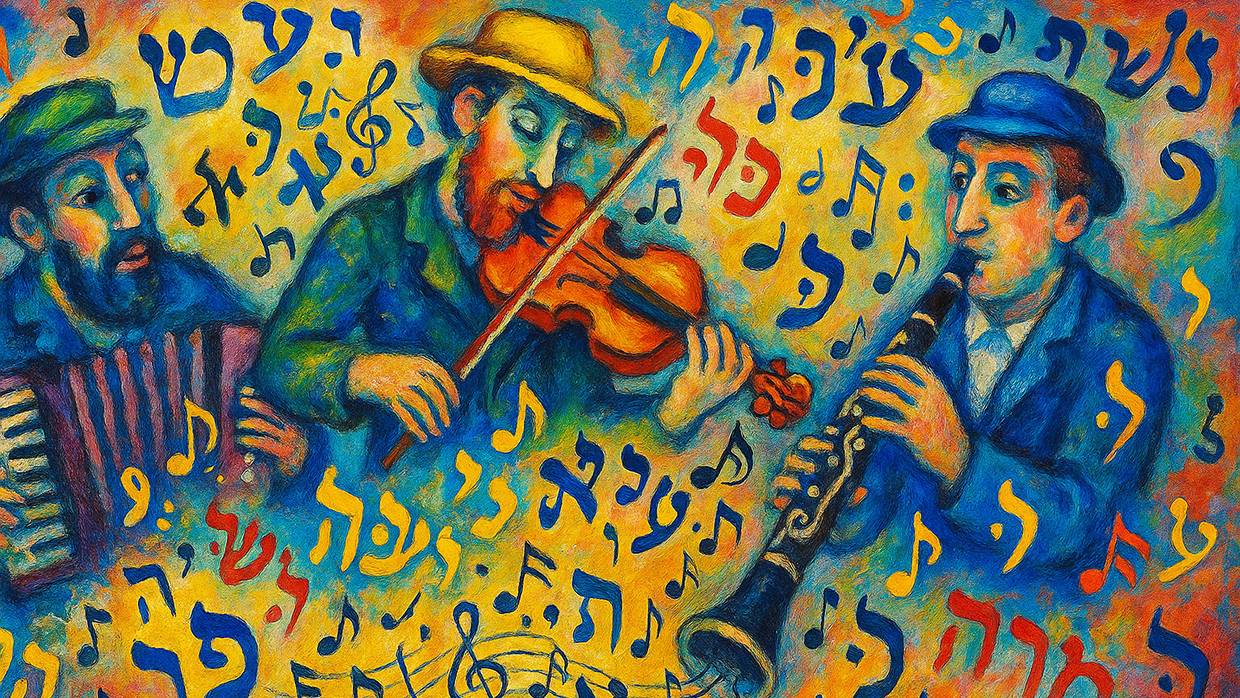
who is the artist that painted the illustration ?
I learned Yiddish because my parents spoke it when they didn’t want me to understand what they were saying. That didn’t last too long. Then, when I was older, I used the same trick (in French) as payback!😂😂😂
I grew up in a three generation household where my Grandfather and my parents used Yiddish as a way to speak in front of us about things they did not want the children to understand. The result of that was three children who understood very little Yiddish and do not speak it at all, leaving the next generation (who are now parents themselves) without any understanding of the language beyond widely used terms. Quite sad. This article may motivate me to take on online course.
To put the record straight, yiddish is still widely used as a living language , largely in chassidish commmunities eg in Skver,and Satmar in USA and in Stamford Hill in UK.. There is even a Yiddish version of Waze! No sign of spoken Yiddish dying out soon!
These days, it is more Yinglish. Yiddish mixed with lots of English words. Either way, I am dumbfounded whenever I read the Yiddish is a dying language when my local non Jewish library offers a full selection of contemporary Yiddish books ( including the dreaded comics style books) for their Yiddish speaking, chassidish patrons.
It'd be useful to know why Israel chose Hebrew and not Yiddish.
I think the reason is that Yiddish is, basicly, a dialect of German and after the Holocaust, there was a natural revulsion against anything German.
Besides that, Jews from Arab countries would likely have no attachment to Yiddish.
That should've been the case but until (and perhaps including) recently, German products abound in Israel!
Whereas Yiddish started as a Diaspora language used mostly by East European Jews, Hebrew is our ancient language that has been continuously used by Jews worldwide for many centuries, even if only in prayer and Torah learning, together with Aramaic.
The founders of the state of Israel chose Hebrew because to them, Yiddish represented Judaism, the religion, and they were trying to portray themselves as a nation like any other - unencumbered by the religion that identified Jews as such for a couple of millennia.
That seems the reverse of what the languages meant to the speakers: Hebrew was for prayer and Yiddish was the vernacular.
Not only was there (and still is, to some extant) a revulsion against anything German, but the Yiddish spoken (and even written) reached for common English and Hebrew words, to replace the Germanic ones--and permanently!
Hebrew was chosen long before the Holocaust. In fact, some early Zionists deliberately eschewed Yiddish, so as to sever the bonds between their young followers and their parents, who were mainly Yiddish-speaking. If the generations could not communicate easily, and Yiddish was cast as a 'galut' language, the youth would more easily assimilate into Zionist ideas and society. The 'modernization' of Biblical Hebrew, by incorporating lots of Greek roots and 'Hebraizing' their conjugation and declination, also served to distinguish the 'new Jew' from our historical (and religious) heritage. So, no, it was not the Holocaust that shunted Yiddish aside in favor of modern Hebrew.
I am not sure if Yiddish was the Jewish language for 1,000 years. Why did Rashi explain Torah words to his readers in French, and the Ramban use Arabic? Yes, Yiddish was a rich language, but it seems to me we need to move on. Just as the Jews of 2,000 years ago used the widely spoken Aramaic and Greek languages, we need to accept that today the international language is English—the language people visiting this website obviously speak.
Much Torah has been translated into English (and many other languages) but such Torah literature remains just that—a translation.
Most serious Torah learners eventually use Hebrew (and Aramaic, the language of the Talmud).
Yiddish could not have been in widespread usage by Jews for 1,000 years, since it only began developing as a distinct sub-category of German in the 900's. Then it took a few centuries before it was adapted for use by Jews, through incorporation of Hebrew and Aramaic words as needed to express distinctly Jewish ideas. As many Jews did not have daily contact with their German neighbors, the 2 'dialects' eventually developed rather differently. If you understand Yiddish, you can probably read even modern German easily. But don't try to understand the spoken language, since pronunciation underwent a number of shifts over the centuries (just as we probably wouldn't understand Shakespeare as spoken, though we can (barely) manage grasping the written word from 4 centuries ago.