







 The World Says You're a Jew. Now What?






A 7-point guide to the Jewish coming-of-age ceremony.
Caterer? Photographer? What is the essence of a Bar/Bat Mitzvah? Here are the key points you need to know.
First, let's understand what the words "Bar (or Bat) Mitzvah" actually mean. The phrase translates as "son (daughter) of commandment" – i.e. the young person becomes responsible to observe the commandments (mitzvot) of the Torah.
The purpose of the commandments are to keep our lives focused on what's truly important: family, community, and a relationship with God.
Although we commonly refer to "having" a Bar Mitzvah, technically speaking, this is impossible. The term "Bar Mitzvah" refers to a status, in the same way that being a student or parent is a status.
A Jewish boy automatically becomes Bar Mitzvah when he turns 13 years old, and a girl at age 12. (In general, girls tend to mature earlier than boys.)
On a deeper level, just as their bodies are growing and changing, so too their souls are growing and changing. Kabbalistic tradition says that a person's spiritual being has several levels of soul. A new level of soul (called neshama) comes into awareness at Bar/Bat Mitzvah time. This is the time when moral awareness and sensitivity fully develops, enabling young people to take responsibility for their actions.
One's actions after reaching this stage of life are considered more significant for another reason: The Talmud explains that a mitzvah performed because one is commanded, is considered greater than a mitzvah performed voluntarily. This is because a person has a natural aversion to fulfilling an obligation. Overcoming this aversion is a sign of maturity, and this is what the Bar/Bat Mitzvah celebrates – reaching the stage of obligation.
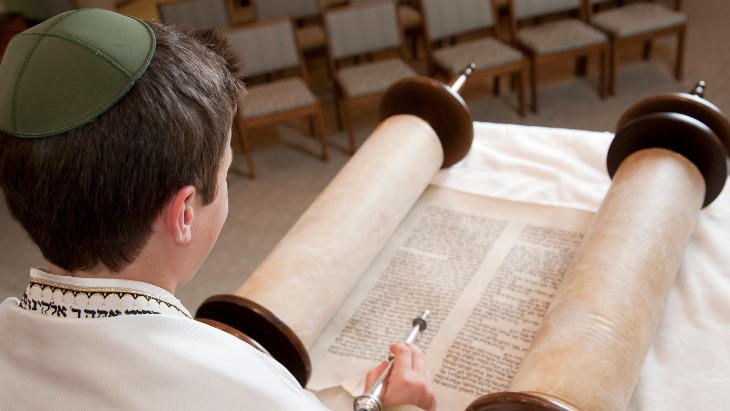
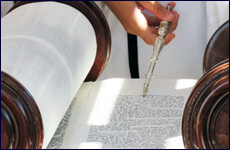
 On Shabbat (and various other days), the Torah – a scroll containing the Five Books of Moses – is read publicly. The Torah is divided into 54 portions, following an annual cycle, with one portion read each week in the synagogue.
The weekly portion is further sub-divided into seven sections. At Shabbat morning services, people are called up and honored with saying the special blessings before and after the reading of each section.
The Torah is removed from the holy ark, and then carried to the bima, the raised platform from where the Torah is read. While the Torah is being carried, everyone stands out of respect.
Colloquially speaking, when people say, "I had a Bar Mitzvah," it means that they had an aliyah to the Torah in synagogue. "Aliyah" means to "go up" to the bima.
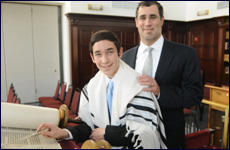
On the Shabbat following his 13th birthday, the young man is called up to the Torah. This calculation follows the Jewish calendar. At the conclusion of his final blessing, some synagogues have the custom to good-naturedly pelt the young man with candies.
At this point it is customary for the father to recite the following blessing:

Following this, the bar mitzvah boy reads a portion from the biblical prophets, called the Haftorah. During a period of persecution 2,000 years ago, Jews were forbidden from reading the Torah, so they instituted a reading from the prophets that corresponds to the theme of that week's Torah portion. The Haftorah is read with a traditional melody.
Following services, the congregation usually joins in a Kiddush, a small lunch that begins with a blessing over wine.
One popular feature of the Bar/Bat Mitzvah celebration is a reception. This should ideally be held on the day which the young man/woman becomes 13/12 years old. If necessary, the celebration may be postponed somewhat.
There are different practices regarding what is done at a Bar Mitzvah celebration. It is proper for the young person to relate some Torah thoughts at the celebration – i.e. the famous Bar Mitzvah speech. The speech usually contains ideas from the weekly Torah portion, and emphasizes the young person's commitment to Jewish values.
And what about that Titanic-themed party with Hollywood-style special effects? It's important that the festivities should not become so ostentatious that the spiritual significance becomes secondary. The new adult should appreciate that this is a celebration of maturity and responsibility, a message which will carry through for the rest of their life.
Now what about the ubiquitous Bar Mitzvah gift? In the old days, the gift of choice was a fountain pen, then a Walkman, and today an iPod.
Those are just fine but there are much more meaningful gifts for a Bar/Bat Mitzvah. Since this event celebrates the young person becoming obligated in the commandments, the most appropriate gift is, naturally, one that gives a deeper understanding of the Jewish heritage and enables one to better perform the mitzvot!
 You can also always give money. It is customary to give in multiples of $18, since the numerical value of 18 in Hebrew is "Chai," which means "Life."
Upon reaching age 13, a boy begins the obligation to put on tefillin every day (except Shabbat and holidays).
Tefillin are two square, black leather boxes, which contain parchments of Torah verses. Attached to each box are black leather straps. One of the boxes is worn on the bicep, and the other is worn on the front of the head.
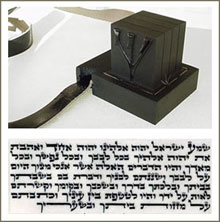 The two boxes represent the two ways that we serve God in this world: thought (the head) and action (the arm). The arm-tefillin contains one parchment in one compartment, whereas the head-tefillin is four parchments, each in its own separate compartment. This is to signify that in service of God, the two powers must work congruently: We use the totality of our mind to gain the full perspective, and then we act with a singular clarity of purpose.
Inside each tefillin box are parchments containing four Torah sections, which speak about God's unity, the obligation to observe the commandments, and the responsibility to transmit Judaism to our descendants.
Now here's a Jewish trivia question: Who was the first person to have a Bar Mitzvah?
We could actually suggest three answers:
1) Abraham – The first person to begin observing some of the mitzvot was "the first Jew," Abraham. However, he was older than age 13 when he started, so...
2) Isaac was the first person who was "Jewish" upon reaching age 13. The Torah writes, "And Abraham made a great party on the day" (Genesis 21:8), which the Midrash explains was a celebration for Isaac becoming Bar Mitzvah.
3) Mount Sinai – Only when the Torah was given at Mount Sinai did Jews became truly obligated to observe the mitzvot. Therefore, the Sinai experience was actually a mass Bar/Bat Mitzvah of the entire Jewish people.
In Jewish life, a Bar/Bat Mitzvah does not represent the culmination of one's Jewish education, but rather a stepping-stone to a more mature and profound relationship with Jewish learning.
This is illustrated by the following idea: If even one letter is missing from a Torah scroll, it is rendered invalid. According to tradition, each Jew corresponds to one letter in the Torah. This teaches that each and every one of us has an integral role to play in the future of the Jewish people.
Bar/Bat Mitzvah means to become educated, and to strengthen one's Jewish pride through knowledge and understanding. It means to grow Jewishly, one step at a time. It means standing up for Israel and respecting every Jew. It means taking responsibility for the world, using the Torah as our guide, because that is the mission of the Jewish people. And most of all, it means to love being Jewish.
Success in achieving these goals is what we wish for the Bar/Bat Mitzvah, and the beginning of that journey is what we celebrate on this joyous occasion.
Mazel tov!
With thanks to Rabbi Dov Lev and Rabbi Moshe Schapiro








Yasher koach Rav Shraga on this and all your work for the Klal! If you can contact would be greatly appreciated.