





 The Shofar Is Silent, Remember to Breathe






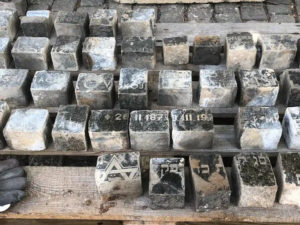
The Holy Temple's ancient stones - a pathway to wisdom - now lay in ruins.
It was early on in the Al-Aksa Intifada, over a year and a half ago. I turned on Israel radio to hear the latest news on the crisis, and stumbled onto a call-in program. The host was taking calls from listeners giving their reactions and opinions as to what should be done. A broad range of views was aired, but one stands out in my mind:
The caller advocated pressing forward with the policy of land for peace. When asked how far he would go, he stated his willingness to concede to the Palestinian demand for sovereignty over East Jerusalem, including the Temple Mount.
When the host asked him, "But doesn't the Temple Mount have any special meaning for you?"
"No," came the reply.
"Is it nothing more to you than stones?"
"That's right,"he said, "as far as I am concerned they are stones and nothing more."
The host, though a non-religious person himself, was clearly taken aback by the caller's cold rejection of anything special about the holiest place in Jewish tradition, and the conversation abruptly ended.
To be sure, the opinion expressed is that of a minority. While most Israelis are willing to trade land for peace, they are not so willing to surrender their centuries-long attachment to the focal point of Jewish tradition, especially in return for what would be at best an uncertain peace. Yet, that caller is not alone; a significant minority of Israelis share his disaffection with Jewish tradition and anything to do with it.
I am reminded of the story of the encounter between the Jewish prophet Jeremiah and the Greek philosopher Plato. When Jeremiah returned to Jerusalem from the Babylonian exile and saw the ruins of the Holy Temple, he fell on the wood and stones, weeping bitterly. At that moment, the renowned philosopher Plato passed by and saw this.
He stopped and inquired, "Who is that crying over there?"
"A Jewish sage," they replied.
So he approached Jeremiah and asked, "They say you are a sage. Why, then, are you crying over wood and stones?"
Jeremiah answered, "They say of you that you are a great philosopher. Do you have any philosophical questions that need answering?
"I do," admitted Plato, "but I don't think there is anyone who can answer them for me."
"Ask," said Jeremiah, "and I will answer them for you."
Plato proceeded to pose the questions that even he had no answers for, and Jeremiah answered them all without hesitation. Asked the astonished Plato, "Where did you learn such great wisdom?"
"From these wood and stones," the prophet replied.
The subscript to their not-so-Platonic dialogue is as folllows: To the philosophic mind of Greece, human reason marked the limit of wisdom. Plato could not entertain the possibility that the answers to his questions could be discovered in the holiness of the Temple, where the Divine Presence resided. Jeremiah told him that there is wisdom that lies beyond man's intellect; the pathway to that wisdom now lay in ruins, and that was the cause of his tears.
It says in Psalms, "The stone that the builders despised will become the cornerstone." There are those who would build a society on materials other than the materials of Jewish tradition; but the stones of the ancient Temple of Jerusalem---mourned by some and despised by others---will ultimately be the cornerstone of human wisdom and peace among the nations.
We cry on Tisha B'Av in mourning over the destruction of the Temple and its lifegiving wisdom, as Jeremiah did in ancient times. But we should do so with an awareness that the sorrows of exile will soon find their limit, and that there the boundless wisdom and kindness of the G-d of Israel will be revealed once again as in former times.












Mekor?
In Pearlman Chronology Plato certainly overlapped with Jeremiah if either:
Jeremiah alive at 3386 end of Evel-Merodach (ambiguous in Jeremiah if all the days a reference to K' Yeoachin or Evel-Merodach.
Or if Jeremiah living at our 3390 return from Bavel.
As concensus has Plato age 29 or 24 at 3405 death of Socrates.
If 29 Plato birth in 3376 so age 14 in 3390. It could have been a several years after that.
What is the youngest Plato could have been when he traveled out of Athens?
It could be Plato was over 29 at the 3405 death of Socrates.
Cite follow and share Pearlman vs Ptolemy's Canon and the many other related articles on researchgate where we falsify the confirmation bias permeated concensus.
OK i looked up Plato and Jeremiah chapter in Pearlman Torah Chronology to refresh my memory.
Plato was born in 3347 or 3348 and lived until 3427 or 3428. so plenty of overlap.
Nice story, but certainly it isn't something really happened. Yirmeyahu lived More than a century before Plato. They never met. The Seder Olam Rabbah has a mistaken chronology. Reality and Historia don't support ir. However, the moral lessons implied here still stands