



 100 Years After Houdini: The Escape Artist Who Held On to His Judaism

7 min read
7 min read
3 min read




Harry Houdini died 100 years ago. The world’s greatest escape artist was also a rabbi’s son who prayed with tefillin every morning.
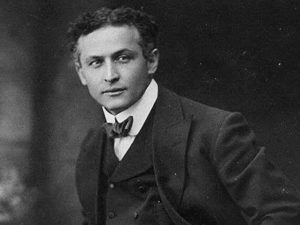
On Halloween 1926, Harry Houdini died in Detroit at 52. A century later, his name is still shorthand for the impossible escape. Yet history’s most famous magician and the world’s first international superstar started life as Erik Weisz, a Hungarian Jew.
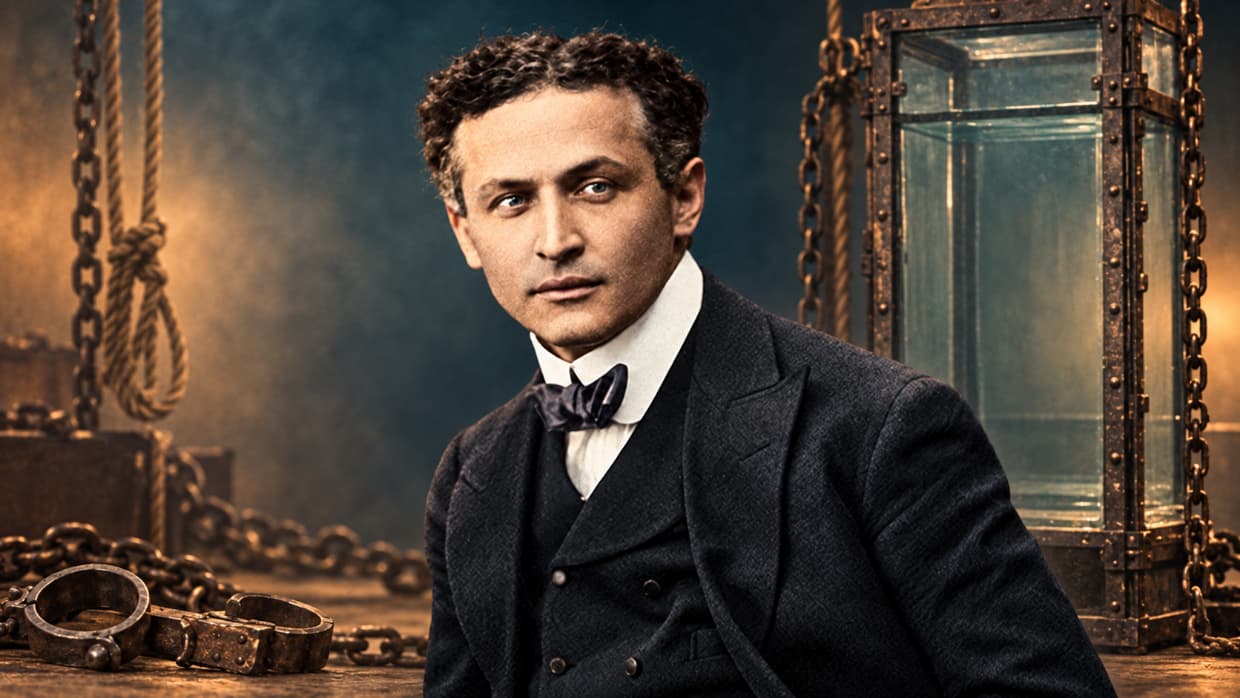
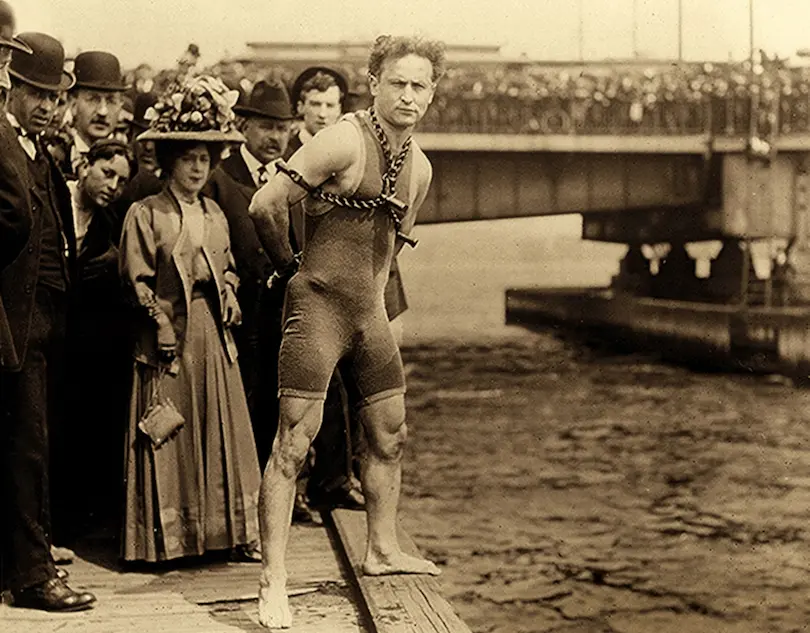
Houdini built his legend on stunts that should have killed him. He broke free of chains, of straitjackets underwater, of ropes slung from skyscrapers, and of a sealed milk can filled with water, holding his breath the whole time. You know, the same ways you and I unwind on weekends. Fine, I’ll speak for myself.
Plenty of people know Houdini was Jewish. Far fewer know he was the immigrant son of a rabbi, or how deeply Judaism shaped his life. On the 100th anniversary of his death, let’s make that story reappear.
Erik Weisz was born in Budapest in 1874 to Rabbi Mayer Sámuel Weisz and Cecília Steiner. In 1878 the family moved to America and settled in Appleton, Wisconsin, where his father served as a rabbi. Erik caught the magic bug early, after seeing a show in town. He worked a string of jobs and made his public debut at age nine as a trapeze artist, billed as “Erik, the Prince of the Air.” He was also a champion cross-country runner.
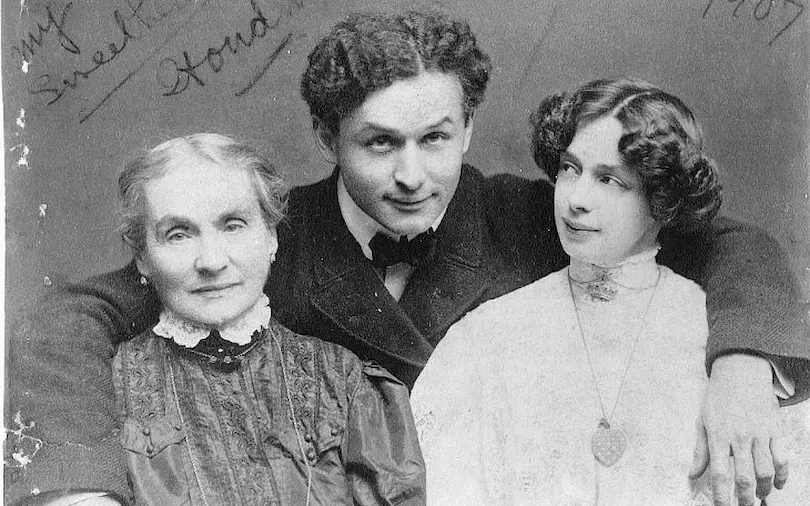 Houdini with his mother, Cecilia, and his wife, Bess. On the photo he wrote, “My two sweethearts.” (Library of Congress)
Erik celebrated his bar mitzvah with Orthodox Rabbi Bernard Drachman. At 17, determined to avoid the grueling factory work expected of young men of his age and class, he turned to magic full time. He ran away to New York City and performed at the Young Men’s Hebrew Association as “Erik the Great.” Still hunting for the right stage name, he discovered Jean Eugène Robert-Houdin, the 19th-century French magician known as the father of modern conjuring. That was too many names, so Erik borrowed one, “Houdin,” and tacked an “i” on the end. Not the most Jewish name, admittedly. Then again, would “Houdiniwitz” have packed the same theaters?
In 1898, performing in Maryland, Houdini billed himself as the King of Cards. The title earned him far less than a king’s ransom. A fellow Jewish immigrant, Martin Beck, told him to drop the cards and sell himself as the King of Handcuffs instead. The advice worked.
Houdini embraced his Jewish heritage, but the world was less welcoming. Touring Germany, he was shocked by his first encounters with antisemitism. Performing in Russia shortly after the Kishinev Pogrom of 1903, a notorious massacre of Jews, he wrote critically about Russian antisemitism.
His attachment to his faith ran through his whole life. On a memorial to his mother he signed himself “Your devoted son, Harry Houdini,” adding “Erik Weisz” in parentheses. For a full year after she died, he recited the Mourner’s Kaddish, the prayer said in memory of a loved one, every night.
On November 1, 1926, the day after Houdini died, the Milwaukee Sentinel ran a feature in which members of the city’s Jewish community described him as serious about Jewish tradition. They said he returned regularly to weep at his childhood home and at his parents’ graves.
The article reported that Houdini’s friends “know him as a man devoutly religious, who, wherever his performance brought him, carried his tefillin, phylacteries and mezuzahs, Jewish credal symbols, with him. … The mezuzahs, strips of parchment with scriptural passages encased in tin, considered effective in warding off evil, he is said to have nailed to the door of the hotel room wherever he lodged for the night, in the true orthodox Jewish fashion. And the phylacteries, little leathern boxes with scriptural parchment recognized as charms, he bound to his forehead and left arm each morning during his prayers, his friends declare.”
The 1926 reporter’s descriptions are a little off (tefillin are prayer boxes, not good-luck charms), but the picture is clear. Wherever Houdini went, his Judaism went with him.
As Saul J. Singer wrote, “Houdini was particularly important to American Jews, for whom he came to embody the idea that a Jew could achieve success in an antisemitic world. For Jews who had a long history of fear and vulnerability, Houdini was the ultimate contemporary symbol of strength, and the renowned escape artist became the paradigm of the Jewish immigrant’s belief that he could escape the metaphorical shackles of Jewish history.”
Even at the height of his fame, Houdini stayed loyal to his faith and his family. “I never was ashamed to acknowledge that I was a Jew,” he said, “and I never will be.”
In fact, the more famous he became, the more comfortable he seemed with his Judaism. During World War I, he founded the Rabbis’ Sons Theatrical Benevolent Association, a group of Jewish-American stars. Houdini served as president, Al Jolson as vice president and Irving Berlin as secretary. The group raised money for Hebrew associations helping military families, and for the Red Cross. Houdini was also a major supporter of Zionist institutions. He gave generously all his life, but insisted on anonymity, because “the Jewish way is to give charity quietly.”
Houdini is buried in New York’s Machpelah Cemetery, a Jewish cemetery founded around 1855, alongside his parents, his grandfather and several of his siblings. Every year on the anniversary of his death, magicians gather there for a secular memorial service and mark his yahrzeit. Rabbi Noach Dally, a member of the Magic Fraternity, explained, “In 1976, we added El Malei Rachamim (a prayer of remembrance) to the service as well as a broken wand service, a ritual performed to symbolize the passing of a fellow magician.” This year, that ritual marks a full century.
A hundred years on, most of Houdini’s secrets are out. Magicians have explained the handcuffs, the straitjackets and the milk can. What remains is the story of a rabbi’s son from Appleton, Wisconsin, who became one of the most famous men on earth and brought his tefillin to every city that cheered him. He could slip out of any lock ever made. His Judaism was the one thing he chose to keep.