






 What Repentance Really Means in Judaism








How the Jewish people celebrate Shabbat, its customs, origins, and traditions.
You may have seen references to Shabbat in pop culture, on “Curb Your Enthusiasm” or the movie “The Big Lebowski,” where John Goodman’s character famously yells, “I don't roll on Shabbos!”
But what is Shabbat? How is it celebrated? What are the Biblical origins for it and what Shabbat customs do we practice today?
Learn more about the Shabbat traditions and what this very important day for the Jewish people is all about.
The word Shabbat is a reference to the Jewish Sabbath. The Hebrew term literally translates to “rest.”
You may be wondering, “What day is Shabbat?” It’s the time from Friday at sundown until Saturday approximately one hour after sundown – when three stars illuminate the night sky – that the Jewish people cease working and stop and rest. It lasts for 25 hours.
Sephardic Jews, or Jews with origins in the Iberian Peninsula say “Shabbat,” so they’ll wish someone “Shabbat Shalom.” Ashkenazi Jews, or Jews from Eastern Europe, say “Shabbos” and will commonly wish someone a “Good Shabbos.”
Shabbat is a time to disconnect from unceasing distractions and reconnect with yourself and with those you love. It’s also an opportune time to recalibrate and reconnect to the Divine. Shabbat is a transcendent oasis of completion, when you can stop all work and just be.
The commandment to observe the Sabbath appears in the Torah. It first shows up in Genesis (Bereshit in Hebrew) 2: 1-3: “On the seventh day God finished the work that had been undertaken: [God] ceased on the seventh day from doing any of the work. And God blessed the seventh day and declared it holy—having ceased on it from all the work of creation that God had done.”
It is the only Jewish ritual observance that appears in the 10 Commandments. The fourth commandment is: “Remember the Sabbath Day, to keep it holy. Six days you shall labor and do all your work; but the seventh day is a Sabbath unto the Lord your God. On it you shall not do any manner of work—you, your son, your daughter, your man-servant, your maid-servant, your cattle, and your stranger that is within your gates. For in six days the Lord made heaven and earth, the sea and all that is in them, and rested on the seventh day; wherefore the Lord blessed the Sabbath Day, and hallowed it.”
The Torah, the Written Law, was not very specific about what it meant to observe Shabbat. It says not to work or gather wood or kindle a fire, but that’s about it. The rabbis based the current laws on Shabbat – the 39 Melachot (creative activities) that are banned – on the building of the Tabernacle, the portable sanctuary the Jews used in the desert before they entered the land of Israel following their exodus from Egypt. The myriad of details are laid out in the Talmud, primarily in the large tractate called “Shabbat”.
Some of the 39 categories of creative work include:
Throughout the millennia, these melachot have been applied to modern times. For example, while it’s forbidden to start a campfire, you also cannot turn on your oven, switch a light on and off since it creates an electrical spark, drive your car, or use your phone on Shabbat.
Erev Shabbat is the time right before Shabbat, on Friday morning and afternoon before Shabbat starts. While we aim to be as calm as possible on erev Shabbat, it’s typically a hectic day, as Jews are trying to finalize preparations before sundown.
The day is typically spent shopping and cooking food for Shabbat, since we cannot use a fire and cook on Shabbat itself, as well as cleaning the house, setting the table, taking a shower, and getting ready in general. Doing all of this with a calm attitude is what we strive for during this time, since it brings in Shabbat with a sense of calm as well.
Shabbat is a time when we can rest, recharge, and connect with our family, friends, community, and spirituality. It is arguably the most important Jewish holiday, since it is celebrated every single week. As the Jewish journalist Ahad Ha'am famously said, “More than Jews have kept Shabbat, Shabbat has kept the Jews.”
Here’s a rundown on how to celebrate Shabbat.
The rabbis instituted a rule that you must eat three meals on Shabbat: Shabbat dinner, lunch, and Seudah shlishit (or shaleshudes), a third meal that comes late in the day, between the mincha and ma’ariv prayer services.
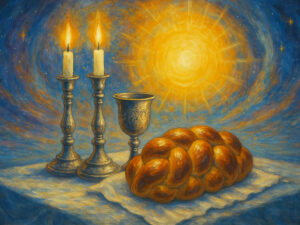
Shabbat dinner comes after Jewish women light Shabbat candles and recite the prayer: “Blessed are You, Lord our God, Ruler of the Universe, who has sanctified us with commandments, and commanded us to light Shabbat candles.” Women typically light one candle for themselves and one for their spouse, and some also light one candle for each child.
After the Friday night prayer services, it’s time to sit around the table and sing “Shalom Aleichem” as a group to welcome in the Shabbat angels. Husbands sing “Eishet Chayil,” the “Women of Valor” song that praises wives for all the hard work they do. Then, the children are blessed.
Follow this, it’s time to make kiddush, the sanctification blessing over wine or grape juice. The person making the blessing keeps everyone in mind for it, or people around the table can make their own blessing on it. Everyone must drink some of the wine once kiddush has been recited.
Then, everyone washes for ha’motzi, eating the two loaves of challah. They go to the sink, take the washing cup, wash the rite hand three times, wash the left hand three times and recite the “Netilat Yadayim” prayer. Once they wash their hands and say the prayer, it’s a custom to remain silent until the person saying the blessing over the challah cuts it, dips it in salt, and distributes it. Fun fact: Ashkenazi put it on a plate and pass it, while Sephardim toss it to their guests.
Shabbat dinner consists of traditional Jewish foods like gefilte fish, chicken soup with matzah balls, and kugel. Sephardim may make Moroccan fish and serve a bunch of salads like Moroccan carrots, schug (spicey dip), matbucha, hummus, cabbage salad, and Israeli salad. The main dish typically consists of chicken or meat and sides, and then dessert might be fruit along with a cake or cookies. It all depends on the host’s and guests’ preferences and family customs.
Following the meal, Grace After Meals, or the bensching, is recited, to thank God for the food and signify the end of the meal.
Shabbat prayers take place on Friday night (Kabbalat Shabbat and ma’ariv), Shabbat morning (Shacharit), and Shabbat afternoon (mincha). After Shabbat is over, many people stay in synagogue to say Ma’ariv evening service as well.
Shabbat morning services involve Shacharit with prayers like the typical morning blessings, Pesukei d'Zimra (verses of praise), the Shema, and a Torah reading of that week’s Torah portion (parsha), along with prayers for the state of Israel and the government of the country in which you live. Kaddish, the mourner’s prayer, is said throughout services. The rabbi will usually give a speech that reflects on that week’s Torah portion. We also recite the Amidah, also called the Shemoneh Esreh, during Schacharit and Mussaf, which follows the Torah reading. Other prayers like “Ein Keloheinu” and “Aleinu” conclude the services.
After services end, there is typically a kiddish where members of the congregation convene and eat cholent, a stew that is cooked overnight starting on Friday and consists of ingredients like meat, beans, potatoes, barley, and kishka. Then, people go home to eat Shabbat lunch with their family and friends.
“Kabbalat Shabbat” is the series of prayers said on Friday night, and it means “welcoming Shabbat.” The service consists of prayers like “Lecha Dodi (Come My Beloved),” where we turn to the back of the synagogue and bow to welcome the Shabbat. The Shema and Amidah are also recited, along with the Kaddish. Kabbalat Shabbat is shorter than other prayer services, lasting about 45 minutes.
Jews establish their own Shabbat customs in line with the laws, such as reading good books or playing games with their family and friends. They may take a long walk or go to the playground with their kids as well.
Note: Jews cannot carry objects on Shabbat unless they live inside a proper eruv, a wire that makes a public domain private for the purposes of Shabbat. With an eruv, you can carry your house keys, push strollers, or bring a backpack with you when you go outside.
Jewish meals are eaten in the privacy of one’s home, with friends and community members in their homes, or in a communal setting, such as a lunch or dinner at synagogue.
Shabbat ends with havdalah, where we light the havdalah candle, say kiddush over grape juice or wine, sniff spices, and look at our fingernails in the light of the candle and welcome in the new week. Some Sephardic Jews laugh to start the week out on a happy note. After havdalah, we wish each other a good week: “Shavua Tov!” Some Jews go to a “Melava Malka,” a special community gathering with food and sometimes songs to celebrate the new week.
Shabbat is a wonderful time of the week when we can get a break from the outside world, feel more spiritual, and fit in precious time with our loved ones. Though it takes some practice to learn the laws of Shabbat and keep it in the proper way, it’s well worth it and can make your life much more fulfilling, joyful, and meaningful.
Shabbat starts Friday night at sundown and lasts until 25 hours after that. Three stars must appear in the night sky on Saturday night for Shabbat to be over.
Shabbat is 25 hours long.











Very nice article—thanks. On a mystical note, during Shabbat, one's soul gains conscious access to a higher dimension. The withdrawal from daily distractions on Shabbat allows for a deeper alignment and perception of this spiritual realm.