What makes a bagel… a bagel? Is it the crisp, slightly chewy crust that contrasts with its dense, tender interior, is it the malty savory flavor or is it something else entirely?
What began as a humble staple in the Jewish ghettos of Poland has evolved into an international culinary phenomenon. From classic plain bagels to bagels dusted in poppy seeds, sesame or onion we've found plenty of ways to spice up the Jewish breakfast classic.
But bagels can be even more adventurous and inventive than just being topped with seeds.
Pumpernickel Bagels

Pumpernickel bagels are one of the quintessential bagel varieties, yet bring with them a wholly unique caramelized and rich flavor that is entirely different from any other variety.
Pumpernickel bread was originally a dark bread made from coarsely ground whole rye that was popular among laborers and peasants in Eastern Europe for its filling and robust qualities.
Our contemporary pumpernickel bagels adopted aspects of the original bread by maintaining elements of its predecessor, such as the use of rye flour and a special fermentation process that produces a bagel that is both distinctly modern and deeply entrenched in tradition.
Pumpernickel bagels began to catch steam with New Yorkers looking for a way to satisfy their craving for the old world bread while keeping it fresh and modern.
Bialys

Another innovation was the Bialy, which further adds to the question of what a bagel is.
While they are both made with the same dough, instead of being boiled then baked, the Bialy is impressed with a thumb and filled with caramelized onions before being tossed into the oven to get golden brown.
Named after Białystok, Poland where Ashkenazi Jews first came up with this creation, the Bialy was baked in wood-fired ovens. While the crispy, almost burned tops have been replaced with a softer, whiter bread.
By the 1930s, New York bialys were almost entirely produced in tenement basements and transported by horse and wagon throughout the boroughs. Bialys had become such a phenomenon that there were even bialy bakers’ unions to decide where new bakeries could be opened.
With some modern bakeries forgoing the hole inside and simply leaving a dense ball of dough meant to be pulled apart and dipped into assorted flavors of cream cheese. It begs the question, without a hole, is it a bagel?
Artisanal Bagels
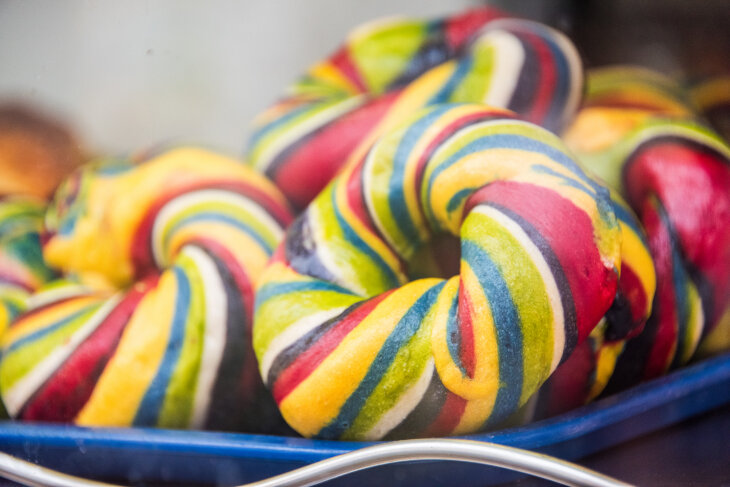
In recent years, the bagel has undergone a gourmet renaissance. Artisanal bakeries have emerged, offering inventive flavors and high-quality ingredients. From blueberry and cinnamon raisin to jalapeño cheddar and everything bagels, to the very instagramable rainbow bagels the possibilities are endless. Some bakers even infuse their bagels with unique ingredients like matcha, beetroot, and charcoal, creating visually stunning and deliciously unique options.
Beyond Borders

Bagels even vary from country to country. While New York remains the bagel capital of the world, other cities and countries have embraced the bagel with their own twists.
Take Los Angeles for instance, one of the culinary capitals of the world that boasts several bakeries dishing out bagels stuffed with cream cheese and dunked in copious amounts of garlic butter. Where others are filled with cheddar cheese and habanero filling and many others.
Across the border in Montreal, bagels are customarily boiled in honey-sweetened water and baked in wood-fired ovens, resulting in a slightly denser and sweeter product.
While not a modern invention, all the way over in China they have their own spin on the bagel, called a Guang-Bing. That was made by necessity when Chinese warriors needed sustenance on the go, a necklace full of round Guang-Bings did the trick. While it's crunchier than the Jewish variety, its shape is very much the same.
Jerusalem Bagels are another hole-y baked good. Known to those in the Levant as Ka'ak. It's a circular bread encrusted with sesame seeds and became popular in Israel following the six days year. Unlike the classic Polish bagel which is designed to stay fresh for long periods at a time, the Jerusalem bagel is baked and served warm out of the oven ready to be dipped in cream cheese, labneh or even a fresh bowl of hummus.
The Future of Bagels
As we look to the future, it's clear that the bagel's journey is far from over. With ongoing innovations and an ever-expanding global reach, the humble bagel continues to evolve and delight.
The evolution of the bagel from its roots in the Jewish ghettos of Poland to the diverse and inventive variations we enjoy today is a testament to its enduring appeal.
If you recall the viral video of a Californian visiting New York and being denied a bagel when asking for it to be scooped out, it's clear that the cultural differences can be too much for many. Though to me that's part of the beauty of the bagel. Whether you prefer a classic plain bagel with cream cheese, a pumpernickel bagel with smoked salmon, or a red bean bagel dipped in matcha cream cheese, there's a bagel out there for everyone. So instead of coming up with a catch all definition for what describes a bagel, let's get crazy and push the limits of what the bagel can be.