






 Charlie Kirk, Shabbat, and the Secret of Jewish Survival


8 min read


Experiencing the power of Shabbat and the mystical reverberations of the joyful Lecha Dodi prayer.
The Germans occupied France in 1940, yet the Great Synagogue of Lyon resolutely continued to function for prayer services. French Nazi collaborators, known as the Milice, decided to take advantage of the situation by attacking the Jews in their synagogue on Friday night of December 10, 1943.
Friday night services in synagogue begin with Kabbalat Shabbat, the “Welcoming the Shabbat” liturgy. This prayer consists of six chapters of Psalms, followed by a poetic prayer that was composed in the 1500’s called Lecha Dodi. When reciting the final stanza of Lecha Dodi, the custom is for all to turn around and face the back of the synagogue to usher in the Sabbath Queen.
As the congregation of Lyon welcomed Shabbat with the prayer service, the would-be murderer silently entered the synagogue from the back. He prepared to throw grenades into the crowd, when he had the shock of his life. The entire congregation that had been facing forward suddenly turned to face him! He was so shocked that he dropped the grenades and ran out of the shul, fortunately only causing injuries and killing no one.
As the shul rabbi described, Divine Providence arranged for the Milice collaborator to walk in precisely as the congregation was reciting the final stanza of Lecha Dodi, which saved their lives.
This unique prayer has uplifted and spiritually protected Jews for centuries.
When Shabbat begins, we welcome it with song, as it says, “A psalm, a song for the Shabbat day” (Psalm 92:1). Why do we start Shabbat with singing?
Rabbi Shimshon Pincus answers that when one is overcome with emotion and joy, words are limiting. Song, on the other hand, is expansive. Each week when Shabbat begins, the Jewish people are so joyous that words are not adequate to express it. We turn to songs to fully express our joy and connection.
Initially, Jews would begin Shabbat by going to shul to recite the Shabbat Maariv (evening prayer), which differed only slightly from the weekday Maariv. No additional prayers or psalms were recited.
Reciting Psalm 92, a Song for Shabbat Day, and Psalm 93 before the Maariv service on Friday night became widespread during the 12th and 13th centuries.
In 1488, the Italian Sage, Rabbi Ovadia of Bartenura traveled to Alexandria, Egypt. He wrote that the Jews there prepare for Shabbat, light candles and then serve food for the evening meal. “Afterward, everyone comes to the synagogue dressed in fresh, pressed clothing, and they begin with song and praise and pray for a lengthy Maariv for two hours after nightfall." However, we do not know what prayers they were singing.
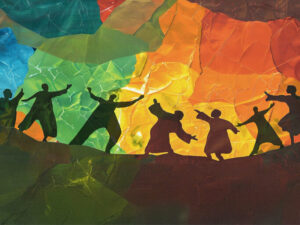
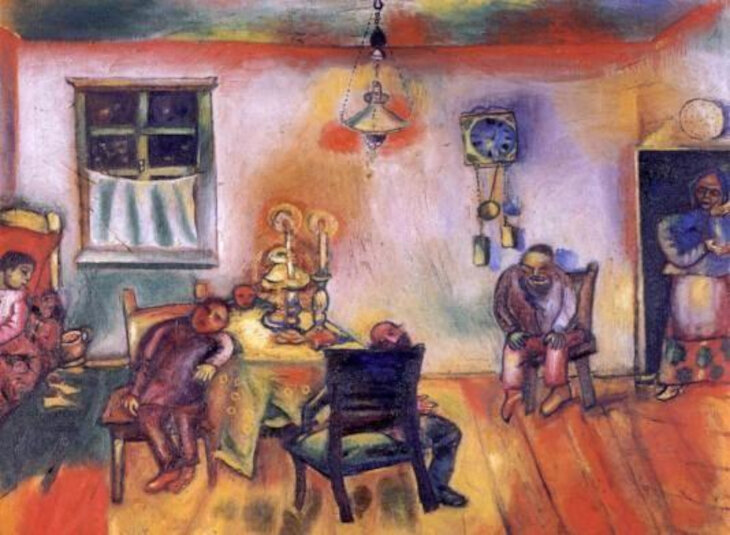 Marc Chagall, Sabbath, 1910
In the 16th century, the Kabbalat Shabbat service began to take the form we know of today. Jews would recite six chapters of Psalms, beginning with chapters 95-99 and then chapter 29, corresponding to the six days of Creation.
At around this time, Rabbi Shlomo Alkabetz who lived in Safed composed a poetic prayer welcoming Shabbat and describing the joy of leaving aside weekday worries. He spoke about the Jewish people returning to their greatness, and “leaving the Valley of Tears.” His prayer was known as Lecha Dodi, after the first two words of the refrain.
His words struck a chord in the Jewish people and soon became universally accepted, recited by Jews the world over as Shabbat begins. In fact, his prayer is such an integral part of the liturgy that Jewish law states that the congregation accepts the sanctity of Shabbat with the final paragraph of Lecha Dodi.
Rabbi Shlomo HaLevi Alkabetz was born in Salonika in the early 1500’s. In 1529, he married the daughter of Yitzchak Cohen, a wealthy man from Salonika. Rather than giving his wife a traditional wedding gift of jewelry, he presented her with his newly completed Torah work, Manos HaLevi. His bride’s family greatly valued Torah study and respected Torah scholars, and were delighted at this gift, their joy surpassing that of receiving jewelry.
Shortly afterward, Rabbi Alkabetz and his wife decided to settle in the Land of Israel. On the way, they stopped in Adrianople, Turkey. Recognizing the spiritual stature of their visitor, the people begged him to remain and guide them how to serve God and keep the commandments. Rabbi Alkabetz agreed to stay and teach the community, and several of his students became great Torah scholars. He also wrote several works at this time.
Yet, Rabbi Alkabetz would not remain in Adrianople indefinitely since he longed to settle in the Land of Israel. He arrived in Safed in 1535.
Safed at the time was a city steeped in Torah knowledge and mysticism. One of the renowned leaders living there at the time was Rabbi Yitzchak Luria, known as the Arizal. He is considered the father of contemporary Kabbalah since he formulated the study of Kabbalah into a comprehensive system, known as Lurianic Kabbalah. Two other great leaders were Rabbi Yosef Karo, the author of the Shulchan Aruch, the foremost classic the Code of Jewish Law, and Rabbi Moshe Cordovero (the Ramak) one of the most prolific and systematic teachers and authors on the teachings of the Zohar (the “Book of Splendor” which is the foundational work of Kabbalistic literature). Both Rabbi Karo and the Ramak became Rabbi Alkabetz’s disciples, testimony to his greatness.
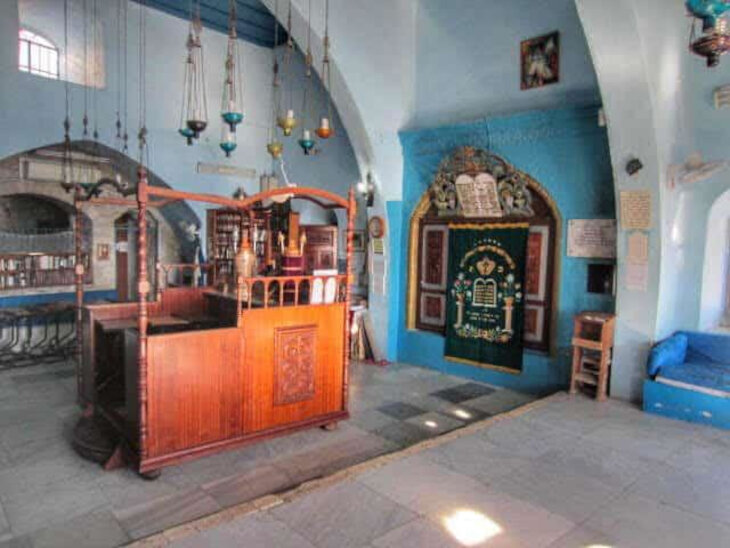 The Yosef Karo Synagogue in Safed
Every week, as Shabbat began, the great Kabbalists of Safed would go out to the fields to greet Shabbat in a display of love and honor for this special day. They would joyously recite Psalms, and call out “Welcome Bride, Shabbat Queen.”
Around 1540, Rabbi Alkabetz composed the prayer of Lecha Dodi, which includes many biblical references in its words, as well as an acronym of Rabbi Alkabetz’s name. His prayer was incorporated as part of Kabbalat Shabbat, in Safed and the rest of the world.
Rabbi Alkabetz died in 1580 and was buried in the old cemetery in Safed where one can still go and pray by his graveside.
Over the centuries, many have followed the example of the Kabbalists of Safed who welcomed Shabbat in the fields by reciting the final paragraph of Lecha Dodi outdoors. The Turkish Sage, Rabbi Chaim Benveniste (1603-1673), author of the halachic work K'nesses Hagedolah, writes that when he became rabbi in Tite and discovered that the congregation remained indoors for the entire Kabbalat Shabbat, he directed them to go back to the older custom of going outside to welcome Shabboat the way they did in Safed.
Rabbi Yechiel Michel Halevi Epstein (1829-1908), in his classic work Aruch Hashulchan, stated that going outdoors to greet Shabbos had been largely forgotten in his time. Yet, what remains of this custom today is that we turn to the back of the shul with the final paragraph of Lecha Dodi, turning westward with the setting sun as we welcome Shabbat.
In a moving turn of events, Rabbi Alkabetz’s own descendant returned to his roots thanks to the prayer of Lecha Dodi.
A young man appeared at a synagogue in Israel and was invited to someone’s home as a guest. He was utterly unfamiliar with Shabbat rituals but did his best to follow along. During the meal, he asked if they could sing Lecha Dodi again, explaining that he found the song exceptionally beautiful when he had heard it in the synagogue. Politely, his hosts sang Lecha Dodi again, and again, and again, as per their guest’s requests.
At the end of the meal, the hosts spoke to him some more and discovered their guest was actually Mahmoud from Ramallah. At their shocked expressions, he hesitantly explained that recently he had many questions about Islam and had asked his father why Islam treated Jews so badly. In response, his father threw him out of the house.
His mother managed to contact Mahmoud. She told him that his father had been infuriated by his questions, since he, Mahmoud, was actually Jewish since she was a Jew. She admitted that she made a terrible mistake in marrying an Arab and gave him his birth certificate and her old Israeli ID card, proving what she said to be true. The final item she gave him as she bade him goodbye was a picture of her parents standing next to the grave of an ancestor of the family.
When Mahmoud finished his story, his hosts asked Mahmoud if they could see the picture. They were amazed at what it showed: an older couple standing next to a grave, on which the name Rabbi Shlomo Alkabetz – the great composer of Lecha Dodi – could be seen clearly.
Rabbi Alkabetz’s descendant had been so moved by Lecha Dodi, not realizing that this holy prayer was written by his own ancestor!
For the past 500 years, why have the words of Lecha Dodi resonated with all segments of the Jewish people? It continues to inspire and reconnect Jews wherever they are - in a shul, at the Western Wall, in Safed. It’s not merely because of the beautiful words that Rabbi Alkabetz wrote, but rather based on what the words really mean.
Lecha Dodi is a reminder to Jews of the beauty of our relationship with Shabbat and with God. Jews have kept Shabbat for millennia, as a testimony that God created the world and of His special relationship with His nation. Each week, we can once again experience how Shabbat protects us and continues to be an eternal source of blessing for the Jewish nation.








Beautiful! Yes! Where ever I am in the world when it is Shabbat and I recite Ledha Dodi I then feel that. Shabbat is really here! I feel one with Zjews all over the world and with Adonai.
What a wonderful history. It explains the reasons for why we do as we do.
Beautiful and inspiring article. L'cha Dodi has always been one of my favorite parts of the Shabbat service.
BEAUTIFUL!
Great article
I can not imagine Friday night without Lecha Dodi....
Very informative and inspirational!