





 What Mamdani Won't Say About His Wife's Hamas Posts



7 min read
4 min read
4 min read


3 min read


How to remain more balanced during stressful times, wherever you are living.
The Jewish People aren’t strangers to existential wars and crisis.
Resilience has always been a big thing for us. As my uncle likes to quip: “Same story, different bad guys, we’ll survive.”
But while the capacity for psychological toughness is based on a combination of genetics and environmental influences, there are always things that each of us can do to remain more balanced during stressful times.
As a clinical psychiatrist who has been working in Jerusalem for a decade, I encourage my patients to keep in mind that we all have the ability to rise to the occasion.
Terrorism? Hamas? Hezbollah? Houthis? Iranians? It is within our capacity to experience Post-Traumatic Growth instead of Post-Traumatic Stress Disorder if we keep the following three things in mind:
Beyond the psychological terrorism of our enemies, it’s easy to get sucked into the never-ending flow of information out there. But while compulsively scrolling through the internet separates us from our loved ones and our communities, connecting with others who are experiencing similar challenges allows us to feel less alone and helpless during challenging times.
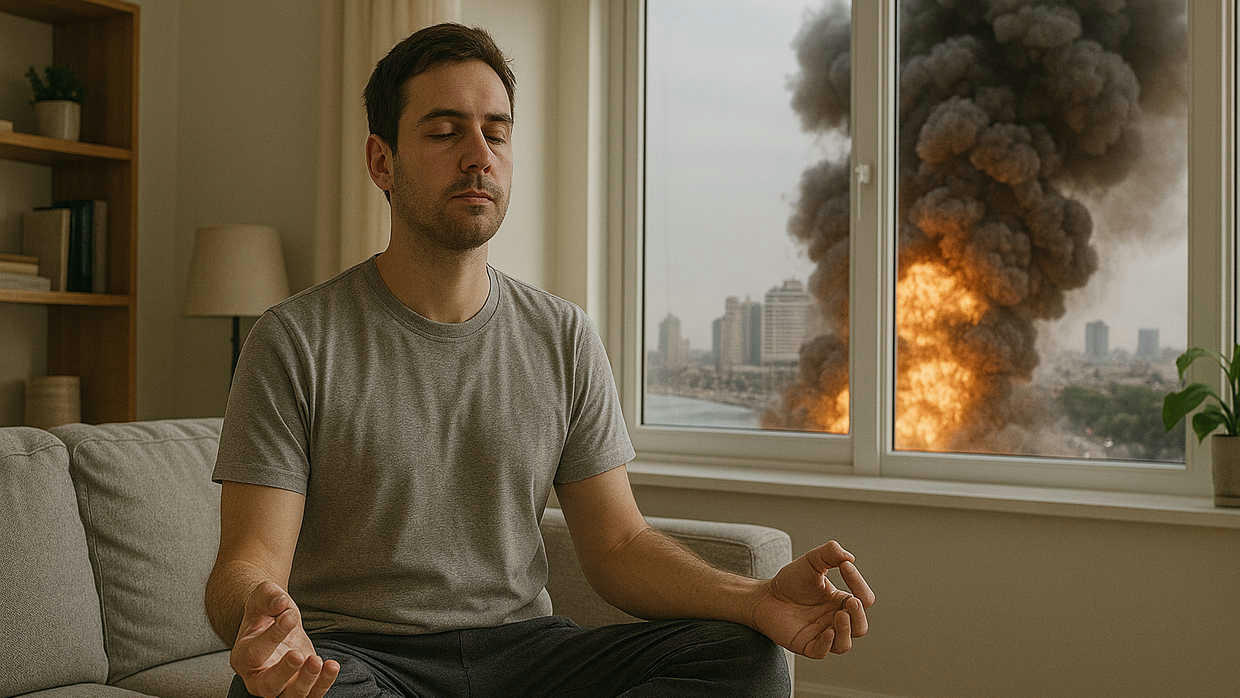
It’s normal to feel stressed, angry, sad, frightened, furious, despondent, terrified, and just about everything that goes through our mind. We shouldn’t pathologize the expected range of emotions that our brains will inevitably experience during air raid sirens while running towards a safe room. Being aware of our internal state further facilitates our ability to reframe distressing feelings as a natural, biological response instead of a catastrophic psychological panic.
Disruption of sleep, work, school, and our daily routine makes children cranky and adults disoriented (and also a bit cranky). But while we cannot control the missiles that wake us up at night by forcing us into bomb shelters, we can try hard to maintain our structure and circadian rhythms as much as possible. Getting enough sunlight, daily exercise, and healthy eating can do wonders for decreasing systemic inflammation associated with stressful times.
With this as a framework, it will be easier to offer an optimistic perspective for ourselves and our loved ones during this current war. Because in the end, this isn’t a new thing for our nation.
Those of us who are old enough to speak to our ancestors who experienced The Holocaust—and the violent expulsion of entire Sephardi/Mizrachi communities from their homes in Northern Africa and The Middle East—will forever know the true grit of The Jewish People. Listening to the courage, the perseverance, and the humanity of the previous generations and their survival from unfathomable traumas were the most inspiring moments of my childhood.
In ten, twenty, a hundred years, when our descendants will ask us about this current war, I hope to tell them about our bravery as a nation and about the special things we did to help one another as individuals.
Am Yisrael Chai!
Jacob L. Freedman MD is a psychiatrist and a business consultant based in Jerusalem, Israel. His newest book—Stories and Halacha from The Psychiatrist’s Couch—is available from Adir Press. Dr. Freedman can be most easily reached via his website: drjacoblfreedman.com












Thanks doc! Practical and positive