







 The Toy Torah a Soldier Found in Gaza
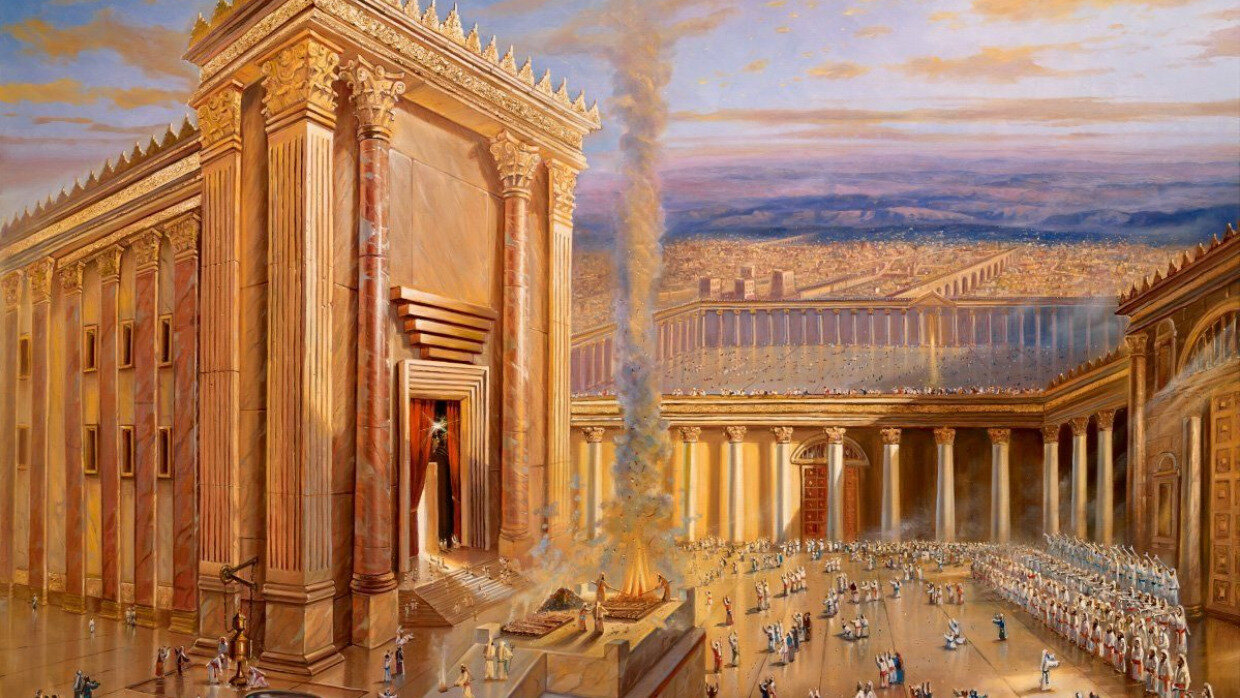








Explore the deeper meaning of the role of First and Second Temples in Jerusalem and why Jews still mourn their destruction.
Why does the groom at every Jewish wedding break a glass under the chuppah?
The origin of this custom is an oath that the Jewish people took over 2,000 years ago to never forget Jerusalem. As recorded in the Book of Psalms, “By the rivers of Babylon, there we sat, and we wept when we remembered Zion… If I forget thee, O Jerusalem, let my right hand forget its skill. Let my tongue adhere to my palate, if I fail to recall you, if I fail to elevate Jerusalem above my foremost joy” (Psalm 137).
In fact, there is an entire section of the Code of Jewish Law devoted to practices and customs surrounding remembering the Temple and the City of Jerusalem. (See Orach Chaim 560)
Every year, for at least 2,000 years, the Jewish people have fasted on the Ninth of Av, Tishah B’Av, and recite, often in tears, elegies and mournful poems (kinot) in memory of the First Temple, destroyed by the Babylonian Empire about 2,500 years ago, and the Second Temple, destroyed by the Roman Empire about 2000 years ago. (Mishnah, Ta’anit 4:6). We also lament the other tragedies of our lengthy exile, but the central focus of all the mourning is really the loss of the Temple in Jerusalem.
This focus is difficult for us to understand in the 21st century. The First Temple, built by King Solomon in Jerusalem lasted for 410 years and was destroyed by Babylon. On the return to Israel by many of the Jewish exiles to Babylon, the Second Temple, was built under the leadership of Ezra and Nechemiah, and it lasted for 420 years. We are far removed from those times and events, but since the Temples stood for over 800 years, and since the Jewish people’s national memory has preserved those times, it is incumbent upon us to try to understand the Temples’ importance, then and even now.
When King Solomon originally built the Temple, he gave a speech at its inauguration. The Biblical Book of Kings (I:8) preserves the speech where King Solomon eloquently explains his understanding of the Temple’s purpose.
There are certain places where God’s presence is more obvious and is more manifested and accessible.
First, he points out that clearly the Temple cannot “contain” God: “Will God indeed dwell on the earth? behold, the heaven and heaven of heavens cannot contain You; how much less this house that I have built?”
What do we mean when we say that the “presence of God,” the Shechina rests somewhere, such as the Temple or the Western Wall? God’s presence permeates all of time and space, and existence itself is “within” God. What we mean by Shechinah is that there are certain places (and times) where God’s presence is more obvious and is more manifested and accessible. (Commentary of Ibn Ezra, Exodus 25:40) One of those places was the Temple in Jerusalem, and its remnant, the Western Wall.
King Solomon continues to explain the purpose of the building: “Listen to the prayer of your servant, and for his supplication, O Lord my God, to listen to the cry and to the prayer, which your servant prays before you today; That your eyes may be open toward this house night and day, toward the place of which you have said, My name shall be there; that you may listen to the prayer which your servant shall make toward this place.”
The Temple was a tangible focal point for people’s prayers. A place where God’s presence, the Shechinah, was obvious and would draw people to spirituality and to a connection with God. Even today, the Arks of synagogues all over the world face the direction of Israel. Synagogues in Israel face Jerusalem; in Jerusalem they face the Temple Mount. (Talmud, Berachot 30a) And an individual praying alone is supposed to face Israel and Jerusalem. (There’s even an app that helps with this.)
The Temple was also intended to be a place of worship and inspiration for non-Jews. As King Solomon states, “And also concerning a stranger, who is not of your people Israel, but comes from a far country for your name’s sake… when he shall come and pray toward this house; Listen in heaven your dwelling place, and do according to all that the stranger calls to you for…”
The Temple was a font of Jewish wisdom and values.
In addition to being a place toward which people prayed, the Temple was a place from which emanated teachings, wisdom and direction. It was the meeting place of the Jewish supreme court, the Sanhedrin, whose members were the spiritual and moral leaders of the Jewish people for over 1,500 years.
Today there is no central voice of Judaism or agreed upon authority in Jewish law and morality. There is division, disagreement and dissent and it is difficult to find unity. (If you do not like “organized religion,” Judaism is for you!) But we yearn for unity, and we pray for inspiration and clarity. This is yet another reason that we mourn the loss of the Temple. It was, and we hope, will be, as described by Isaiah (2:4) “For from Zion shall come forth the Torah, and the word of the Lord from Jerusalem.”
I should point out that even today Jerusalem is the center of traditional Jewish scholarship, academic Jewish scholarship and also of Jewish education and publications. It is rare to find a Rabbi, a Jewish educator or scholar anywhere in the world who has not spent time studying, researching or teaching in Jerusalem. All this however, is only a shadow of Jerusalem’s and the Temple’s original status as beacons of light for the world.
The Book of Psalms (122:3) describes the Temple and Jerusalem as places of “joining.” The Temple is a place that “joins” heaven and earth, physical and spiritual and the actual world with the ideal world. In the words of the 13th century Spanish sage, Rabeinu Bachya (Commentary on Numbers 19:13) “Jerusalem derives its sanctity because it is a city joined with its counterpart, i.e. celestial Jerusalem. This is the mystical dimension of the very word Yerushalayim (transliteration of the Hebrew pronunciation) which, because of its plural ending (yim), indicates a dual city, one terrestrial the other celestial.” The Temple was the interface between the spiritual and the physical, like a wormhole in space that allows travel to other galaxies and other dimensions of existence.
Jerusalem and the Temple symbolize the eternity of the Jewish people and the splendor and beauty of Judaism.
Jerusalem and the Temple were also the “joiners” of the Jewish people. Every one of the Twelve Tribes of Israel contributed toward the purchase and building of the Temple so that it was the communal property of the entire Jewish people. (Sifri, Deuteronomy 352)
This was the place where Jews from all over Israel and the Middle East would come three times a year for the pilgrimage festivals of Passover, Shavuot and Sukkot. There they would eat together, pray together and bring offerings together as a means of creating and enhancing Jewish unity and sense of community. In the words of the Maharal of Prague (Netzach Yisrael 82) “The Jews are united through the Temple.”
Jerusalem and the Temple symbolize the eternity of the Jewish people and the splendor and beauty of Judaism. These are both muted and concealed by a history of destruction, war, and exile. But we can still discern traces of the original glory of the Temple, and we cry over the loss of the full measure of that splendor. The Talmud tells us that “One who mourns for Jerusalem will merit to see its joy” (Taanit 30b). May that blessing be fulfilled for all of us, speedily and in our days, Amen.
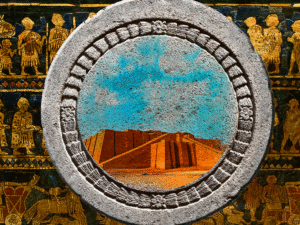
Featured Image: by Alex Levin
https://artlevin.com/product/










Thank you for sharing this article.
Pleasure
Do you hear and see an evolving unity similar to that of Change Ringing Bells? Today, an integration of always a higher calling suggests an understanding for, of and with Matter? Seemingly every bit of life awakens to the space perceived perhaps differently in part because the audience is also arising to the idea of an emergent Temple Expression as Assemblage and Ensemblage? Thank you for the poetics of the voicing in your article!
WONDERFUL!
Thank you
According to Jewish spiritual tradition, the Holy Temple was a place where one could instantly reach a higher state of consciousness. It was the ultimate high, but without any side effects. In that space, it became clear that everything is connected—that all is One—while also recognizing that each individual is a unique and valued part of that Oneness.
Leaving the Temple, a person was transformed. The questions 'Is there a God?' or 'Is there an immortal part of me?' were no longer up for debate—they were as clear as the sun in the sky. Instead, the focus shifted to 'How can I best express my true self to make a positive impact?' This profound experience is what we are missing in a world without the Holy Temple.
Well said, 100% correct
Let us build the Third Temple!
Amen