







 After the Manchester Synagogue Attack, They Danced Through Their Tears






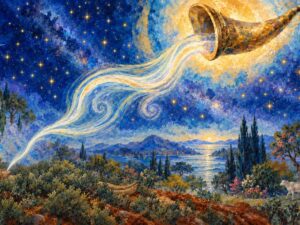
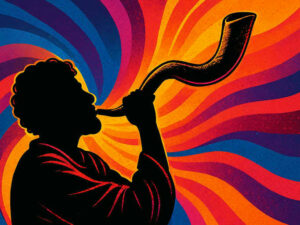
The shofar has no words and no tune. That is precisely its power.
Dear Prudence is one of my favorite Beatles’ songs. It was written for Prudence Farrow, a friend of the Beatles who was on a course of Transcendental Meditation with them in India. Apparently, she went into a catatonic state. Lost in herself, she would not come out of her room or speak to anyone.
And so, John Lennon wrote her this song: “The sun is up; the sky is blue; it’s beautiful; and so are you. Dear Prudence; won’t you come out to play?”
In a certain way, we are all Prudence Farrow.
Lost in the busyness and craziness of it all. Caught up on the treadmill of day-to-day drudgery, we so easily forget the beautiful world out there. Opportunity, possibility, hope, love, meaning, greatness, contribution. All disappear in the dense fog that we innocently create for ourselves.
We forget what a gorgeous world we have been gifted and, instead, find ourselves lost in the pettiness and emptiness of day-to-day existence.
Maimonides says that this is exactly the message of the shofar call: “Awaken sleepers from your sleep and slumberers from your slumber. Examine your actions, reconsider them and remember your Creator.”
He describes people who forget what is true and real in the madness of the times and spend their lives engaging in activities that will ultimately achieve nothing for them.
In other words, you and me. (Or at least me!)
The shofar is a call to something deeper, to the soul. A call that cuts through the nonsense of our made-up stories about life and ourselves and speaks directly to the Godly part inside each of us.
Music often talks to something deeper. It relaxes us; it uplifts us; it inspires us. Music is powerful.
But music comes with a message, an agenda. It has form shaped by the human mind that created it, and that form has content. If it has words, there is even more content. So, while music might call to our soul, it does so with its own agenda. Some agendas are for the better and some for the worse.
Not so the shofar.
It has neither words nor tune; the shofar is pure sound; it is pristine, unsullied by a human creator.
Formless music. Simple, humble and unpretentious. With no agenda.
A primordial cry that is the tekiah, the first and last blast of the shofar.
In between those two tekiahs comes a crying sound – a teruah, a shevarim or both.
And each note has its own purpose.
The first tekiah is a call to the soul within. Awake. No need for a particular message. Change in this way, do this instead, be better like this… No need for a message because every human soul knows what it is – as long as it is awake.
Then comes the middle crying sound. From the newfound spiritual perspective of the tekiah, reflect back on life as it has been lived. It is a cry of shock, or pain, or both.
Remembering who I truly am, how could I have been living this way?
And then another tekiah. Look forward, with confidence, to a bright future, with the clarity and perspective of the soul to drive me forward.
Tekiah – awake to the present moment. Teruah/Shevarim – look back and contrast, but only for a split second. Tekiah – the future is yours to create. Carpe Diem.
The power of the shofar comes from its simplicity.
When you arrive at the shofar in the service, close your eyes and just listen. But don’t listen to the shofar, listen beyond the shofar. Listen within.
And do so with an open heart. Listen and be open to hearing something new.
The sound of the shofar works magic. It calls: “Dear soul, won't you come out to play?”
But it only calls to a soul that is listening.
The shofar always makes me shiver on Rosh Hashanah and brings tears to my eyes.
There is a message in the sound of the shofar, but that message is a message of feeling, not form or ideas. Listen for that feeling. See where the sound points you and allow that feeling to sit with you.
The blessing we say before blowing the shofar ends with the words lishmoa kol shofar – “to hear the voice of the shofar.”
A voice is not content. It is pitch; it is tone; it is resonance; it is quality.
You are looking to be moved by the voice of the shofar, the feeling of the shofar.
Rosh Hashanah is an opportunity to wake up from the sleep of everyday life, to catch a glimpse of true life: life that is about engagement, connection, love and building a better and more Godly world.
The shofar doesn't need to tell us how to do that. We already know.
Its job is simply to call.
Our job is simply to listen.










Calling it a wake up call trivialize the entire event. There are many ways to give a wake up call. The sounds of the shofar are intimately linked to the nature of the Divine which is what RH is about-see my comment below. The Akeda and Hagar story chanted on RH are about hearing and understanding the nature of God-Ekev sheshamata b'koli-the final statement from the Angel.
DEAF DOC Auto license of a Jewish doctor, who treats deaf people.
Perhaps, the sound of the Shofar, can remind us to pay attention, and wake up, more
Throughout the year, ahead, we can imagine, sounds, like from the Shofar, etc.
(We can use simple words and sounds, over and mover) GoodYear TNX MCH
My take on the shofar is different. On RH we celebrate creation and the nature of the Divine. The importance is that we achieve holiness by emulating the Divine hence the need to understand HaShem. The three sounds (based on Sefer Ytzirah) of the shofar correspond to the extented beyond space and time aspect of HaShem (the Mmmm part), the contraction, localization and creation aspect corresponds to the Shhh sound and the mix/balance of the two to create shlemoot-wholeness which is what we aspire to.
Last year was the first year that I was able to hear the shofar in person at shule. For decades I hadn't been able to attend in person. I would watch the services on You tube, on my laptop and on TV but nothing can compare to hearing it with your community in the synagogue. I also wept and felt that shiver.
I think of the custom of the nigunim that are wordless songs sung when our hearts are too full and beyond words to express our love of HaShem.
The shofar encompasses the soul and might of the Jewish people and our love for G-d and our belief and prayer that the People of Israel live!
I appreciate the spiritual message. And yet,
what the shofar calls awaken in me is a
memory, perhaps imagined, a memory of our ancestors. The shofar was used millennia ago,
in the desert, where one crucial migration
of our people entered Canaan and joined the Tribes of Israel. They brought their God with them. The One whose name we forgot. My intuition tells me that this Name, coming from that unforgiving desert, had a crying resonance
similar to the shofar. It communicated across
the vastness, it summoned the ancestors to collective knowledge and action.
How needed is this memory of Peoplehood
today .Our survival as Jews and strength as humans always depended on that visceral summons.
This week I have been contemplating the shofar blowing louder and louder on Mount Sinai that first Shavuot when G-d spoke to the people, and its relationship to Teruah and Messiah. I appreciate the message today of being awakened, stirred by the shofar, to be awake and attuned to its calling of mindfulness without words or tunes.
Wonderful insight; thank you and shanah tovah!