







 The Red Cross’s Jewish Problem


6 min read
5 min read
5 min read





Though Amsterdam served as a safe haven for Jews for centuries, many of today’s Jewish residents of Amsterdam no longer feel safe.
Before the brutal Hamas attack on Israel on October 7th, 2023, the Jews of Amsterdam did not experience any overt antisemitism. They felt comfortable walking around town wearing a kippah, a Star of David necklace, or any other visible sign of their Jewishness.
Nati Banet, a graduate student of psychology at the University of Amsterdam and the chair of the Dutch Union of Jewish Students, grew up in Amsterdam, attending synagogues and Jewish schools. He has always worn a kippah. Antisemitism was not part of his childhood.
Before last October, whenever Nati would attend international events for Jewish students, he heard students from other European countries complain about antisemitism. “I couldn’t relate to them,” he says. He thought they were exaggerating.
Michelle, an American-born mother of three, moved to Amsterdam five years ago because of her husband’s job. She and her family fell in love with the community and the city, which they now consider their home.
“We were very warmly welcomed,” says Michelle. Coming from a larger Jewish community, Michelle found the Jews in Amsterdam more involved and more engaged, “people who are willing to be counted on.” The family is happy in their synagogue and contribute their share to communal events.
Michelle’s children attend an international school. When her son celebrated his Bar Mitzvah, many of his non-Jewish classmates attended. Until recently, Michelle was not concerned about antisemitism in Amsterdam.
David, a lay leader of one of Amsterdam’s synagogues, grew up in Amsterdam and is now raising his own family there. Though he feels very much at home in Amsterdam, he is concerned about the future of its Jewish community.
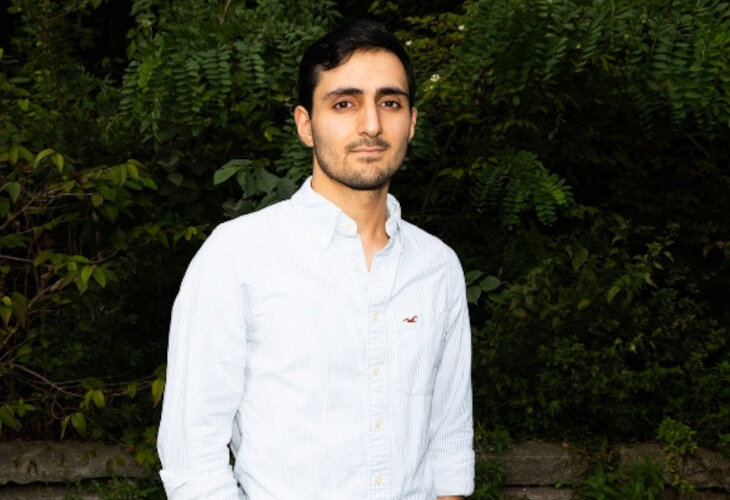 Nati Banet
In recent years, and especially since the beginning of the current war in Israel, antisemitism has been on the rise. “I still love Amsterdam,” says Nati. “It’s a great place to live, also for Jews. But the situation has become tense for Jews in the past year.”
David adds, “We are used to being confined to limited spaces. We are used to security at Jewish events, even if it’s just a picnic in the park. We know that there are some areas where it’s best not to wear a kippah. But over the past ten years, the number of places where one can safely wear a kippah is becoming smaller and smaller. Many schools and colleges are hostile to Jews. The streets have become less safe.”
Growing Population of Muslim Arabs
Amsterdam has a growing population of Muslim Arabs, who have become very vocal about their opposition to the State of Israel. They’ve conducted numerous protests, openly expressing their support of Hamas.
At the opening of the National Holocaust Museum this past March, protestors “were shouting the worst things to Holocaust survivors,” says David. At the October 7th memorial event, protestors physically attacked the attendees, tearing Israeli flags out of their hands.
The Jewish community was shocked. “I’d never experienced such feelings,” says Nati. “Suddenly, people [claim to] know everything, everyone is an expert, they’re against the existence of Israel, they openly support terrorist groups.”
Since then, things have only gotten worse. “The rise of antisemitism is insane,” says Nati. “People get attacked on the street.”
Nati tells of being attacked three times in one week. Two of the attacks were verbal, with the perpetrator screaming expletives in Arabic-accented Dutch. One of the perpetrators, seeing Nati’s kippah, said with a smile, “You guys know what Hitler did to you.”
The third attack almost turned violent. Nati was biking to his university when a keffiyeh-wearing biker riding behind him started screaming, “Free Palestine! Jews to gas chambers!”
Nati recalls, “I tried to bike slower, but the guy stayed behind me. Then he blocked me off on the bike and came closer. I was scared that he’d kick me off the bike.”
Nati called the police. He got off the bike and told the attacker that he was on the phone with the police. The attacker continued screaming and threatening him. He reached for his backpack and said, “I can shoot you!”
Nati didn’t know whether the attacker actually had a weapon or was simply bluffing. Meanwhile, several passersby heard the commotion, came over, and started yelling, “Stop it!” They scared off the attacker who got back on his bike and rode away. When the police finally showed up, they were unable to find him.
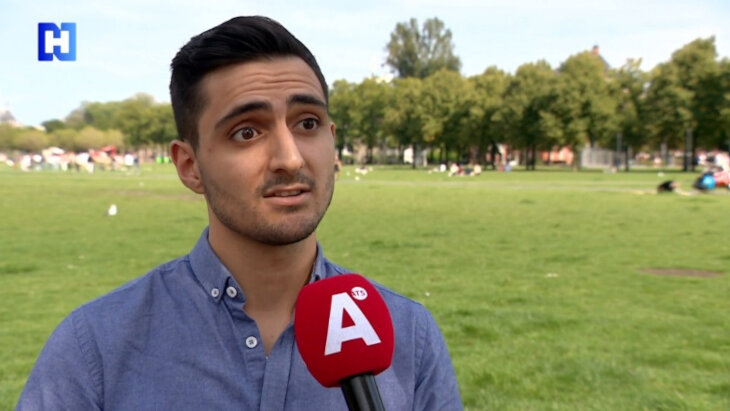 Nati telling his story on the local news.
Disappointed that the police couldn’t help him, Nati contacted the local news station and told the story. Though the police came too late, Nati says, “I don’t necessarily blame them. When I filed a report, the policeman was kind. He listened to me and tried to help. The problem is not with the police themselves but with the orders they get. And when it comes to riots, it’s a much bigger problem. Jews get attacked, and the police just stands by.”
David agrees that the police response to antisemitic incidents has not been very effective. Instead of pursuing the perpetrators, they tell the Jews to hide their Jewish symbols. The weak response gives the offenders the message that “they can do whatever they want.”
Much of the antisemitic propaganda is spread over social media. Since the October 7th attack, “one to two million people are fed hateful and inciteful messages on a daily basis,” says David. Most of them are lies and libels.
Michelle says that the social media propaganda reaches school age children. Her children have heard their classmates say things that were “crazy antisemitic and would never have been acceptable in the U.S. – things like ‘gas the Jews’ or ‘hail Hitler.’ Maybe I’m naïve, but I think they are not being vicious but are simply trying to make a bad joke to get attention. They are hearing this on TikTok, not from their parents.”
Michelle’s children have spoken up and explained to their classmates why such comments are inappropriate. Other parents would like the school administration to take more action. An Israeli family is currently keeping their son out of school until they feel that the situation is handled properly.
The social media war is not just unpleasant. It has put Jews in real physical danger. For example, a picture of a local Jewish woman, whose daughter is currently serving in the IDF, was posted on social media, along with her home and workplace address. An angry crowd showed up at the woman’s home and at the hospital where she works. A Jewish college professor was also besmirched on social media, to the extent that he no longer feels safe coming to campus. “Some people have had to leave the country,” says David.
On the evening of November 7th, Nati attended the soccer game between Maccabi Tel Aviv and the Dutch team Ajax. A fan of Ajax, Nati came to support his local team. “It was a great game,” he says. “We cheered, enjoyed, had fun.” He also enjoyed meeting the Israelis who came to support Maccabi.
On the way out, Nati noticed a heavy police presence around the stadium. He also noticed groups of men, dressed in black and wearing hoodies over their faces, speaking Arabic among each other. “They looked dangerous,” Nati says.
In the dark, they must have not noticed Nati’s kippah. He walked past them and went home. It was only later, when his phone was buzzing with worried messages from family and friends, that Nati realized how close he had been to danger. “I was in shock,” he says. “I didn’t know what to do with myself. My heart was beating. I was worried about my friends.”
The next day, the Amsterdam Jewish community mobilized to help stranded Israelis return to Israel. They set up a shelter, where the Israelis could be safe as they rearranged their flights. Nati spent the day volunteering there.
That evening, which was Friday night, Dutch politicians visited Nati’s synagogue to express their support. They promised to do everything to protect the Jewish community. “It was a good feeling,” says Nati. Nevertheless, the Jewish community remains uneasy.
All the antisemitic incidents described by our interviewees were perpetrated not by the native Dutch but by immigrants from Arab and Muslim countries.
How to handle this imported antisemitism is the subject of a heated debate among Dutch politicians. Even the well-meaning politicians find themselves between a rock and a hard place. No matter what they say or do, they get accused either of antisemitism or of Islamophobia.
Michelle understands the dilemma. “Upstanding Muslim citizens, who do teach their kids right from wrong, don’t want to be faulted by the criminal behavior of the few.” She believes that only a small percentage of the Muslim immigrants engage in violence. “It’s very hard when real clashes happen in the world and the government is supposed to mediate,” she adds.
On a practical level, because the Dutch Jewish community is relatively small, Jews don’t have much political influence. Coming from the U.S., Michelle is used to feeling heard by politicians. In the Netherlands, that’s not necessarily the case.
David explains that the Dutch government has recently become more right-wing. “An average person is fed up and wants their country back,” he says. The government has passed motions intended to combat antisemitism. “They are taking it seriously,” says David.
The local Amsterdam city government, on the other hand, is more left-wing, filled with identity politics and people who believe that Israel is committing genocide and that compulsory army service makes every Israeli complicit. Though they may condemn violent antisemitic attacks, they are less likely to do something about them. And at times, they refuse to acknowledge that violent incidents were in fact antisemitic.
“The local government says they are doing what they can, but we don’t expect so much,” says David. “They are not equipped to handle incidents like little hit and runs by guys on scooters. They claim that it’s part of life in a big city.”
Jewish institutions in Amsterdam are increasing their security measures and hoping for a strong response from the government in cracking down on antisemitism.
More and more Jewish parents have switched their children from public schools to Jewish schools. David says that the local Jewish schools have grown like never before. Unfortunately, not every Jewish child can be accommodated by Jewish schools. Parents of children with special needs, who attend public schools, are concerned about their children’s safety.
The silver lining is that the disturbing rise in antisemitism is bringing the Jews of Amsterdam together like never before. “We’ve become way more connected with other Jews,” says Nati. “From the beginning of the war, more students have been signing up for Jewish social events. The Shabbat meals are full. People are there for each other, and barriers come down. We’re strong and resilient, and when we come together and sing Am Yisrael Chai, it really comes from the heart.”
After October 7th, many Jews in Amsterdam have begun to ask themselves whether the time has come to leave Amsterdam. Nati’s parents, who are Israeli, are considering moving back to Israel.
David says that recently, more and more people have been talking about making aliyah. “People are more scared now than after October 7th,” he says. “They feel that their children are not safe in schools and colleges. More and more people are wondering if there is a future for them in Amsterdam, or even in Europe.”
Michelle says that she and her family still feel safe, but they don’t look overtly Jewish, and her son doesn’t wear a kippah outside. Michelle has heard from others, who do look visibly Jewish, that they no longer feel safe.
The Dutch Chief Rabbi Binyomin Jacobs said in an interview with ILTV Israel news that though the local community must be aware of the growing antisemitism, the big difference between pre-Holocaust Europe and now is that “the government is not antisemitic. I know a lot of them personally. Do we have to leave here? Personally, as the captain of the ship, I’ll leave the ship last. The situation is not a very pleasant situation at all. Should the Jewish people in Europe be aware of it? Sure! Nevertheless, we can’t compare it completely.”
He continues, “I also don’t think it’s right to call it a ‘pogrom.’ A pogrom is organized by government or by the Church. There was no connection between the government and what happened.” Perhaps the government and the police did not respond properly, but, says Rabbi Jacobs, “The mayor of Amsterdam is not antisemitic. I know her personally. And as long as we have a government that is absolutely not antisemitic and cares about the Jewish people and wants them to stay here, I don’t think we have to leave Holland.”
David is planning to stay and raise his family in Amsterdam for the foreseeable future. Nevertheless, he says, “We have a plan B.”













About 75% of Jews in Holland were killed in the Shoah, a high percentage for a European country whose citizens were Jews and which still had a shell of sovereignty. Compare this to France, which allowed 25% of its Jews to be shipped to death camps. Or Denmark, where very few Jews were arrested and killed. Holland's result leads one to believe that the Dutch were only too complicit in getting its Jews shipped out and killed. So, no surprise about the wishy-washy response in the Dutch legislature.
Well it’s easy to find a solution if governments are determined.
Get rid of the violent immigrants.As a government you send them back a few times and it will stop. Stop talking action
A lot of Jews are leaving Europe, in droves in a lot of them are making Aliyah, French Jews are living in Natanya a beautiful city next to the beach, I wonder where the other Jews of Europe go to besides Israel
Over here, Germany, many of my friends will not use public transport anymore and won´t wear their Magen David, because the least to expect are hateful looks.
I believe the sad thing about Amsterdam is, that the jews seemed to have been left unsupported whereas the Dutch of long ago, my upbringing, would have jumped in to help the people, who are being opppressed. Shame on my fellow countrymen.
I read once in a Jewish magazine that Europe got Muslims now as a curse, for murdering/ killing Jews in the Holocaust, and the European governments let the door wide open for this populations, Jews were a nice lawful citizens and now they got these unruly violent Muslims, that don't listen to the law of the land they want Sharia Law( Muslim Laws) in the places they ended up ( it is like a invasion like a scary movie that is real)
These protests expose how weak/indecisive governments are. They should ship the Muslins back to their original homeland. They have been "brainwashed" that theirs is the only religion to be or died. That does not work!
My wife and I decided already seven years ago to leave the Netherlands because of the growing antisemitism. I am very sorry, but everone claiming that the rise is only a more recent phenomenon has it very wrong. I am not surprised by the events in Amsterdam: this sick behavior has been building up for many years. And the Dutch authorities have done nothing to stop it. Quite the opposite: they marginalized every antisemitic event and looked the other way. The message they have been sending for years is that it is ok to be antisemitic and even assualt Jews. The current 'discussions' on the event in Dutch Parliament reflect exactly that disgraceful attitude.
Not surprisingly, the attacks are not coming from native Dutch, with a long history of tolerance. I hope that if assailants are caught who are not Dutch citizens (I.e. immigrants), they can be deported. Europe generously took in Syrians and others who fled repressive regimes and war. That should not be a permit to assault citizens of their new country, including Jewish citizens.
Fear of Islam is not a phobia because it is rational and justified by the hatred and violence exhibited by the practitioners of Islam. A basic principle of Islam is elimination of all other religions and killing Jews. If the so-called liberal Dutch would get this through their collective head, then maybe it would be the towel headed terrorists needing to leave Amsterdam not the kippah wearing people whose religion is the basis of Western civilization.!
That is not totally true. The country with the largest population of followers of Islam is an ASIAN country, Indonesia and they could care less about Jews. While there is great conflict in that country and other Asian countries between Buddhists and Musliums, it is not common knowledge in the US. Also, the Asian Ughars who follow Islam are currently being genocided by the Chineese government. There was finally an article on this in the New York Times magazine. The Arab countries could care less about the genocide of their brothers and sisters in Asia, because those people are ethnically Asian, they do not count I guess. The Arabs followers of Islam are hypocrites in the most terrible way, but do not blame their brothers and sisters in Asia who are being genocided.
You are right, also there are Sunni and Shati Moslems, I am not sure if I am spelling it right, that don't like each other either, if I read they will kill each other in a heart beat,( I mean other Muslims) so what do you expect when it comes to Jews, their mind set is to kill, also the have something called honor killings, and the Muslim women felt safer in Israel than in their Arab Muslim village, to bad nobody knows the real facts about Muslim, one Jewish woman unfortunately married a Muslim and she wrote a book about her experience her name is Phyllis Chesler, and she wrote about in the Jewish Press newspaper, that the west should learn the truth about Muslims, it really is a eye opener, some people don't know the real true facts about Muslims
Shia Iran has teamed up with Sunni Palestinians against Israel.
Well written
You are absolutely right, but unfortunately some people don't see the real facts
It's always difficult to leave a place where one has settled; nevertheless, it's unsettling to read about David's decision.
Unlike pre WWII, there is a home for Jews, and although it may currently sound like a war zone to outsiders, people tend to overlook the obvious miracles that happen in Israel!
Thank you for this eye opening well written article on Antisemitism in Amsterdam. I will be sure to share this article with many!