





 The God Factor: From the Exodus to the Iran War



8 min read
7 min read
9 min read



6 min read


Two Jews, Giacomo Meyerbeer and Jacques Offenbach, helped shape what Europe celebrated as its most refined art form.
Opera, a craft long regarded as the pinnacle of European cultural refinement, owes more to Jewish imagination than polite cultural memory admits. The same continent that confined Jews to ghettos for centuries on end found itself, in the nineteenth, applauding their craft from velvet boxes beneath crystal chandeliers. One might term the irony “operatic.”
This irony is most visible in the careers of Giacomo Meyerbeer and Jacques Offenbach: one the architect of grand opera, the other the master of operetta.
Giacomo Meyerbeer effectively created grand opera and was the most frequently performed composer of the nineteenth century. Opera historians regard him as the bridge between Mozart’s classicism and Wagner’s epic. Opera as we know it owes its scale, stagecraft, and cinematic quality to his influence.
 Giacomo Meyerbeer
Born Jacob Liebmann Beer, Meyerbeer retained his Jewish practice amid antisemitic personal attacks and pogroms. After his grandfather’s death, Meyerbeer wrote to his mother, “Please accept my promise to always live according to the laws of the religion of which he was an adherent.”
Meyerbeer’s Judaism sustained his spirit and animated his craft. His 1815 cantata Hallelujah, was dedicated to the Jewish community of Berlin, and his first opera Jephthas Gelübde, brought the Biblical story of Jephthah (from Judges 11) to stage.
Les Huguenots tells the story of star-crossed love between a Catholic woman and a Protestant nobleman against the backdrop of the St. Bartholomew’s Day Massacre. Upon its 1836 premiere at the Paris Opéra, it was an immediate triumph and became one of the most frequently performed operas of the nineteenth century. Composer Hector Berlioz praised it as a “musical encyclopedia,” and its fourth-act duet is one of the most immediately recognizable moments in opera repertoire.
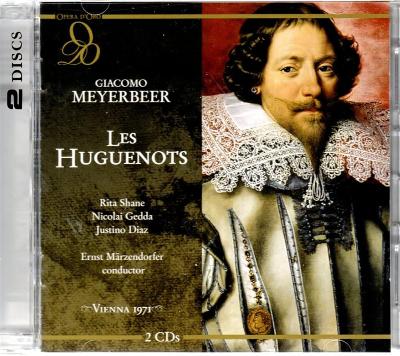 Le Prophète extended that achievement by dramatizing the Anabaptist uprising, transforming a humble innkeeper into a revolutionary zealot, and staging one of the most elaborate coronation scenes in operatic history. The opera was among the first major works to incorporate Adolphe Sax’s newly invented saxophone into its orchestration, which gave the composition an otherworldly timbre. Together, Les Huguenots and Le Prophète cemented Meyerbeer’s supremacy and helped define the architecture of the five-act grand opera.
High society and musical critics were not the only ones to take notice of Meyerbeer’s successes. Richard Wagner was generously supported by Meyerbeer at the start of his career, who provided Wagner with financial support and used his influence to prompt stagings of Wagner’s Rienzi and The Flying Dutchman. Wagner even wrote in a letter that without Meyerbeer's support, he and his wife would have starved.
Despite Meyerbeer’s kindness, Wagner took to polemicizing him as Meyerbeer reached the height of his fame. In his essay Das Judenthum in der Musik (Jewishness in Music), Wagner lambasted Meyerbeer’s works as superficial and attributed his popularity to insidious Jewish influence, not talent. To Wagner, Meyerbeer’s success represents a Jewish anathema to pure European culture. Wagner’s polemic, however, inadvertently testifies to Meyerbeer’s stature. The very need to explain away Meyerbeer’s success underscores its undeniability.
Wagner’s antisemitism was later embraced by the Nazi regime. Adolf Hitler openly revered Wagner and adopted his conception of an “Aryan” artistic tradition, one that excluded Jewish composers from the European canon. Under the Third Reich, Meyerbeer’s works were banned from German stages and his scores were deliberately suppressed as part of the regime’s broader campaign to eliminate Jewish contributions to German cultural life.
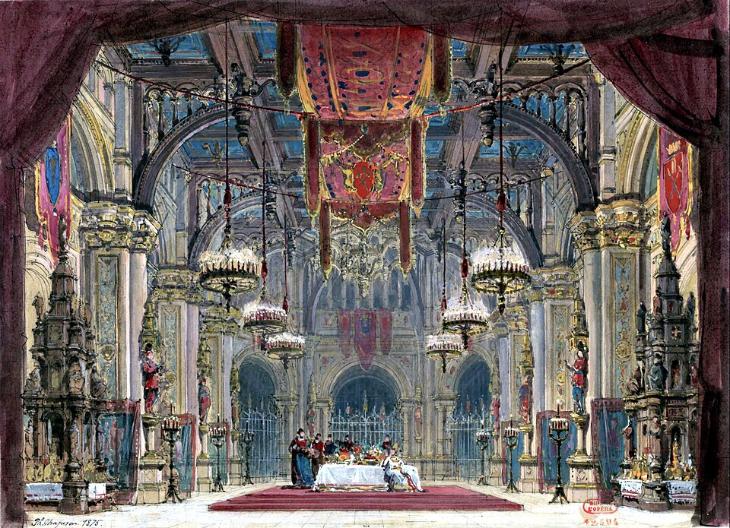 Le Prophète : sketch of the opera set for the second scene of the fifth act (1875) by Philippe Chaperon (1823-1906) (WikiMedia Commons)
Although the Third Reich erased Meyerbeer’s name from archives, they failed to do so from history. In recent decades, major opera houses have returned to Giacomo Meyerbeer, staging Les Huguenots and Le Prophète anew.
Without Meyerbeer, opera, and indeed modern performance as we know it would be unrecognizable. Meyerbeer was among the first to recognize and harness the power of the press. Meyerbeer granted selective access to rehearsals, invited critics to his premieres, and instrumentalized their anticipation. His instinct, that artistic success requires mastery of both craft and the narrative that surrounds it, is remarkably modern, anticipating the logic of movie trailers, hit singles, and world tours.
Jacques Offenbach may sound obscure today, but his music was anything but in the nineteenth century. Born Jakob Offenbach, the son of a cantor in Cologne, he refined the modern operetta: a shorter and bolder production than the three-hour operas that dominated stages at the time. Before Offenbach, opera was confined to the realm of the aristocratic. He changed opera’s tempo and target, making opera legible to urban audiences and responsive to contemporary life.
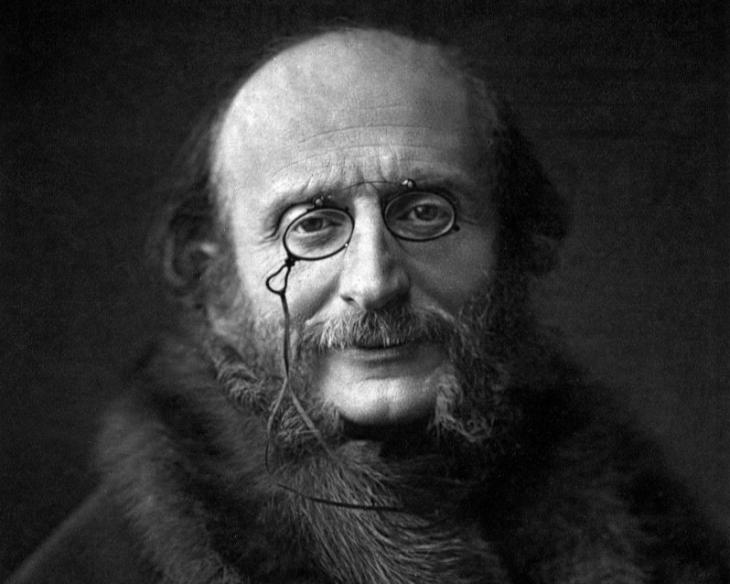 Jacques Offenbach
Offenbach’s early works were testaments to his Jewish identity. In 1841, he composed two synagogue chorals (Tovo lefone'ho and Ochamnou) for Yom Kippur. His 1837 Waltz, Rebecca, quoted 15th-century Hebrew melodies. However, he is beloved today for his operettas.
When Orphée aux enfers premiered in 1858, critics were scandalized. The Romantic era considered Greco-Roman myth to be sources of European glory and elevated them to the realm of the sacred. Orphée’s plot, however, blasphemes the myth of Orpheus and Eurydice as satire: with the pair unhappily married and eager to escape one another, and one of the gods turns himself into an insect.
The press condemned it as “Unheard of! Indecent! Inappropriate!” with one critic calling it a “profanation of holy and glorious antiquity.” Crowds, however, adored it. The show ran for over 200 performances, at a time when a run of 100 marked a success. The “Galop infernal,” which we know today as the Can-Can, became an almost immediate cultural sensation.
His later works confirmed that Orphée aux’s success was no one-off.
In La Belle Hélène (1864), Offenbach recast the Trojan War as a satire of political vanity under Napoleon III’s ruling class. The opera ran for over 700 performances in Paris and enjoyed a record-breaking run of more than 400 in St. Petersburg. Today, La Belle Hélène is known as the opera that made satire respectable in high art.
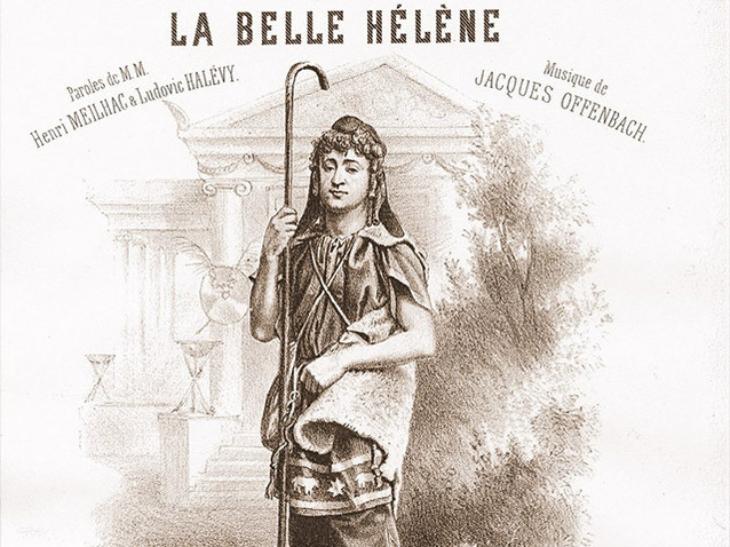
In 1866, Offenbach dispensed with myth altogether in La Vie parisienne. In it, Offenbach mocks Paris’s residents and tourists for their bloated obsession with novelty and performance. Its soundtrack is beloved for its waltzes, and scholars champion it as one of the earliest portraits of metropolitan life.
Offenbach secured the idea that artists could treat society, both high and low, as an object of satire without sacrificing virtuosity. Mozart’s opera buffa mocked aristocratic pretension with individual characters, while Offenbach challenged the entire system. Without his boldness, there would be no Johann Strauss II to refine Viennese operetta, no Gilbert and Sullivan to perfect comic opera, and, in many respects, no modern Broadway musical.
Jews helped shape what Europe celebrated as its most refined art form. Taken together, Meyerbeer and Offenbach shaped opera in ways that still structure modern performance. Meyerbeer expanded it to a monumental scale, while Offenbach made it responsive to modern life. Between them lies the craft as we know it today.












I knew Offenbach was Jewish and love The Tales of Hoffman set to his music. I did not know Meyerbeer was Jewish. Very nice piece and I am going to check out more of Meyerbeer's work.
I had no idea these 2 composers were Jewish!