







 The World Says You're a Jew. Now What?

7 min read
6 min read
7 min read





The two groups most reliably targeted when hatred surges have rarely been seen as natural allies. A new PBS series makes the case that they can’t afford not to be.
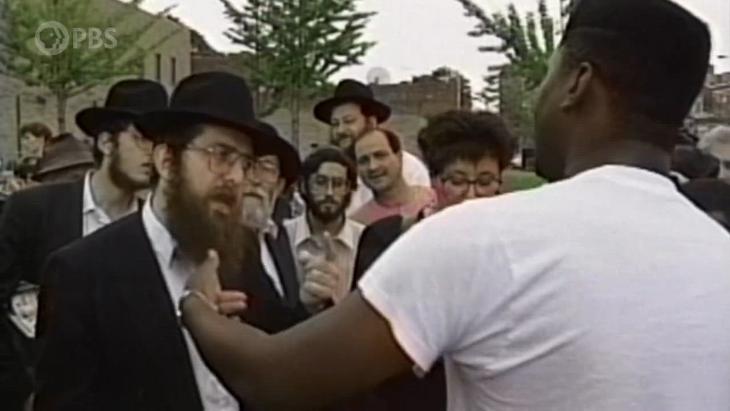
In Charlottesville, Virginia, in August 2017, white supremacists marched through the
streets carrying Confederate and Nazi flags, chanting “Jews will not replace us.” For
Harvard historian Henry Louis Gates Jr., (host of PBS’ popular genealogy series, “Finding Your Roots”) that moment wasn’t just a shock — it was a confirmation of something he had long taught: that antisemitism and anti-Black racism are not separate phenomena, but dual currents running beneath the surface of Western civilization, surging upward whenever a demagogue needs a scapegoat.
“People who hate Jews, uncannily hate Black people too,” acknowledged Gates in “Black and Jewish America: An Interwoven History.” That conviction became the seed of his new PBS docuseries, which he created alongside Jewish director and co-executive producer Sara Wolitzky.
“Because when the stuff hits the fan, they’re coming after both of us.”
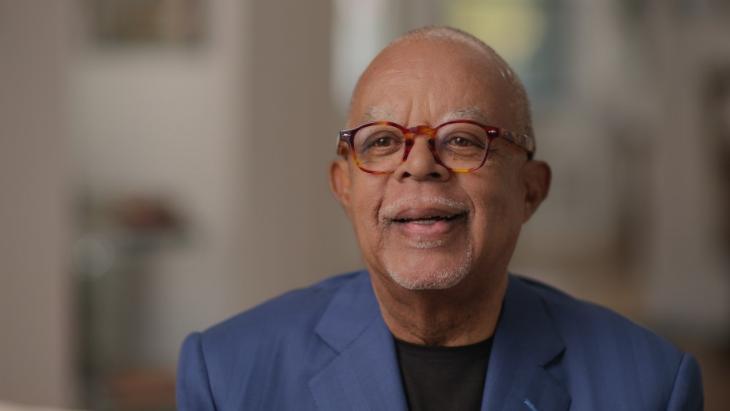 Henry Louis Gates Jr.
“Black and Jewish America” is an urgent and illuminating exploration of American identity in recent memory. It covers a sweeping, complex history and features interviews with an extraordinary range of voices, including actor Billy Crystal, playwright and actress Anna Deavere Smith, New Yorker editor David Remnick, Rabbi Abraham Joshua, Rabbi Israel Dresner, Angela Buchdahl, and Marc Dollinger, a Jewish studies professor at San Francisco State University and author of “Black Power, Jewish Politics: Reinventing the Alliance in the 1960s.”
The documentary traces how Black and Jewish Americans began on fundamentally different footing in this country, but by the early 20th century, were drawn together by a shared experience of entrenched racism, rising hatred, and the denial of basic rights.
“This is a deeply personal subject for me,” said Gates. “It’s connected to my own coming of age during the heroic days of the civil rights struggle and is an urgent response to the violent forces I’ve seen reawakened in our society over the last decade. By tracing the long arc of Black and Jewish history in America, I hope we can see each other more clearly, more honestly, and find hope in our mutual stories of survival, resilience, and solidarity. But this series is not only about the past. It is about us — and how, together, we can prevail over the forces of hatred that seek to divide us.”
For Wolitzky, the project was never just professional — it was personal in ways that reached back generations. Though she didn’t experience much direct antisemitism growing up in New York City in the late 1980s and 90s, she carried something far older inside her.
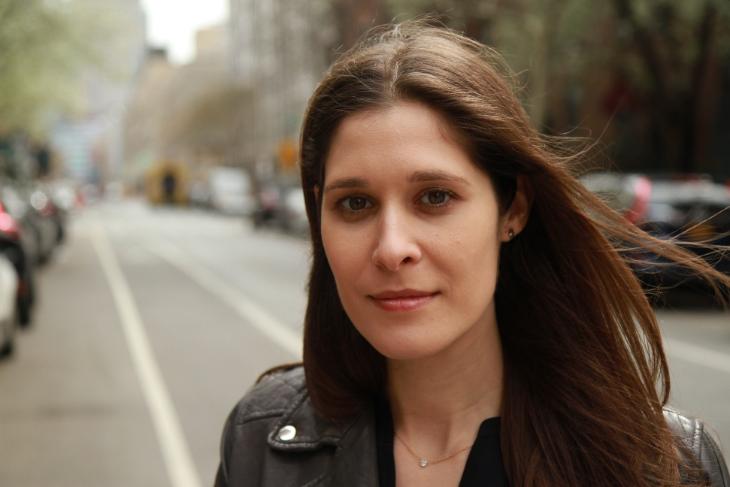 Director Sara Wolitzky (Photo credit: McGee Media)
“From the age of four, my grandmother was telling me the story of her pogrom and almost being murdered, and having her father murdered on top of her,” Wolitzky recalled. “So I had a very visceral sense of how hated Jews have been and could be — and therefore, a sense that part of being a Jew meant taking the side of anybody who was vulnerable, just because of who they were.”
That sense of inherited vulnerability became a source of solidarity rather than insularity. “I think it was important to identify being persecuted as a source of being able to find commonality with other people, rather than retreat and make it about the tribalism of only your community’s best interest. To realize your best interest ultimately lies with standing for anybody in danger — because as we say in the film, no one’s safe until everyone’s safe.”
The series stretches back centuries to trace the roots of antisemitism, including the Spanish Inquisition of the 1400s, when Jews were cast as the ultimate “other” in Christian Europe — barred from most professions, forced into money-lending, and then vilified for it.
 “You always need an ‘other,’ especially for those in power,” Wolitzky explained. “As non-Christians, let alone followers of a religion that preceded Christianity, they became that ‘other.’ And that’s where so many of the financial conspiracy tropes were born — the idea that Jews are pulling the global financial strings. That narrative traveled to America and never fully disappeared.”
Drawing on Isabelle Wilkerson’s landmark book Caste, Wolitzky frames the hatred faced by both communities not as isolated episodes but as expressions of a universal human impulse to create hierarchy out of difference.
“Whether it’s the caste system in India, centuries of antisemitism across Europe, or anti-Black racism in America,” she said, “humans can always find some difference to use to create hierarchy. Jews were the most accessible other; in so much of Europe for so many centuries.”
One of the series’ more surprising revelations is the story of George Washington and his remarkable openness toward Jewish Americans, evidenced in a letter he sent to
Congregation Touro in Newport, Rhode Island, one of the oldest still-operating synagogues in America.
“It’s hard to know exactly what was in his head,” said Wolitzky, “but I think part of the founding principle of America was going to be this idea of religious equality and freedom —and that’s part of what distinguished it from the old world.”
That founding promise, however imperfect, gave Jewish Americans an avenue to citizenship and rights long denied to them in Europe. But as the series makes clear, it also created a crucial and painful asymmetry: Jews had access to whiteness, and the protections that came with it, in ways that Black Americans never did.
The relationship between the two communities deepened dramatically after the Holocaust, as the full horrors of the concentration camps came to light and strengthened a sense of shared struggle. The Civil Rights era became “the golden age” of the alliance, a moment when Jewish Americans marched, organized, and put themselves at risk alongside Black leaders working to dismantle Jim Crow segregation.
The series also looks at how the relationship between Blacks and Jews evolved from the 1970s until today, examining political gains, global tensions and rising antisemitism, encountering lessons of coalition building and solidarity.
Sadly, the alliance didn’t survive the decades that followed without fractures. While shared ideals of justice united Black and Jewish people in the 1950s and 1960s, they were increasingly split by the realities of race in America. The historic alliance suffered as each community prioritized its own struggles and agendas in an increasingly divided social and political landscape.
The documentary also gives moments where Black antisemitism is discussed. Video footage from writer James Baldwin and his controversial essay, “Negroes Are Anti-Semitic Because They’re Anti-White,” which argues that African American resentment of Jews reflects generalized anti-White sentiment, is discussed.
Another controversial event happened amid an intense labor dispute between Jewish teachers and Black parents in 1968, or the Ocean Hill Brownsville teacher strike – an anonymous antisemitic leaflet was circulated by the United Federation of Teachers. This became “another flashpoint in the unravelling of the Black-Jewish coalition, Gates said.
Wolitzky noted that many in the Black community came to see their Jewish allies not as a distinct group, but simply as white people — and wondered, decades later, whether that solidarity had held.
“There was a feeling, not unwrongly, that Jews maybe hung their hats on that moment —and 30 or 40 years later, ‘what have you done? Have you been there for us lately?’” said Wolitzky. “I think they have, in a lot of ways. In the Black Lives Matter movement and other social justice movements in recent years, you’ll find a lot of Black folks and a lot of Jewish activists on the ground together — even if it’s not as visibly distinct an alliance as it once was.”
Nevertheless, the hope and promise of cross-cultural solidarity continues to this day, despite constant reminders of the persistent threat of global violence and injustice. What the series ultimately argues — and what both Gates and Wolitzky believe with urgency — is that the stakes of division are too high to ignore. The forces that drove white supremacists through Charlottesville don’t distinguish between their targets. They never have.
“There is only increasing danger for both of us,” said Wolitzky, If we don’t work together.”
“Black And Jewish America: An Interwoven History” can be seen on PBS.org & the PBS app. There is also a community engagement and discussion guide for viewers who want to discuss each episode.









it was a wonderful series and well worth watching. I already kew much of the history but found it very educational and very well researched --well worth watching. Henry Louis Gates is an amazing historian, and I appreciated hearing the other side of the story from a non Jewish African American scholar. I watched it on the PBS website--where it is still available i think for another week.
Any kind of hate can easily be broken down when viewed as two people where only one can be right.
One is righteous, connected to truth and has HaShem.
The other is not connected to HaShem and truth, and is in a state of ignorance, and misguidance, and has no power given by HaShem.
Know who you are.
Be strong! Be strong! And be strengthened; and, strengthen each other!
Please don't view this as an attack: the article mentions that the documentary touches upon Antisemitism in African-American communities. Does it also touch upon Anti-Black Racism in Jewish communities? Air both communities' grievances so that they can begin to move forward from here.
The Founding Fathers were very much aware of the Bible and took more from Deuteronomy in designing the government/country than any other biblical source. The founding principles are the biblical principles and more people should be aware of the influence of Israel on the founders. The founders called the US the New Jerusalem. There are even more examples from what is called the Old Testament. The Founders were believers and had biblical quotations and paraphrase in most anything they wrote. They constantly referred to providence which is one of their baroque names for the creator -- "Nature's G-d."
They did more than that. They had seriously considered making Hebrew the official language and Judaism the official religion.
Can you imagine how better the world would be right now had they followed through.
Christopher Columbus was a Jew. And there has been a continuous Jewish community/presence in America since at least the 1600s.