



 NBC’s Outrageous Antisemitic Ad



5 min read
5 min read
12 min read




Discover how the 22 letters of the alphabet act as the building blocks of creation, and what they reveal about you.
If you speak English, you’ve probably never given much thought to why a four-legged barking animal is called a "dog."
Linguists will tell you that there's nothing inherently "doggy" about the word dog. The connection between a sound and its meaning is arbitrary, a product of historical accident. Call the animal a "blick," and nothing in the universe would shift.
But the Hebrew language is not like all these other languages, which are just random sets of human labels. The Hebrew alphabet is actually the foundational periodic table of the universe!
According to the Torah, the 22 letters of the Hebrew alphabet are not human inventions. They are the spiritual atoms of reality. They are discrete, divine channels of energy through which the Creator spoke our cosmos into existence, and through which He continues to sustain every single particle of creation at every moment in time.
Think about how chemistry operates. Science tells us that if you break down a wooden chair, a glass of water, or a human hand, you find atoms—protons, neutrons, and electrons—configured in precise mathematical formulas. Two atoms of hydrogen combined with one atom of oxygen (H20) don’t merely describe water; they create water.
In spiritual chemistry, the Hebrew letters function in the same way. Two letters named Mem (מ) and one letter named Yud (י) spell the Hebrew word for water: Mayim (מים). But the letters of the word mayim don’t just describe water; the energies of those specific letters actually build the physical and spiritual essence of water itself.
We see this principle embedded in the very structure of the Hebrew language. In Hebrew, the three letters, ד-ב-ר, are the root for the words davar and dibur, which mean "word" and "speech." But when you look up davar in a dictionary, you’ll discover something amazing: Davar also means "a physical thing" or “an object.”
In Hebrew, speech and substance are identical.
We see this in the Torah: God does not create the universe using physical tools. He speaks. "God said, 'Let there be light,' and there was light." God’s spoken words materialized into the four-dimensional matrix of time and space as the actual creations of this world. His articulated letters become the physical reality of light itself.
Just as a chemist alters a physical substance by adding or subtracting specific elements, so too, changing a single letter in Hebrew transforms the spiritual essence of a word, and the actual reality that word creates.
In Hebrew, the word for blood—the physical, instinctual animal drive circulating through our veins—is Dam (דָּם). Dam represents biology, physical instinct, and dust.
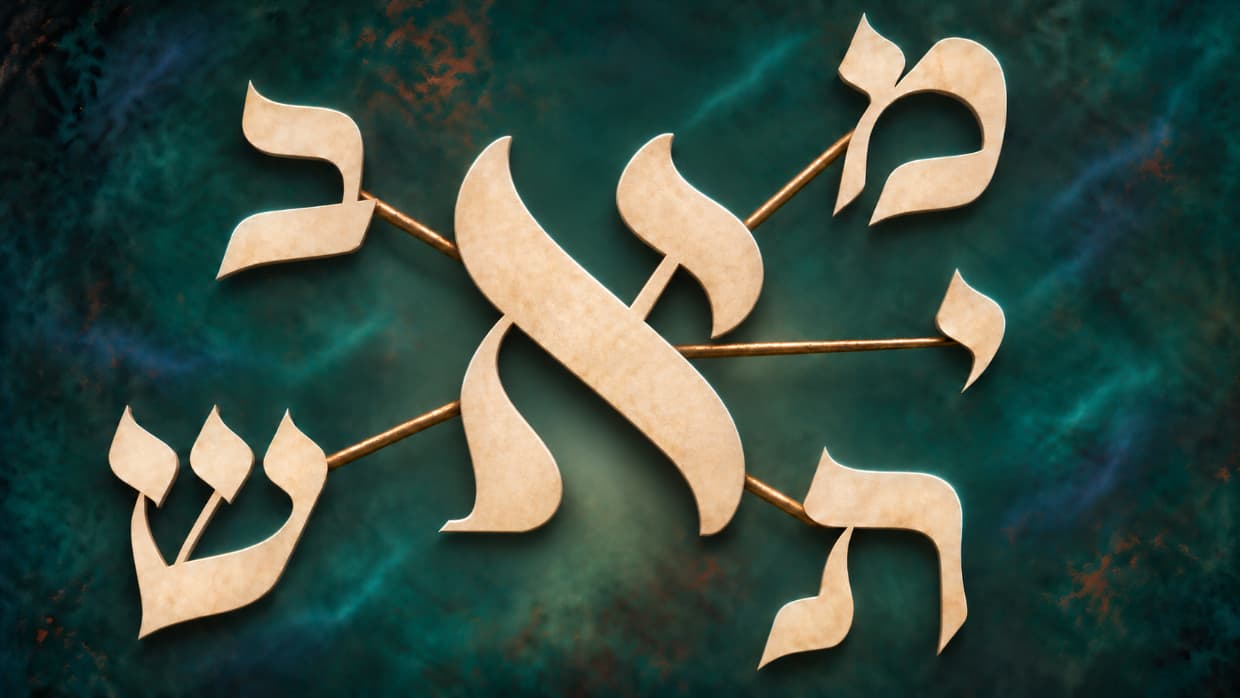
Now, place the letter Aleph (א) at the front of Dam, and you create the word Adam (אָדָם)—human being.
Why does the Aleph make all the difference?
The word Aleph is related to Aluf (אַלּוּף), which means "master," "ruler," "leader," or "champion." On a cosmic level, Aleph refers to the Aluf Ha'olam—the Master of the Universe. But on a human level, Aleph represents the principle of self-mastery. Aleph represents the Divine spark breathed into our nostrils by God.
Aleph is the letter of conscious, free choice, spiritual alignment, and self-governance. When the Aleph infuses flesh and blood (Dam), it elevates an animal into a human being, an Adam. The Aleph represents our capacity to master our ten internal character traits, govern our instinctual drives, exercise moral autonomy, and reveal the Godly soul hidden within our physical flesh.
When we activate our Aleph, we achieve personal mastery, becoming an Aluf over our lower nature and rising to our full potential as Adam.
But when a human being forgets his Aleph—living purely for physical gratification—he collapses into mere Dam: instinct, flesh, and blood.
When man invites the Aleph to guide his life, his physical existence is elevated, transforming him into Adam—a walking sanctuary of Divine light.
Every Hebrew letter is like a precious, multi-faceted gemstone, and just as a jeweler turns a diamond beneath his lamp to admire how light refracts through its many different angles, we, too, can examine every letter through three primary facets:
Every single letter of the Hebrew alphabet offers a masterclass in living with intention and spiritual depth. For example:
Why doesn't the Torah begin with Aleph, the first letter? Instead, the first word of Genesis is Bereishit, starting with Beit (ב), the second letter.
Beit spells Bayit (בַּיִת), which means "home." Kabbalah teaches that God created the entire universe for one overarching purpose: He desired a Dira B'Tachtonim—a warm, welcoming home in the lower physical world. The Torah begins with Beit to teach us that the purpose of creation is not to escape the physical world, but to refine it, to transform ourselves and to build a dwelling place for the Infinite Presence right here on Earth.
The letter Tet (ט) is shaped like a pitcher, but unlike a normal pitcher designed to pour out, Tet has its lip turned inward, curling back toward its interior. Tet is a vessel crafted specifically not to pour out, but to guard and contain its contents within.
Tet represents Tit (טִיט)—the humble clay from which humanity was formed—and Tov (טוֹב)—essential Divine goodness. Tet teaches us the power of modesty and spiritual gestation. True goodness, like a fetus in the womb or a seed in the soil, requires time, privacy, and patient process in the dark before it can fully ripen and be birthed into the world.
Yud (י) is the smallest letter of the alphabet—a single, concentrated dot of ink on the parchment. Yet, like the visible tip of a massive submerged iceberg, Yud is the tiny portal through which Infinite Divine Light interfaces with our finite world.
The root of Yud’s name (י-ו-ד) spells Yad (יָד), meaning "hand"—representing both the active hand of God reaching into creation and our human reach into the world. Another meaning of Yud’s root is "to acknowledge" and "to give thanks in gratitude" (l'hodot). And yet an additional meaning to Yud’s root is “echo” (hed). Gratitude acts as a spiritual echo, returning the light of blessing back to the Giver and transforming our everyday physical lives into an eternal vessel.
For centuries, these deep Kabbalistic secrets remained tucked away in esoteric manuscripts, accessible only to advanced scholars. Yet understanding the Hebrew alphabet isn't an abstract academic exercise—it is the master key to understanding yourself, your relationships, and your life's purpose.
When you learn the language of the Creator, you begin to see that your name isn't an accident, your daily words carry incredible creative power, and that the world around you is a living book waiting to be written.
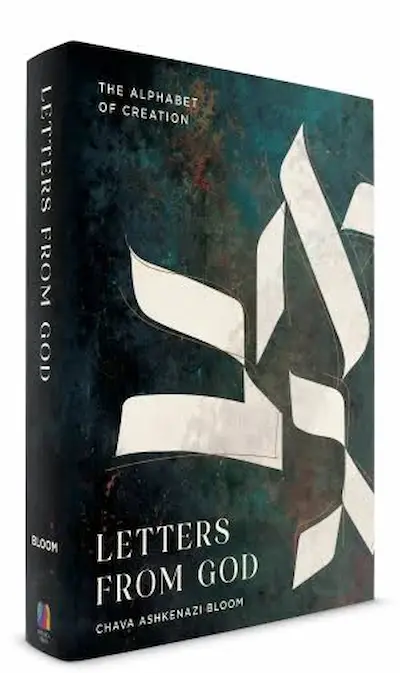 In her book, Letters from God: The Alphabet of Creation, Chava Ashkenazi Bloom take readers on an extraordinary journey through all twenty-two letters of the Hebrew alphabet. Blending deep Kabbalistic insights, Midrashic wisdom, scribal anatomy, and practical spiritual psychology, this encyclopedic work illuminates how each letter serves as an active channel for personal growth and Divine connection.
In the U.S. and Canada, click here to order your copy of Letters from God today.
Available in Israel in December 2026. Pre-order here
Visit Chava’s website at https://www.chavaashkenazibloom.com/